Legacy ERP Data Extraction: Masters, Stock, and Open Invoices Intact
You cannot cut over cleanly without a complete erp data extraction from Pastel Partner, Evolution, Accpac, or SAP Business One. Manual CSV dumps miss relationships, leave opening balances wrong, and hand your new system a broken day one.
We build the structured extraction and validation pipeline that de-risks the replacement.
Sound Familiar?
These are the exact issues CEOs, FDs, and ops leads face before a legacy erp migration:
- Finance exports Pastel or Accpac CSVs that strip customer-invoice-stock relationships
- Opening balances refuse to reconcile after the first import into the new ERP
- Open invoices and purchase orders arrive missing, duplicated, or with broken links
- Stock quantities, BOM links, and warehouse locations land incomplete, so picking fails on day one
- Chart of accounts, VAT codes, and payment terms are remapped by hand with silent errors
Sage 50cloud Pastel Xpress reached end-of-life on 1 October 2025, and Sage 50 Legacy POS follows on 31 August 2026. Older Pastel and Accpac estates already sit on thinning support. If a replacement is on the board agenda, a complete pastel data export plan cannot wait until the week before go-live.
What Legacy ERP Data Extraction Actually Does
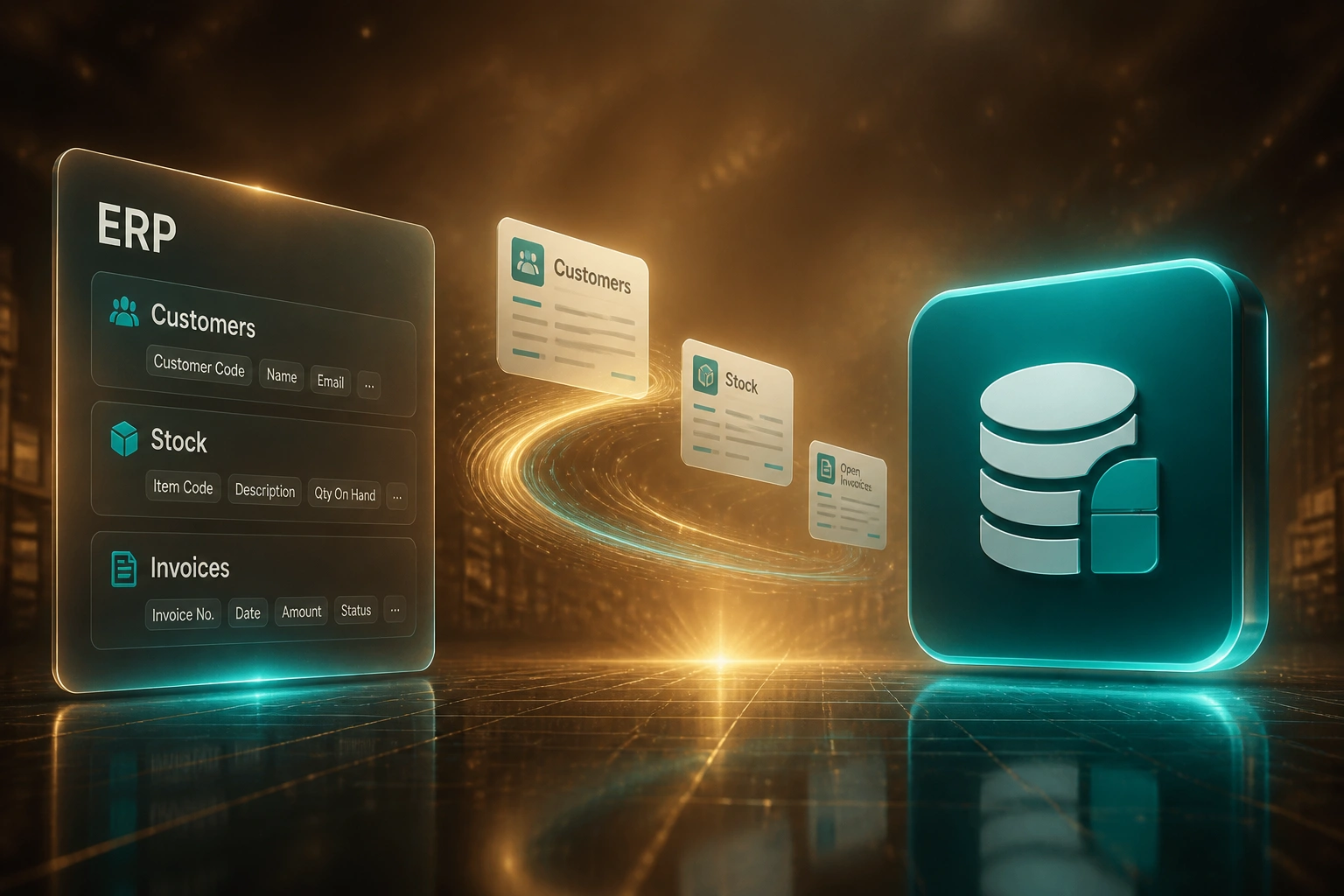
Inventory → extract with relationships → cleanse and map → reconcile. The new ERP starts balanced.
Inventory the Source ERP
Pastel Partner, Evolution, Accpac, or SAP B1: modules, volumes, custom fields, and what must cut over
Extract Masters & Opens
Customers, stock, GL, configs, and open invoices pull with parent-child links preserved
Cleanse, Map & Trial
Duplicates merged, fields mapped, trial company loaded until totals match the source
Sign Off & Cut Over
Opening balances reconciled to the rand, then month-end go-live with the old ERP read-only
Everything You Need for a Reliable Pastel Data Export
Master Data Extraction
Customers, suppliers, stock items, and the chart of accounts come out of Pastel Partner, Evolution, Accpac, or SAP B1 with codes, VAT, and credit terms intact.
Open Transaction Capture
Unpaid invoices, outstanding orders, and open purchase orders extract with line links preserved so the new ERP can collect and fulfil from day one.
Config & GL Mapping
Payment terms, tax treatments, warehouses, and account structures map to the target system before cutover, not after the first broken month-end.
Relationship-Preserving ETL
We pull structured extracts from the source database, not flat CSV dumps. Parent-child links between masters and open documents survive the move.
Reconciliation Sign-Off
Trial loads reconcile customer counts, stock on hand, AR/AP totals, and opening balances to the source before anyone signs off go-live.
Staging & Trial Migrations
At least one full dress rehearsal in a staging company catches mapping gaps while Pastel, Accpac, or SAP B1 is still the system of record.
Legacy ERPs We've Extracted From
From Six Weeks of CSV Chaos to a Three-Week Validated Extract
How a Gauteng distributor replaced Pastel Partner without breaking opening balances or open invoices.
The Manual Pastel Dump
- Finance spent six weeks exporting customers, stock, and invoices as separate CSVs
- Twenty-two percent of customer records were duplicates or dead codes
- First trial import left AR opening balances R1.8 million off the Pastel trial balance
- Open invoices lost their stock-line links; warehouse could not pick correctly
- Cutover delayed twice while staff patched spreadsheets overnight
The Structured Extraction
- Masters, open invoices, stock, and GL extracted with relationships intact
- Duplicates merged and inactive codes retired before the target load
- Trial company reconciled customer counts, stock on hand, and AR/AP to the rand
- Month-end go-live with signed-off opening balances
- Pastel Partner kept read-only for 18 months for audit lookups
Before vs After Structured ERP Data Extraction
How It Works
From first conversation to a signed-off extract ready for your ERP replacement in 3–6 weeks.
Tell Us Your ERP
Pastel Partner, Evolution, Accpac, or SAP B1, plus modules, data volume, and the target system you are replacing into.
Free Scoping Call
30-minute call to inventory masters, open transactions, and configs, then size the extraction and validation plan.
Extract, Cleanse & Trial
We extract with relationships intact, cleanse duplicates, map fields, and run a trial load until balances reconcile.
Cut Over & Hand Off
Month-end or year-end go-live with signed-off opening balances. Source ERP stays read-only for audit as long as you need.
Frequently Asked Questions
How long does legacy ERP data extraction take before a system replacement?
A focused Pastel Partner or Evolution extraction with masters, open transactions, and opening balances typically takes 3–6 weeks including trial loads and reconciliation. Accpac / Sage 300 and SAP Business One estates with heavy custom fields usually need 6–10 weeks. Full ERP replacements that wrap this work often run 8–16 weeks (Evolution) or 3–6 months (SAP B1 exits). The extraction workstream is what de-risks the cutover date.
Which South African legacy ERPs can you extract from?
We regularly extract from Pastel Partner, Pastel Evolution, Sage 200 Evolution, Accpac / Sage 300, Softline Pastel variants, and SAP Business One. If your finance team lives in one of those systems and you are planning a replacement, we can inventory what must come across.
Why not just export CSVs from Pastel or Accpac?
Screen-level CSV and Excel exports flatten relationships. Sage 300 databases alone often contain over 1,000 tables; assembling a clean AP invoice list can require joining three or more. Manual dumps miss link fields, produce duplicates, and leave opening balances that do not reconcile. Industry figures put data migration errors in roughly 68% of ERP projects, and Gartner has long reported that about 83% of data migrations overrun budget or timeline. Structured extraction with validation is cheaper than fixing the new system after go-live.
What data should we bring across for a clean cutover?
At minimum: customer and supplier masters, stock items, chart of accounts, reconciled opening balances, and open transactions (unpaid invoices, outstanding orders, open POs). Historical closed transactions are a scoping choice: many SA mid-market cutovers archive history and keep read-only access to the old ERP for 12–24 months rather than migrating every journal.
Will extraction disrupt our current Pastel or Accpac operations?
No. We extract in parallel while the legacy ERP stays live. Trial loads run in a staging company. The freeze window is reserved for final delta extract and cutover, typically aligned to month-end, not a multi-week outage.
How much does structured ERP data extraction cost?
Focused Pastel or Evolution extraction and validation pipelines typically start from around R45,000. Multi-module Accpac or SAP B1 estates with heavy cleansing usually range from R80,000 to R180,000. That is a fraction of post-go-live remediation, which industry estimates put at roughly R825,000–R3.3 million when dirty data surfaces after cutover. Most clients planning a full ERP replacement see the extraction pay for itself by protecting the go-live date.
Stop Betting Your ERP Replacement on CSV Dumps
If your cutover still depends on weekend Pastel or Accpac exports, you are accepting the failure mode that derails most legacy erp migrations.
Tell us which ERP you run, what the target system is, and when cutover needs to land. We will show you a concrete extraction and validation plan for masters, stock, open invoices, and configs.