Load Shedding Tolerant Sync Design: No Lost Orders, No Duplicate Invoices
When Stage 4–6 hits, your CRM-to-accounting and ecommerce syncs assume the internet is always there. Orders vanish mid-flight, invoices double-post on reconnect, and finance spends days rebuilding what the power outage sync already broke.
We design and build load-shedding-tolerant integrations that queue, retry safely, and catch up automatically when power returns.
Sound Familiar?
These are the exact symptoms CTOs and ops leads describe after a bad Stage 4–6 week:
- CRM-to-accounting syncs time out mid-outage and never retry, so won deals sit uninvoiced for days
- Ecommerce orders land on the storefront while the warehouse and ERP stay blank until someone notices
- Blind retries after power returns create duplicate invoices, double stock movements, and angry customers
- Finance spends two to three days after every Stage 4–6 stretch reconciling what actually posted
- UPS keeps the office lights on, but cloud APIs and fibre still drop, and the sync assumes constant connectivity
UPS and generators do not fix fragile sync design. IT infrastructure research notes that sudden power loss leaves in-process transactions incomplete and corrupts data integrity. Even with backup power, intermittent connectivity still breaks integrations that were built for always-on networks.
What Resilient Power Outage Sync Actually Does
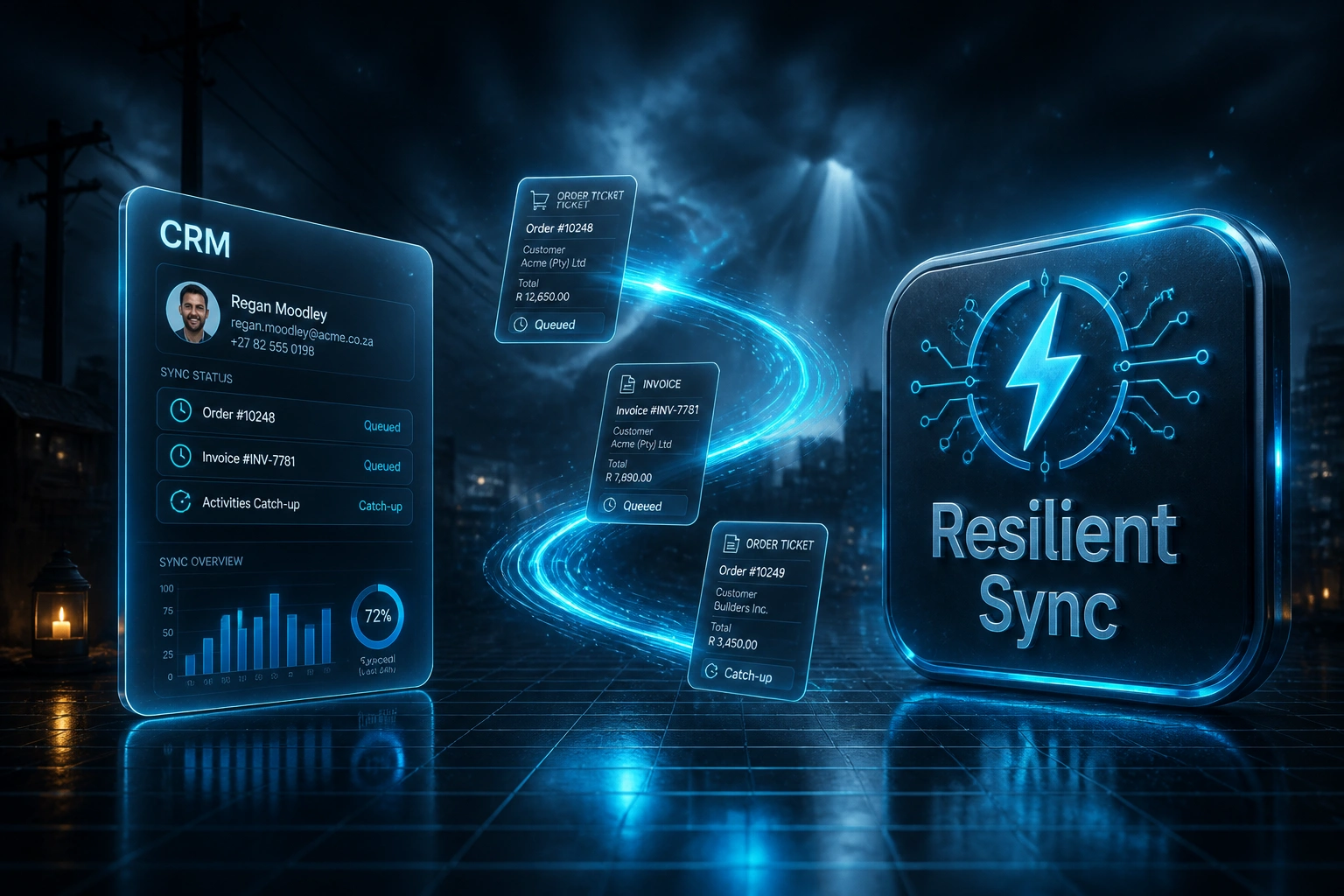
Write locally, queue safely, retry without duplicates, then reconcile when the grid returns.
Event Is Captured
Order, invoice, or stock change is recorded and queued before any cloud call
Outage Holds the Queue
During a 2–4.5 hour Stage 4–6 block, pending work waits in durable storage
Safe Catch-Up Replay
Connectivity returns → idempotent retries drain the queue without duplicates
Books Reconcile
CRM, storefront, and accounting match again, with exceptions flagged for review
Everything You Need for a Resilient Integration
Durable Outage Queues
Every order, invoice, and stock movement is written to a durable queue before it leaves your systems. When connectivity drops during load shedding, nothing is lost: it waits safely until the link returns.
Idempotent Retries
Each sync carries a unique key so a retry never creates a second invoice or a second stock decrement. Safe to replay after a 2.5-hour Stage 4 block without fear of duplicates.
Automatic Catch-Up
When power and connectivity return, the queue drains in order. Hours of pending CRM, ecommerce, and accounting traffic catch up automatically, without a weekend of manual rebuilds.
Conflict Resolution
If the same record changed on both sides during an outage, the integration applies clear merge rules and flags true conflicts for a human, instead of silently overwriting the wrong version.
Offline Buffers at the Edge
POS, warehouse scanners, and field tools keep accepting work during blackouts. Local buffers flush into the durable queue the moment the site reconnects.
Reconciliation Dashboards
Ops and finance see queue depth, failed items, and catch-up lag in one place. Gaps surface in minutes, not at month-end when the books refuse to balance.
Platforms We've Hardened for Intermittent Connectivity
From Three-Day Catch-Up to Under an Hour
How a Gauteng wholesale distributor stopped losing Shopify and HubSpot orders during Stage 6, and ended double invoices in Xero.
Fragile Always-On Sync
- Shopify-to-ERP and HubSpot-to-Xero syncs timed out whenever fibre dropped with the power
- Ops rebuilt missing orders from email confirmations after every multi-hour outage
- Blind reconnect retries created duplicate Xero invoices and stock double-counts
- Finance spent three working days after each Stage 6 stretch cleaning the books
- Generators kept the warehouse lit, but cloud APIs still failed mid-transaction
Load-Shedding-Tolerant Design
- Every order and invoice write enters a durable queue before it leaves the site
- Idempotent retries mean reconnect never creates a second invoice or stock move
- Automatic catch-up drains the backlog when connectivity returns
- Conflict rules surface true mismatches; the rest reconciles without human effort
- Ops watches queue depth live instead of discovering gaps at month-end
Before vs After Resilient Sync Design
How It Works
From first conversation to outage-tested go-live in 3–6 weeks.
Map Your Failure Modes
Which syncs die during Stage 4–6, where duplicates appear, and how long catch-up currently takes.
Free Resilience Review
30-minute call to design durable queues, idempotent writes, and catch-up rules for your stack.
Build & Outage-Test
We build the resilient sync, then simulate connectivity drops and power returns against your real data.
Go Live & Monitor
Live monitoring of queue depth and catch-up lag. Alerts fire when something needs a human, not when the lights go out.
Frequently Asked Questions
Is a UPS or generator enough to keep our integrations safe?
They keep local machines running, but most CRM, accounting, and ecommerce syncs still depend on fibre, mobile data, and cloud APIs that drop during load shedding. Sakeliga research found 67% of surveyed businesses use generators and 37% use small UPS units, yet median firms still reported around R8,000 a month in electricity-shortage losses. Hardware backup without resilient sync design still loses or duplicates transactions.
What does load shedding tolerant sync design actually change?
Instead of assuming constant connectivity, the integration queues every write, retries with unique keys so repeats are harmless, and runs automatic catch-up plus reconciliation when power returns. Orders, invoices, and stock movements survive Stage 4–6 blocks of 2 to 4.5 hours without silent failure or double-posting.
Will this stop duplicate invoices after an outage?
Yes. Blind retries are the usual cause of double invoices and double stock movements. We design every write path to be idempotent, so replaying a queued invoice after connectivity returns updates the same record instead of creating a second one.
Which systems can you harden this way?
We have applied these patterns to HubSpot, Pipedrive, Salesforce, Xero, Sage, Shopify, WooCommerce, and custom ERPs. If your tools can be connected today, they can be redesigned to survive intermittent connectivity.
How long does a resilient sync redesign take?
A focused CRM-to-accounting or ecommerce sync redesign typically takes 3–6 weeks from scoping to go-live, including outage simulation tests. Broader multi-system programmes with warehouse and POS buffers take longer and are scoped in phases.
How much does load-shedding-tolerant integration work cost?
Hardening an existing one-way sync starts from around R25,000. Full bidirectional designs with durable queues, conflict rules, and reconciliation dashboards typically range from R40,000 to R90,000. Most mid-market clients recover that cost within one severe Stage 4–6 season through avoided lost orders, duplicate cleanup, and finance overtime.
Stop Losing Data Every Time the Lights Go Out
If your CRM, ecommerce, and accounting integrations still assume constant connectivity, the next Stage 4–6 stretch will cost you again.
Tell us which systems sync today, where orders or invoices go missing, and how long catch-up takes after an outage. We will show you exactly how a load shedding tolerant redesign would work for your stack.