Moody's Grid Integration: Corporate Entity Verification and Risk Assessment
Your KYB team still opens Orbis in a browser, rebuilds ownership trees by hand, and chases financial risk scores that never make it onto the CRM deal. Manual corporate entity verification turns onboarding into a multi-day research exercise, and examiners still ask for independent ownership evidence.
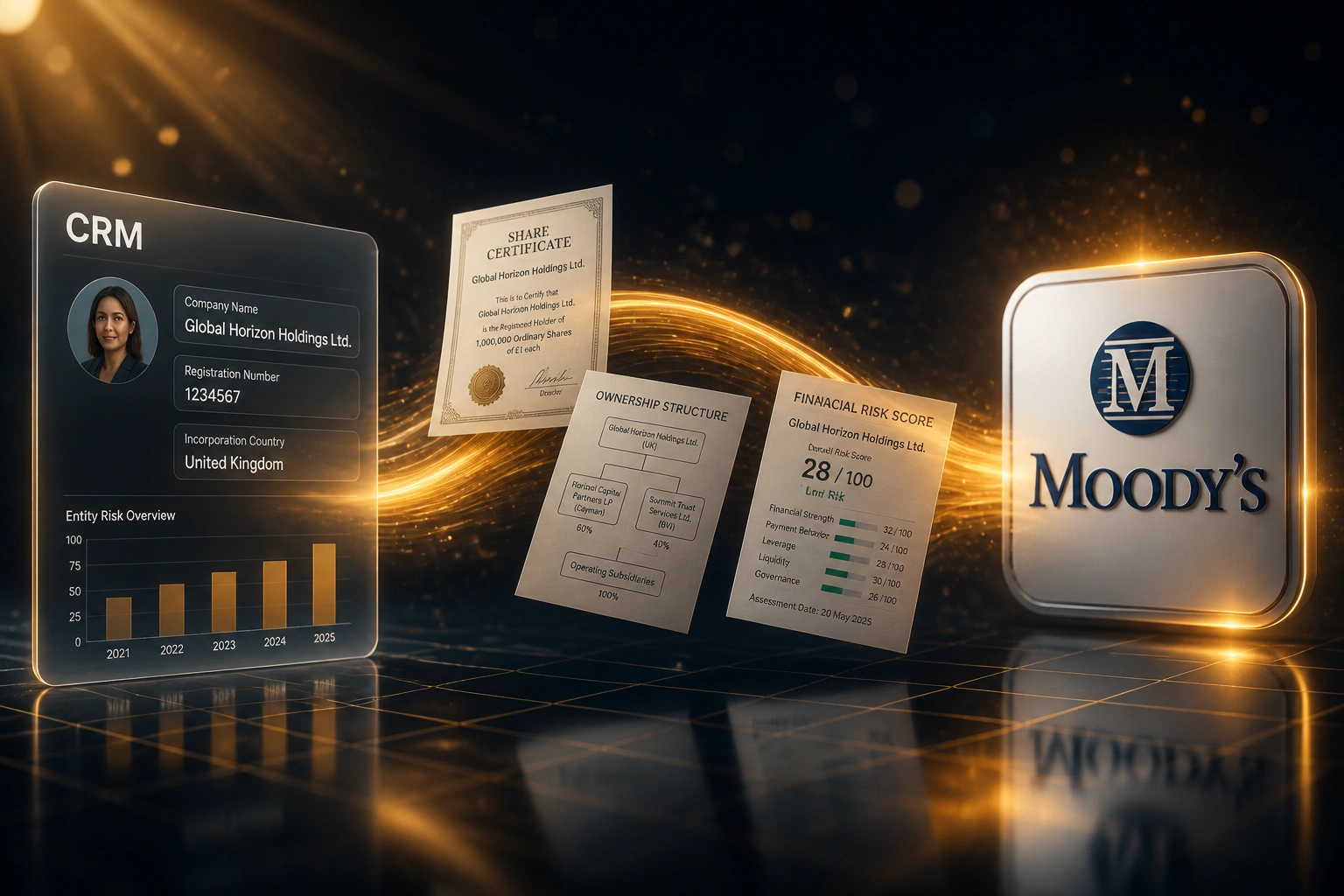
We integrate Moody's Grid and Orbis into your CRM so entity verification becomes an automated KYB step with examiner-ready ownership and risk packs.
Sound Familiar?
These are the exact issues compliance and KYB leads bring to us:
- Analysts still open Orbis (formerly Bureau van Dijk) in a browser, copy ownership trees into spreadsheets, and paste them into the CRM by hand
- Cross-border holding companies leave ownership chains incomplete because the team only has time for the first two layers
- Financial risk scores and entity identifiers never land on the deal record, so credit and compliance work from different pictures of the same client
- Roughly three in ten corporate applications involve trusts, nominees, or layered holdings that self-declaration alone cannot resolve
- FIC examiners ask for independent ownership evidence and the file has screenshots, not a source-attributed Grid and Orbis pack
FIC Public Compliance Communication 59 is explicit: sole reliance on self-declared beneficial ownership without independent third-party verification is not adequate. If your Orbis research still lives in screenshots and spreadsheets, examiners will treat the ownership trail as incomplete.
What Moody's Grid Entity Verification Actually Does
Corporate client lands in CRM → Orbis resolves the entity → ownership and financials sync → Grid risk hits attach. Analysts review exceptions, not blank research folders.
Client Opens in CRM
Juristic onboarding starts with the company name, registration, and jurisdiction on the deal or case
Orbis Resolves Entity
Integration matches the record to the correct Orbis entity and pulls status, identifiers, and financials
Ownership Tree Synced
Corporate structure and beneficial ownership links write back with percentages and jurisdiction tags
Grid Risk Attached
Sanctions, PEP, and adverse-media hits from Grid land on the same case for examiner-ready review
Everything You Need for Corporate Risk Assessment in KYB
Automated Entity Resolution
Match the CRM company record to the correct Moody's Orbis entity across 635+ million companies, then pull registration, status, and identifiers into the onboarding case.
Ownership Structure Sync
Pull corporate trees with active ownership links into your KYB workflow so beneficial owners and control percentages sit on the deal before the analyst starts reviewing.
Financial Risk Indicators
Write Orbis financial strength metrics and comparable financials onto the client record so credit and compliance share one risk view of the corporate counterparty.
Grid Risk Overlay
Screen resolved entities and natural persons against Moody's Grid risk profiles covering sanctions, PEPs, and adverse media, with hits linked to the same case file.
CRM & Case Write-Back
Store entity IDs, ownership organograms, risk scores, and document references on HubSpot, Salesforce, nCino, or your core. The MLRO opens one pack, not a folder of PDFs.
Examiner-Ready Evidence
Every pull carries a timestamp, source citation, and jurisdiction so FICA Section 21B ownership evidence survives inspection without rebuilding the research trail.
Systems We've Connected to Moody's Grid and Orbis
From 3.5 Days per File to Same-Day Entity Packs
How a mid-sized corporate lender cut manual Orbis research, closed ownership gaps, and recovered R890,000 in analyst capacity in year one.
The Manual Process
- KYB analysts logged into Orbis for every cross-border corporate applicant
- 2–4 hours copying ownership trees, financials, and risk notes into Word and Excel
- Complex multi-jurisdiction files sat 3–5 days before credit review could start
- About 18% of packs came back with ownership gaps when cross-checked later
- Grid screening ran in a separate tool, so risk hits rarely sat with the entity pack
The Automated Process
- Deal opens → Orbis entity match, ownership tree, and financials write into the CRM case
- Grid sanctions, PEP, and adverse-media hits attach to the same file automatically
- Analysts review and challenge exceptions instead of gathering data from scratch
- Clean cross-border files reach credit the same day with source-attributed evidence
- FIC-style inspection packs export with timestamps, jurisdictions, and ownership percentages
Before vs After Moody's Grid Integration
How It Works
From first conversation to live entity verification in 3–6 weeks.
Map Your Entity Stack
Which CRM or core holds juristic clients, whether you already license Orbis or Grid, and where manual lookups stall onboarding.
Free Scoping Call
30-minute call to design entity matching rules, ownership thresholds, risk fields, and how results write back into your case queue.
Build & Parallel Test
We wire Moody's Grid and Orbis into your stack, then run parallel on live corporate deals for a week to validate accuracy.
Go Live & Monitor
Switch off browser-based research. Monitoring catches ownership and risk-profile changes so packs stay current after onboarding.
Frequently Asked Questions
What is Moody's Grid, and how does it relate to Bureau van Dijk and Orbis?
Orbis is the global company and ownership database formerly sold by Bureau van Dijk, now part of Moody's. Grid is Moody's risk-profile database of sanctions, PEPs, and adverse media. Together they power corporate entity verification and risk assessment. We integrate both into your CRM or onboarding stack so entity data, ownership trees, and risk hits land in one workflow.
How is this different from a CIPC or BizPortal company check?
CIPC confirms South African registration, directors, and local filings. Moody's Grid and Orbis cover hundreds of millions of entities across 200+ jurisdictions, with ownership links, financials, and risk overlays for cross-border groups. Most banks and lenders need both: local registry proof plus global entity intelligence.
Will this satisfy FICA examiner expectations for ownership evidence?
FIC Public Compliance Communication 59 requires accountable institutions to understand ownership and control structures and to verify beneficial ownership against reliable, independent third-party sources, not self-declaration alone. An integrated Orbis pull with timestamps and source attribution gives examiners that trail. Your analysts still apply the Section 21B process of elimination and sign off.
How long does a Moody's Grid entity verification integration take?
Most builds take 3–6 weeks from scoping to go-live. A focused one-way entity and ownership write-back can be live in about two weeks. Full Grid risk overlay, CRM case queues, and perpetual monitoring usually sit closer to 4–6 weeks.
Do we need an existing Moody's licence?
Yes. Data access is licensed by Moody's (Orbis, Grid, Compliance Catalyst, or KYC API products). We build the integration against the licences you already hold or help you scope the right access model. Integration fees are separate from Moody's data fees.
How much does Moody's Grid entity verification integration cost?
Scoped integrations typically range from R45,000 to R95,000 depending on entity matching depth, ownership write-back, Grid screening handoff, and CRM complexity. Teams running 25+ cross-border corporate onboardings a month usually recover that in analyst time within one to two quarters.
Stop Treating Entity Verification as a Research Project
If your KYB team still rebuilds ownership trees from Orbis by hand, you are spending analyst capacity on a problem that belongs in the CRM.
Tell us which CRM or core you use, whether you already license Moody's Grid or Orbis, and where corporate onboarding stalls. We will show you exactly how automated entity verification and risk assessment would work for your programme.