Invoice From Multiple Legal Entities: One System, Correct Branding Every Time
You manage three to fifteen companies. Every deal still needs the right logo, VAT number, and bank details on the tax invoice. Hopping between accounting logins for group invoicing is slow, error-prone, and a SARS headache waiting to happen.
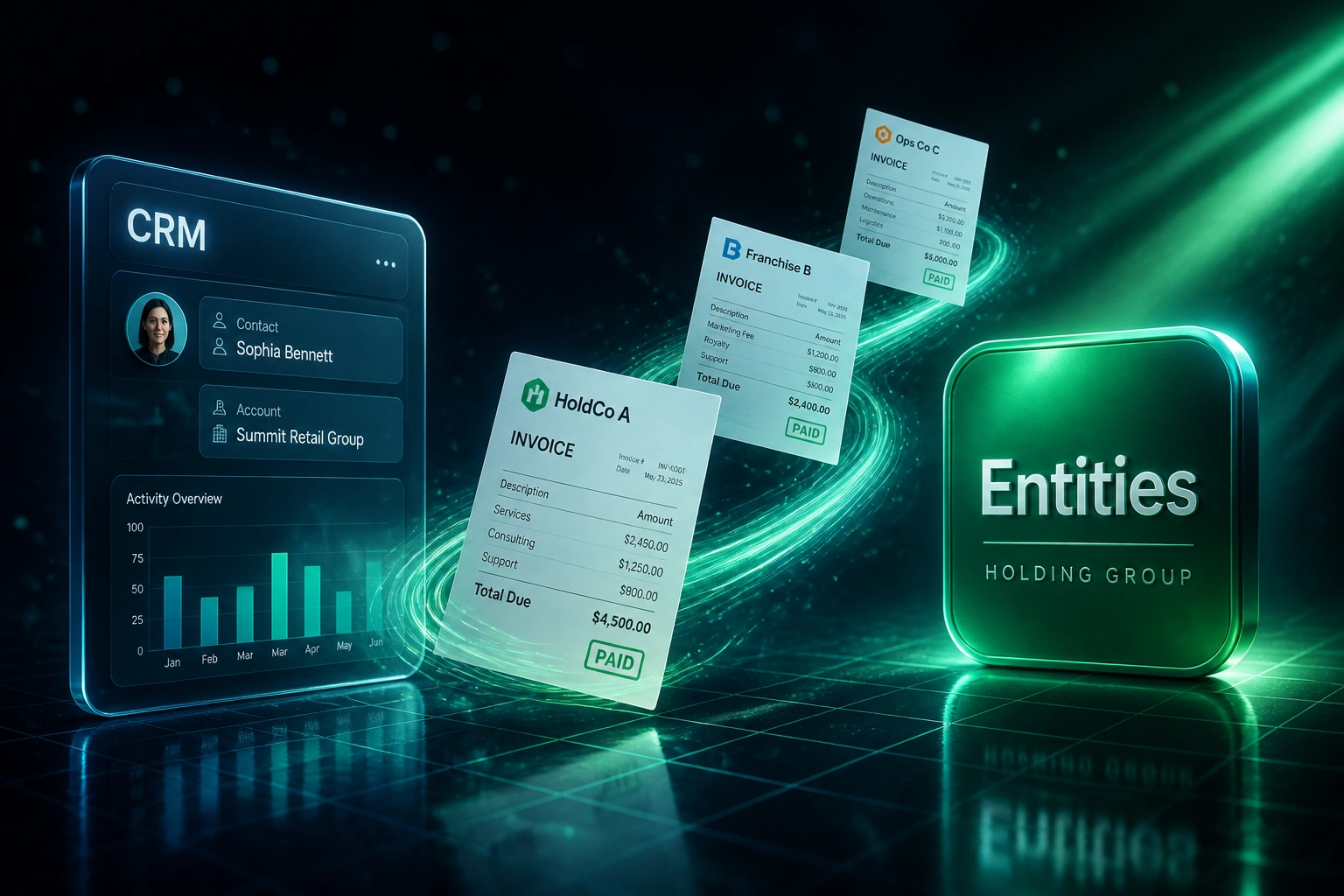
We build multi-entity billing that stamps the correct entity from the CRM deal, automatically.
Sound Familiar?
These are the exact issues group finance directors and franchise ops leads faced before multi-entity billing:
- Finance logs into a different Xero or Sage company for every legal entity just to raise one invoice
- Wrong-entity invoices go out with the holding company logo, VAT number, or bank details on a franchise bill
- Clients reject or query invoices, then credit notes and re-issues eat a week of cash flow
- Group reporting means exporting trial balances into spreadsheets and stitching them by hand
- SARS reviews flag invalid tax invoices when the supplier VAT number does not match the legal entity that made the supply
SARS can disallow input tax and levy a 10% late-payment penalty plus understatement penalties when a tax invoice carries the wrong supplier VAT number or entity details. Wrong-entity billing is not just an ops nuisance; it is a compliance event.
What Multi-Entity Billing Actually Does
Deal closes → correct legal entity selected → branded tax invoice sent. No hopping between accounting logins.
Deal Tagged in CRM
Sales or franchise ops marks the deal won with the billing entity already set
Entity Master Applied
Logo, VAT number, address, and bank details load from that entity's master record
Invoice Posts to Ledger
Draft lands in the correct Xero org or Sage company for finance to approve
Group Books Stay Clean
Entity P&Ls stay accurate; consolidation no longer starts with wrong-entity cleanup
Everything Holding Companies Need for Group Invoicing
Entity Routing from CRM
Each deal carries an entity tag. When it closes, the invoice posts to the correct Xero organisation or Sage company with no login hopping.
Branded Entity Letterheads
Logo, trading name, physical address, VAT number, and bank details stamp onto every invoice from the entity master, not from memory.
SARS-Ready Tax Fields
Section 20 tax invoice fields lock per entity so the supplier VAT number always matches the legal entity that made the supply.
Intercompany Clarity
Shared-services and franchise royalty bills raise against the right counterpart entity, with clear due-to/due-from trails for consolidation.
Group Reporting Roll-Up
Entity-level invoices stay clean while finance gets a consolidated view without weekend spreadsheet stitching.
Payment Status by Entity
When a client pays into the entity bank account, the CRM deal updates so sales and franchise ops see who has settled.
CRMs and Ledgers We Connect for Multi-Entity Billing
From 8 Accounting Logins to One Deal Flow
How an eight-entity franchise group cut wrong-entity invoices from one in eight to near zero and closed group books nine days faster.
The Multi-Login Process
- Group finance director logged into eight separate Xero organisations to bill franchise deals
- Roughly one in eight invoices carried the wrong logo, VAT number, or bank account
- Credit notes and re-issues delayed cash by a week and angered franchisees' B2B clients
- Month-end consolidation took 12–15 days of spreadsheet stitching across entities
- SARS query on one wrong-entity VAT number triggered a full tax-invoice sample review
The Entity-Routed Process
- CRM deal entity tag routes the invoice to the correct Xero organisation in seconds
- Letterhead, VAT number, and bank details stamp from the entity master every time
- Wrong-entity invoices dropped to near zero across a full quarter of parallel monitoring
- Group close moved from mid-month chaos to a four-to-five day confirmation cycle
- Franchise ops sees payment status per entity without asking group finance
Before vs After Multi-Entity Billing
How It Works
From first conversation to live multi-entity billing in 3–6 weeks.
Map Your Entities
How many legal entities, which ledgers, how deals pick the billing entity today.
Free Scoping Call
30-minute call to design entity routing rules, letterhead masters, and VAT field locks.
Build & Parallel Test
We build the routing, test with real deals across every entity, and run parallel for a week.
Go Live & Monitor
Switch off multi-login invoicing. Alerts fire only when an entity tag is missing or ambiguous.
Frequently Asked Questions
How does multi-entity billing differ from a normal CRM-to-accounting sync?
A single-entity sync creates invoices in one ledger. Multi-entity billing routes each deal to the correct legal entity first, then stamps that entity's logo, VAT number, address, and bank details on the tax invoice. Group companies, franchises, and holding structures need this so every invoice is SARS-valid and clients pay the right bank account.
Which accounting platforms support multi-entity invoicing?
We route into multiple Xero organisations, separate Sage Business Cloud or Evolution companies, QuickBooks Online companies, and NetSuite subsidiaries. If each legal entity already has its own ledger file, we connect them from one CRM without forcing a migration.
Will this stop wrong VAT numbers going out on invoices?
Yes. Entity masters hold the supplier VAT registration, trading name, and address. The integration refuses to raise an invoice when the deal has no entity tag, so finance cannot accidentally bill from the holding company for a franchise supply. That protects input tax claims on the client side and keeps your own VAT201 packs clean.
How do you handle franchise and holding company structures?
We map CRM deal properties (brand, region, franchisee, cost centre) to legal entities. Royalty and management-fee intercompany invoices can raise automatically between operating entities and the holdco, with matching due-to/due-from entries for consolidation.
Will this disrupt month-end for our group finance team?
No. We run parallel for at least a week so every entity's invoices are validated before you switch off the old process. Most groups keep the same approval step; only the multi-login copy-paste disappears.
How much does multi-entity invoicing integration cost?
Multi-entity setups typically range from R35,000 to R80,000 depending on entity count, ledger platforms, and intercompany rules. Groups processing invoices across 5+ entities usually see payback inside one to two quarters from avoided credit-note rework and faster group close.
Stop Billing From the Wrong Legal Entity
If your group still hops between accounting logins to raise invoices, you are paying for risk that multi-entity billing already solves.
Tell us how many legal entities you run, which ledgers they live in, and how deals pick the billing entity today. We will show you exactly how holding company invoicing and franchise multi-entity billing would work for your structure.