Multi-Tenant CRM Architecture: Isolate Every Customer's Data Without Killing Margins
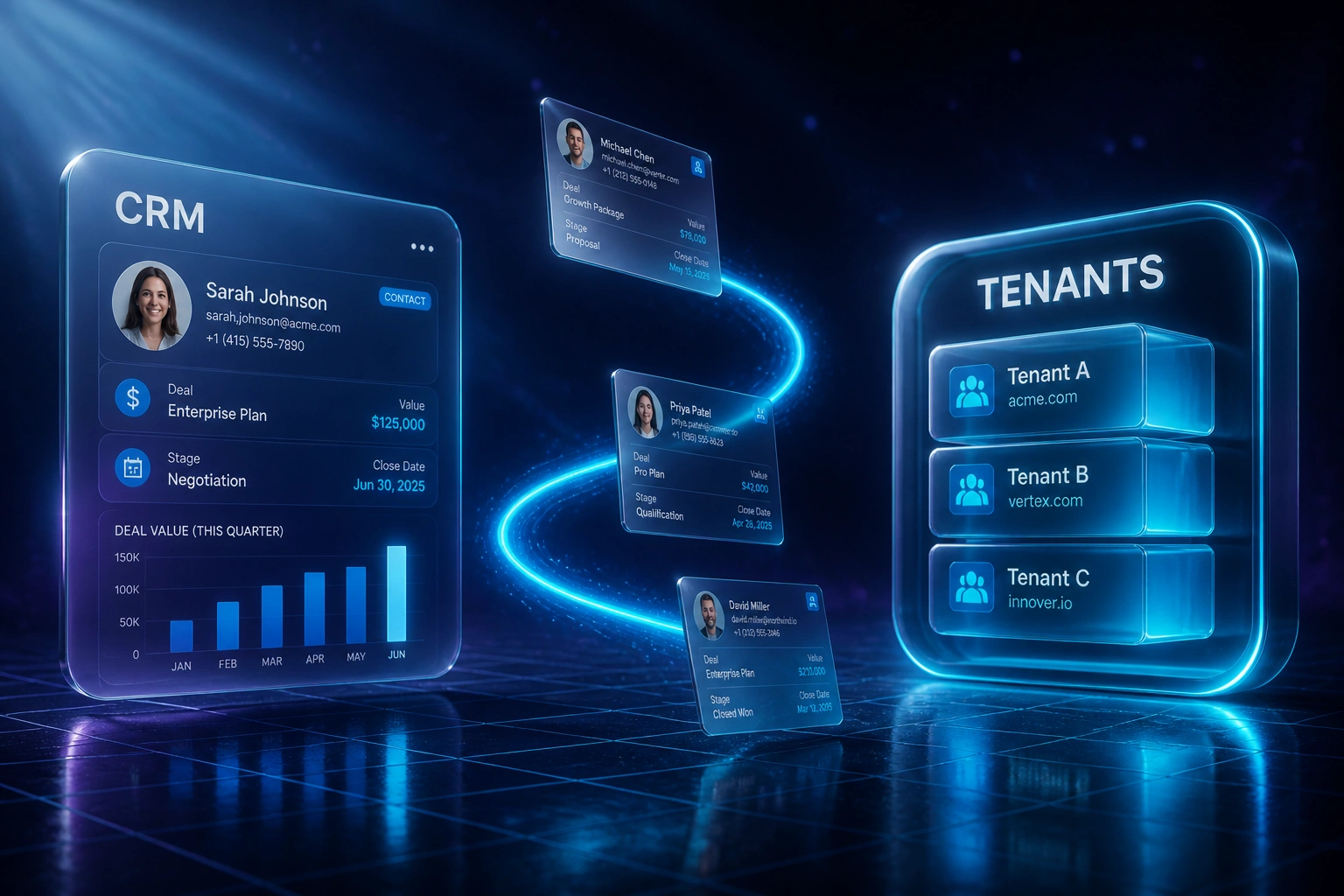
Your SaaS CRM layer stores contacts and deals for dozens of customer organisations in one product. Soft "filter by tenant_id" habits felt fine at twenty tenants. Now the first enterprise buyer asks for proof of tenant isolation, and one missed filter can put Tenant B's pipeline in Tenant A's hands.
We design multi-tenant CRM architecture that unlocks enterprise deals and keeps infrastructure costs manageable at scale.
Sound Familiar?
These are the exact issues SaaS founders faced before proper multi-tenant CRM architecture:
- Soft "remember to filter by tenant_id" habits mean Tenant A can see Tenant B's contacts, deals, and notes when one query is missed
- Enterprise buyers stall or kill the deal when you cannot prove CRM tenant isolation with architecture diagrams and test evidence
- Security questionnaires spend two to three weeks in a Google Doc while procurement windows close
- Database-per-tenant felt safer, but ops cost is climbing linearly and gross margin is disappearing
- POPIA and GDPR expect appropriate technical measures; a cross-tenant CRM leak is exactly the failure mode regulators and buyers care about
Enterprise security reviews routinely pause six-to-nine-month sales cycles for four to eight weeks, and cold questionnaire responses that take two to three weeks often miss the procurement window. Soft filters that "usually work" fail the moment a buyer asks how CRM contacts and deals are isolated. Multi-tenancy isolation failures are among the most reputationally damaging incidents a SaaS vendor can experience.
What Proper SaaS CRM Tenancy Actually Does
Choose the model → enforce isolation → prove it → keep costs sub-linear. No hope-based tenant filters.
Model the Tenancy Choice
Shared schema, schema-per-tenant, or hybrid silo sized to your seat economics and deal mix
Enforce CRM Isolation
Contacts, deals, and activities bound to tenant context at the database layer, not only in app code
Prove the Boundary
Automated cross-tenant tests and diagrams ready for the next security questionnaire
Scale Without Margin Bleed
Shared economics for the long tail, dedicated silos only where enterprise revenue pays for them
Everything You Need for Tenant Isolation That Survives Enterprise Scrutiny
Shared Schema with Enforced Isolation
Contacts, deals, activities, and custom objects share infrastructure for cost, but every row is bound to a tenant ID enforced at the database layer, not by hope in application code.
Row-Level Tenancy Controls
Policies that block cross-tenant reads and writes even when a developer forgets a filter. Soft habits become hard guarantees your enterprise buyers can audit.
Hybrid Silo for Enterprise Tiers
Keep the bulk of customers on shared schema economics. Carve high-ARR or regulated tenants into dedicated databases when the contract revenue justifies it.
Isolation Test Pack
Automated cross-tenant access tests fail the build if a CRM leak path appears. That evidence is what SOC 2 reviewers and security questionnaires actually ask for.
Cost-at-Scale Model
We size shared vs schema-per-tenant vs database-per-tenant against your seat economics so infrastructure stays sub-linear as you grow past hundreds of tenants.
Questionnaire-Ready Evidence Pack
Isolation statement, CRM data-model diagram, and test results you attach to the next vendor security review instead of pulling engineers off the roadmap for three weeks.
Patterns and Platforms We Work With
From Soft Filters to a Closed R3.3M ARR Deal
How a B2B SaaS founder proved CRM tenant isolation, kept infra costs manageable, and stopped losing enterprise deals in security review.
Hope-Based Tenancy
- 180 customer organisations sharing one CRM schema with soft tenant_id filters in app code
- First enterprise buyer paused a R3.3M ARR deal pending isolation proof
- Security questionnaire sat in a Google Doc for three weeks while engineers guessed answers
- Leadership was planning database-per-tenant "for security," projecting ~R390,000/month infra at 1,000 tenants
- No automated cross-tenant tests; one missed filter was a latent leak
Enforced Multi-Tenant CRM
- Shared schema with database-enforced isolation on contacts, deals, activities, and notes
- Hybrid silo path for three enterprise tenants that paid for dedicated databases
- Isolation test pack and architecture pack attached to every vendor security review
- Questionnaire turnaround dropped from three weeks to two days
- Infra stayed near R30,000/month at the shared-schema path instead of the silo projection
Before vs After Multi-Tenant CRM Architecture
How It Works
From first conversation to questionnaire-ready multi-tenant CRM architecture in 4–8 weeks.
Audit Your CRM Tenancy
How contacts and deals are scoped today, where soft filters live, and which enterprise deals are blocked by isolation questions.
Free Scoping Call
30-minute call to choose shared schema, bridge, or hybrid silo, size the retrofit vs greenfield path, and prioritise deal-blocking gaps.
Design & Harden
We design the multi-tenant CRM data model, enforce isolation, add hybrid silo paths where revenue justifies them, and wire isolation tests.
Prove & Package
Cross-tenant tests pass, cost projections hold, and you leave with questionnaire-ready evidence for the next enterprise buyer.
Frequently Asked Questions
Is this the same as multi-tenant authentication?
No. Multi-tenant auth decides who is logged in and which organisation they belong to. Multi-tenant CRM architecture decides how contacts, deals, activities, and notes are stored and isolated once that context is known. Soft filters at the CRM data layer still leak even when login is perfect. Most SaaS founders need both, and we keep the scopes separate so neither half is half-done.
Do we need a separate database per customer for our CRM?
Usually not. Most B2B SaaS products are commercially healthier on a shared schema with enforced tenant IDs and row-level security. Separate databases make sense for regulated silos or large enterprise contracts that demand them. We help you choose based on deal requirements and unit economics, not fear.
How long does a multi-tenant CRM architecture engagement take?
A focused design and hardening programme typically takes 4–8 weeks. Greenfield CRM layers move faster. Live platforms with soft filters and mixed customer records need a staged migration so you do not expose one tenant while fixing another.
Will this help us pass enterprise security questionnaires?
Yes. Buyers routinely ask how CRM customer data is isolated, whether you have had a tenant leakage incident, and how you test the boundary. We leave you with an isolation statement, data-model diagrams, and automated test evidence that answers those questions without a two-week scramble.
How does this relate to POPIA and GDPR?
Neither POPIA nor GDPR mandate a specific database layout, but both require appropriate technical measures against unlawful access. POPIA administrative fines reach R10 million, and a cross-tenant CRM exposure of personal information is exactly the failure mode enterprise buyers and the Information Regulator care about. Enforced isolation is a practical safeguard and a commercial asset.
How much does multi-tenant CRM architecture cost?
Scoped design and hardening engagements typically run from about R70,000 for a lean data-model, RLS, and test pack to R140,000–R220,000 when a live CRM layer needs migration, hybrid silo paths, and a full questionnaire evidence pack. Against one stalled enterprise deal at R3M+ ARR, or a silo path that multiplies infra 13×, most founders see payback on the first unlocked deal.
Stop Losing Enterprise Deals to Soft Tenant Filters
If your CRM layer still relies on developers remembering to filter by tenant_id, you are one missed query away from a leak, and one questionnaire away from a stalled deal.
Tell us how many customer organisations you serve, how contacts and deals are modelled today, and which enterprise deals are waiting on isolation proof. We will show you the shared-schema, bridge, or hybrid path that fits your margins and your buyers.