Order Routing Across Multiple Warehouses: Fulfilment Optimisation That Cuts Courier Cost
Defaulting every Shopify, WooCommerce, or Takealot order to Midrand burns courier rands and delays coastal customers. Intelligent order routing assigns each order to the nearest location with stock, weighing courier zone cost and split-shipment rules at order time.
We build the allocation engine that sits on top of your multi-warehouse stock truth.
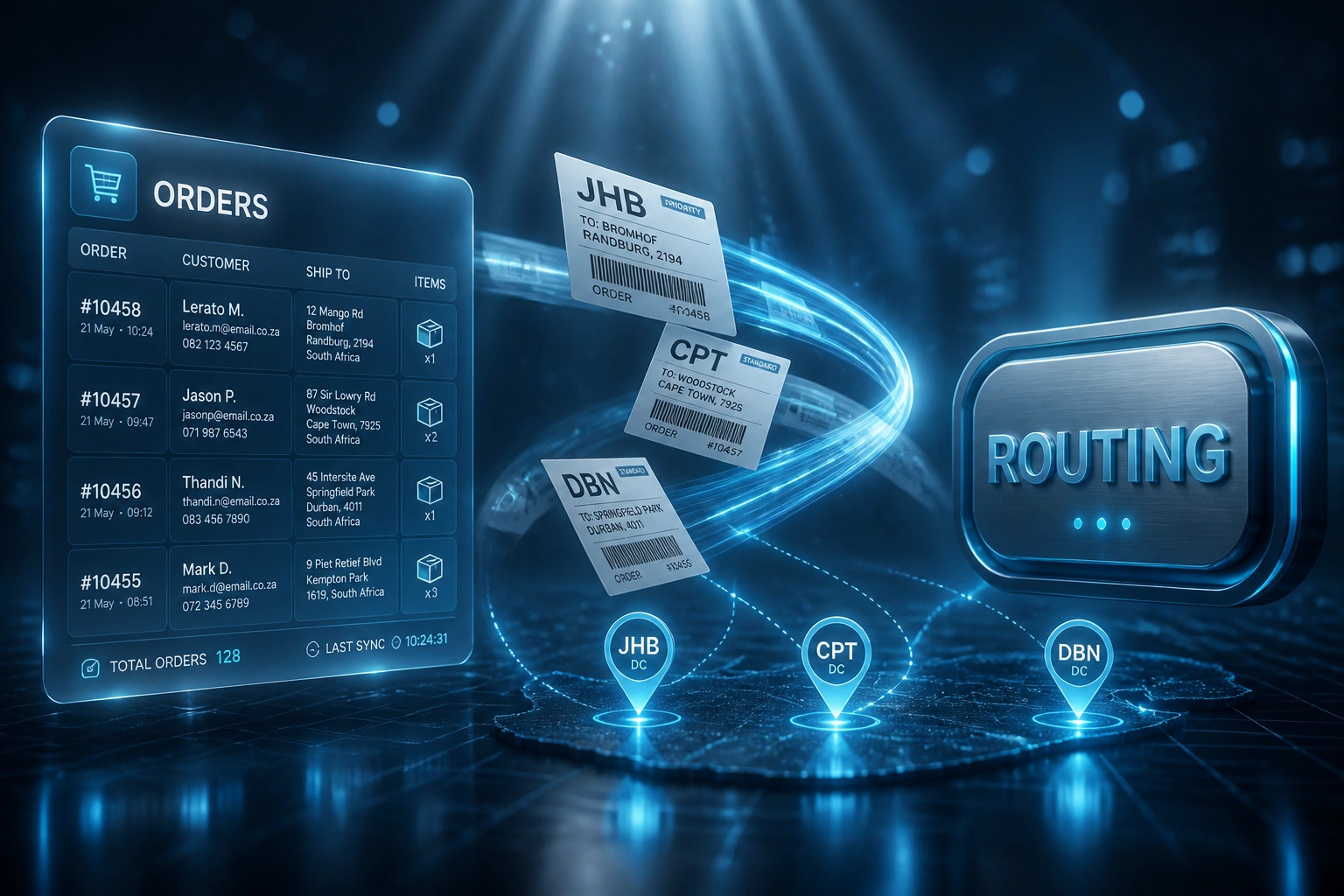
Sound Familiar?
These are the exact issues ecommerce ops and logistics leads faced before warehouse allocation automation:
- Every Shopify, WooCommerce, and Takealot order defaults to the Midrand DC, even when CPT or Durban holds the stock
- Cape Town and Durban customers wait 3–5 days on national road freight while a coastal warehouse sits idle
- Ops staff hand-pick warehouse allocation in a spreadsheet after peak hours, then miss courier cut-offs
- Split shipments fire when line items route independently, doubling The Courier Guy or Fastway labels on one basket
- Marketplace lead-time SLAs slip because the wrong node ships first, then you scramble with overnight labels
The Courier Guy added a 12% fuel surcharge on all shipments from 1 April 2026 after wholesale diesel jumped about 40%. Fastway locked a fixed 5% fuel-related adjustment the same season. Wrong-warehouse fulfilment now multiplies a higher base rate, and Takealot still suspends lead-time selling when more than 2% of lead-time orders arrive late at the DC.
What Warehouse Allocation Actually Does
Order lands → eligible DCs scored → pick ticket issued → courier label from the right origin. No ops manager choosing Midrand by habit.
Order Captured
Shopify, WooCommerce, Takealot, or wholesale order arrives with ship-to address and line items
DCs Scored
Engine checks ATS, courier zone cost, capacity, and whether one node can ship the full basket
Warehouse Assigned
Optimal DC reserved; pick ticket and courier label generated from that origin
Lower Cost, Faster Transit
Coastal orders leave CPT or Durban; Gauteng stays local; splits stay rare
Everything You Need for Reliable Order Routing
Nearest-Node Order Routing
At order time, each ecommerce or wholesale order is assigned to the closest DC with confirmed stock, cutting courier zones across Gauteng, the Western Cape, and KZN.
Courier Zone Cost Optimisation
Routing weighs Fastway, The Courier Guy, and Dawn Wing / DPD Laser zone rates so warehouse allocation prefers the cheaper landed cost that still meets the delivery promise.
Split-Shipment Guardrails
Prefer one-box fulfilment from a single location. Splits only fire when the single-node option costs more than the split plus a configurable penalty you set.
Channel-Aware Allocation
Shopify, WooCommerce, and Takealot orders share one routing engine with channel-specific SLA and capacity rules, so marketplace lead times do not starve your own store.
Capacity & Cut-Off Rules
When a DC hits pick capacity or misses the courier cut-off, volume shifts to the next eligible warehouse before late parcels and overtime pile up.
Stock-Truth Foundation
Routing sits on top of multi-warehouse available-to-sell. Wrong-node decisions stop when each location's real stock, not a spreadsheet guess, drives the assignment.
Channels & Couriers We've Wired Into Routing
From Default Midrand to 20% Lower Courier Spend
How a three-DC ecommerce brand with nodes in Midrand, Montague Gardens, and Durban stopped burning national labels on coastal orders.
Single-Warehouse Habit
- Shopify and Takealot orders defaulted to Midrand regardless of ship-to province
- Average outbound courier cost about R148 per order across The Courier Guy and Fastway
- 22% of multi-line baskets left as split shipments from naive line-level allocation
- Western Cape customers routinely waited 3–5 days on national road freight
- Ops spent 8 hours a week manually reassigning warehouses after peak
Intelligent Order Routing
- Each order scored against ATS, zone cost, and single-box preference at capture
- Average courier cost fell to about R118 per order (20% reduction)
- Split rate dropped from 22% to 7% with single-location guardrails
- Coastal parcels typically landed about 2 days sooner from CPT or Durban
- Manual reassignment shrunk to about 1 hour a week of exception review
Before vs After Order Routing
How It Works
From first conversation to live fulfilment optimisation in 3–5 weeks.
Map Your Network
Which DCs, which channels, where default Midrand shipping burns courier rands, and how splits and late lead times show up today.
Free Scoping Call
30-minute call to design routing rules: nearest stock, zone cost, split penalties, capacity, and courier cut-offs.
Build & Test
We build the allocation engine, test against live orders and ATS, and run parallel so ops can compare before cutover.
Go Live & Monitor
Switch off manual warehouse picking. Dashboards track cost per order, split rate, and on-time ship against your SLAs.
Frequently Asked Questions
How long does multi-warehouse order routing take to set up?
A standard three-DC routing engine on Shopify or WooCommerce with nearest-node and split rules takes 3–5 weeks from scoping to go-live. Two warehouses with simple proximity routing can be live in about two weeks. Complex Takealot lead-time, wholesale, and multi-carrier rate shopping takes closer to 5–7 weeks.
How is this different from multi-warehouse inventory management?
Inventory management is the stock ledger: on-hand, reserved, in-transit, and available-to-sell per DC. Order routing is the decision engine that sits on top of that truth and assigns each order to the optimal warehouse at order time. You need clean stock truth for routing to work; routing is what turns that truth into lower courier spend and faster transit.
Which platforms and couriers can feed the routing engine?
We have connected Shopify, WooCommerce, Takealot seller orders, custom OMS and WMS platforms, and rate or zone logic for The Courier Guy, Fastway, and Dawn Wing / DPD Laser. If a system exposes orders, stock by location, or carrier rates, we can include it.
Will routing disrupt picking while we roll it out?
No. We run parallel allocation so ops can see what the engine would have chosen before it writes live pick tickets. Cutover happens after a validation window, usually aligned with a quiet mid-week period rather than a peak promo.
How do split-shipment rules work in practice?
The engine first looks for a single DC that can fulfil the whole basket. If none can, it compares the cost of a forced single-node ship (including possible delay) against a split plus your split penalty. Splits stay a last resort, which is how brands bring split rates toward the under-8% to 15% industry targets.
How much does order routing across multiple warehouses cost?
Routing on top of existing multi-warehouse stock truth starts from around R35,000. Full allocation with zone-cost logic, split guardrails, and multi-channel SLAs typically ranges from R45,000 to R85,000. Brands shipping 500+ orders a month across two or more DCs often see ROI within 2–4 months from courier savings alone.
Stop Shipping Every Order From the Wrong Warehouse
If coastal customers still receive Midrand labels while CPT or Durban holds the stock, you are paying national rates for a problem that order routing already solves.
Tell us which channels you run, where your DCs sit, and which courier contracts you use. We will show you how warehouse allocation would score your next week of orders.