Switch Payment Gateways Without Losing Subscribers or Data
You are overpaying on MDR or living with unreliable settlement, but every conversation about a gateway switch stalls on the same fear: tokenised cards break, renewals fail, and payment history disappears.
We run staged migrations that protect MRR and recover the fee delta.
Sound Familiar?
These are the exact issues our clients faced before a staged gateway switch:
- Your MDR is 0.3 to 0.6 points higher than the gateway you want, but you cannot risk asking every subscriber to re-enter a card
- Tokenised cards sit locked in the old vault, and nobody has confirmed whether a PCI key exchange or network-token port is even possible
- A previous DIY cutover left failed renewals, orphaned payment history, and a support queue full of "why was I charged twice?"
- Finance cannot close the month because settlement files, chargebacks, and refunds still arrive from two providers with no mapping
- You are stuck paying legacy rates on R1m+ monthly volume because the switch feels more dangerous than the fee leak
A hard cutover that forces card re-entry is a churn event, not a migration. Industry data puts involuntary churn at 20 to 40% of all SaaS churn. Losing tokens overnight turns paying subscribers into failed renewals overnight.
What a Staged Gateway Switch Actually Does
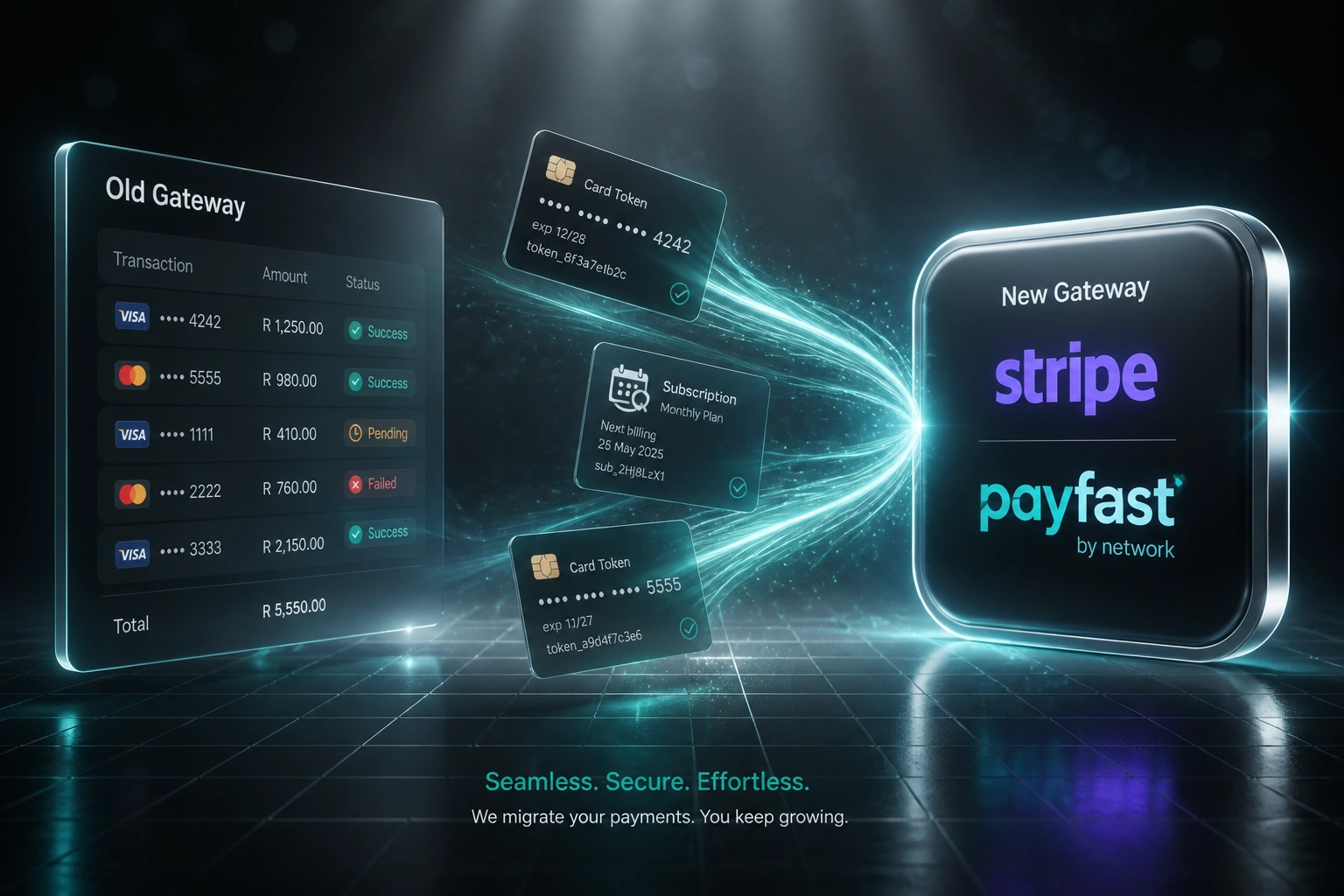
Audit tokens → migrate vault → dual-run renewals → retire the old rail. Subscribers keep paying.
Audit & Map
Active subscriptions, next-bill dates, token portability, and MDR gap quantified in Rand
Migrate Tokens
PCI key exchange or soft re-tokenisation; old token IDs mapped to the new vault
Dual-Run Billing
Both gateways settle in parallel while auth rates and webhooks are compared
Cut Over Clean
Renewals flip to the new provider; history backfilled; old vault retired
Everything You Need for a Safe Gateway Switch
Token Vault Migration
PCI-compliant key exchange between providers so card tokens move vault-to-vault. Subscribers keep billing without retyping card details.
Re-Tokenisation Flows
Where proprietary tokens cannot export, we design soft re-auth at next renewal with clear customer messaging, not a mass "update your card" blast.
Dual-Run Cutover
Old and new gateways run in parallel for one or two billing cycles. Auth rates, declines, and webhooks are compared before the old rail is retired.
Subscription Continuity
Next-bill dates, plan amounts, retries, and dunning rules map onto the destination gateway so MRR does not stall on migration day.
Payment History Backfill
Past charges, refunds, and chargebacks land in the new ledger (or a unified archive) so finance and support keep a single story of every customer.
MDR & Settlement Modelling
We quantify the fee delta between your current stack and Stripe, PayFast, Peach, or Yoco, then tie project cost to months of recovered MDR.
Gateways We've Migrated Between
From Locked Tokens to R154K Recovered MDR
How a membership SaaS moved 5,100 card-on-file records to a lower-MDR gateway without a single forced re-auth blast.
Stuck on the Expensive Rail
- R3.2m monthly card volume at roughly 3.35% blended MDR
- 5,100 tokenised cards locked in a processor-bound vault with unclear export terms
- Finance lead blocked every switch proposal after a peer's DIY cutover spiked failed renewals
- Support still reconciled two years of history only in the old portal
- Estimated fee waste versus Peach or Stripe ZA published rates: about R12,800 per month
Staged Switch, Intact MRR
- PCI key exchange moved portable tokens; soft re-auth reserved for the small non-portable set
- Dual-run for one full billing cycle before retiring the old gateway
- Zero subscribers asked to re-enter a card in a mass campaign
- Payment history and chargebacks backfilled into the new finance view
- Blended MDR landed near 2.95%; fee delta recovered from month one of full cutover
Before vs After Payment Gateway Migration
How It Works
From first conversation to old vault retired in roughly 4 to 8 weeks.
Audit Tokens & Contracts
Export rights, network-token portability, exit fees, next billing dates, and which cards can move without customer action.
Free Migration Scoping
30-minute call to size MDR recovery, pick vault export vs soft re-auth, and design the dual-run window.
Migrate & Dual-Run
PCI key exchange or staged re-tokenisation, sandbox auth tests, then parallel billing on both gateways until rates match.
Cut Over & Retire
Flip renewals to the new gateway, backfill history, monitor for one cycle, then decommission the old vault cleanly.
Frequently Asked Questions
Can we switch payment gateways without asking every subscriber for a new card?
Often yes. When both providers support a PCI-compliant vault export or network-token port, tokens move between vaults and renewals continue without customer action. Where the old vault is proprietary and will not export, we use a soft re-tokenisation path at the next successful renewal instead of a mass email that drives voluntary churn.
How long does a payment gateway migration take?
A focused token migration with dual-run typically takes 4 to 8 weeks from scoping to retiring the old rail. The PCI key exchange alone commonly needs 2 to 4 weeks of provider coordination. Larger bases (several thousand card-on-file records) or mixed Stripe, PayFast, and Peach stacks take closer to 8 to 12 weeks.
What is dual-run cutover and why does it matter?
Dual-run means a share of renewals (or a full cycle) bills on the new gateway while the old one still settles. You compare authorisation rates, decline codes, and webhook delivery before flipping 100% of traffic. It is the difference between a controlled switch and discovering broken tokens on your highest-volume billing day.
Will our payment history and reconciliations survive the switch?
Yes if we plan for it. We map historical charges, refunds, and chargebacks into the destination ledger or a unified archive, then keep settlement files from both providers reconcilable during the dual-run window. Finance should not lose the audit trail that proves a subscription was paid.
Which gateways do you migrate to and from?
We regularly move subscription businesses between Stripe, PayFast, Peach Payments, Yoco, Ozow, and older PayGate-style stacks. The playbook is the same: confirm token portability, protect next-bill dates, dual-run, then retire. Destination choice still depends on MDR, settlement, and whether you need Instant EFT alongside cards.
How much does a staged gateway migration cost?
Token migration with dual-run and history backfill typically ranges from R45,000 to R120,000 depending on subscriber count, vault export complexity, and how many systems (billing, CRM, accounting) need the new token map. On R3m monthly card volume, recovering even 0.4 percentage points of MDR is about R12,000 a month, so most projects pay back inside one or two quarters.
Stop Paying Legacy MDR Out of Fear
If the only thing keeping you on an expensive or unreliable payment gateway is fear of breaking subscriptions, that is a planning problem, not a permanent cost of doing business.
Tell us which gateway you are on, how many card-on-file subscribers you have, and what your monthly card volume looks like. We will show you whether a vault export, soft re-tokenisation, or dual-run cutover is the right path, and what MDR you stand to recover.