Automate Payment Reconciliation to Close Your Books Faster
Your finance team is spending 30 to 50 hours every month matching bank statements to invoices in spreadsheets. Manual matching catches about 60-75% on the first pass, leaving hundreds of transactions for investigation, and the errors it misses sit in your books until the auditor finds them.
We build the automation that matches 85-95% of your transactions without human intervention.
Sound Familiar?
These are the exact issues finance teams bring to us before automation:
- Finance team spends the first week of every month matching bank statements to invoices in spreadsheets
- Manual first-pass match rate sits around 60-75%, leaving hundreds of transactions for investigation
- Duplicate payments and missed credits go undetected until the external auditor flags them
- Month-end close drags past six business days because reconciliation blocks everything downstream
- Senior finance staff trapped in routine matching work instead of analysis and forecasting
34% of financial statement audits require adjustments due to bank reconciliation errors (Journal of Accountancy 2025). If your reconciliation process still relies on spreadsheets, the question is not whether errors exist in your books, but how many and how long they have been there.
Automated Matching, Not Manual Spreadsheets
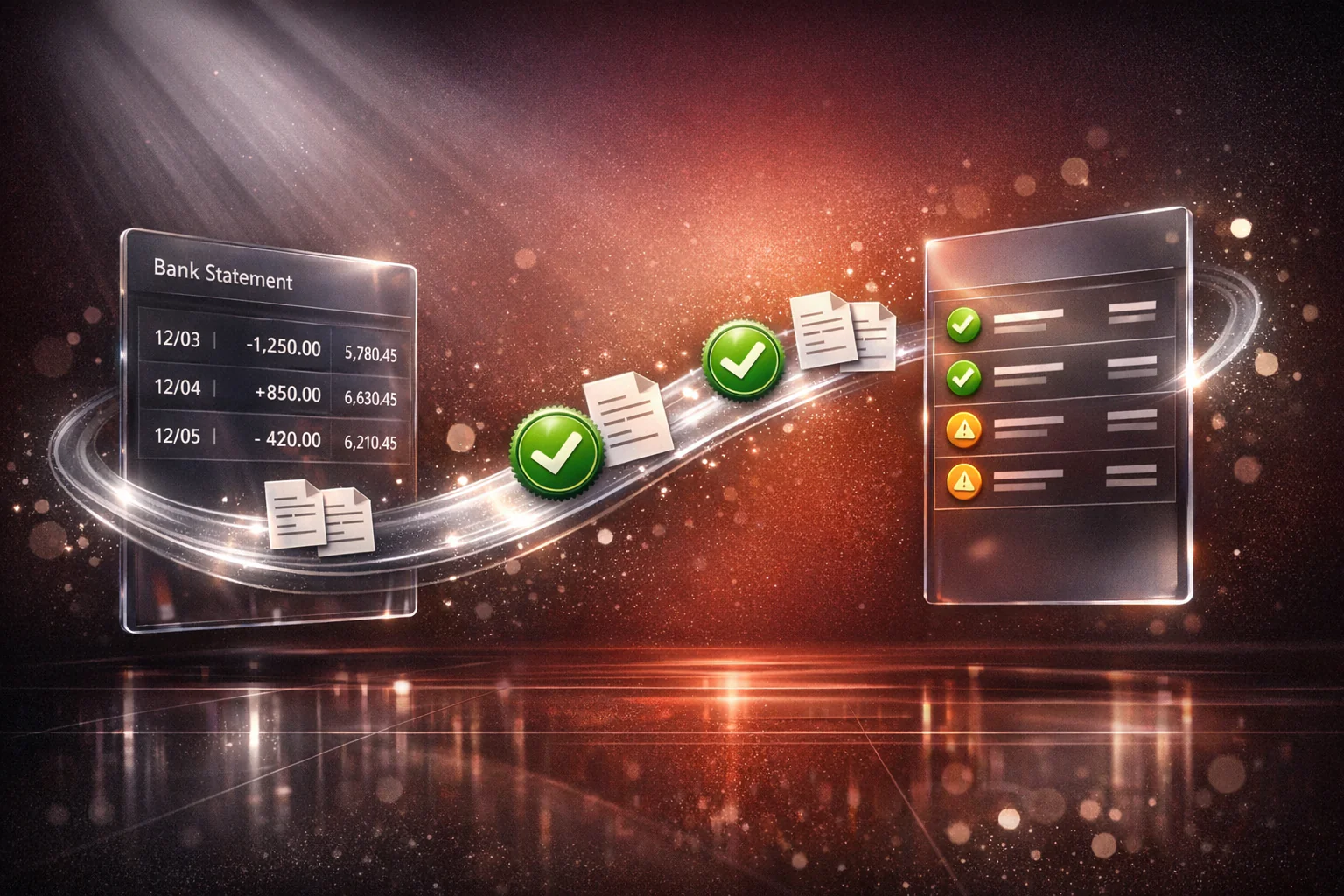
Bank feeds imported, transactions matched, exceptions flagged. No one copying rows between systems.
Transactions Imported
Bank feeds, payment processor settlements, and ERP records pulled into one workspace automatically
AI Matching Applied
85-95% of transactions matched without human intervention using learned patterns and tolerance rules
Exceptions Flagged
Unmatched items routed to a structured review queue with context and suggested matches
Books Closed Faster
Reconciled data flows into your close process, cutting month-end from days to hours
Everything You Need for Reliable Reconciliation
Multi-Source Bank Feeds
Import from multiple banks, payment processors, and card acquirers into a single matching workspace. No more toggling between five systems.
Intelligent Transaction Matching
Handles partial payments, grouped remittances, timing differences, and reference mismatches automatically. Learns your patterns over time.
Real-Time Exception Management
Unmatched transactions surface immediately with context and suggested matches, not in a pile at month-end when memory has faded.
Duplicate Payment Detection
Catches duplicate and near-duplicate payments before they settle, with configurable tolerance rules for amounts, dates, and references.
Multi-Currency Reconciliation
Handles cross-currency transactions with automatic FX rate matching, tolerance bands for rounding differences, and settlement timing adjustments.
Audit-Ready Reporting
Complete matching trail for every transaction. Your external auditors see exactly how each item was reconciled, whether by rule or by analyst.
Platforms We Reconcile With
From 48 Hours/Month to 11 Hours/Month
How a 180-employee wholesale distributor processing 3,500 monthly transactions eliminated spreadsheet reconciliation and closed six days faster.
The Manual Process
- Three finance staff spent 48 hours every month matching bank statements, payment processor settlements, and vendor invoices
- First-pass match rate of 60%: 1,400 transactions required manual investigation
- Error rate of 2.1%, meaning 73 transactions per month needed correction after the fact
- Month-end close took 9 business days, with reconciliation blocking everything downstream
- Duplicate payments surfacing quarterly when the auditor reviewed the ledger
The Automated Process
- 89% of transactions auto-matched: only 385 items per month routed to the exception queue
- Finance team reviews and resolves exceptions in 11 hours, not 48
- Error rate dropped to 0.3%, with duplicates caught before settlement
- Month-end close reduced to 3 business days
- Senior analyst now spends two days a week on cash forecasting instead of matching
Before vs After Automated Reconciliation
How We Set It Up
From first conversation to live reconciliation in 3 to 6 weeks.
Map Your Workflow
How many banks, payment sources, and systems are in play. Where the bottlenecks sit and what volume looks like.
Free Scoping Call
30-minute call to assess transaction volumes, exception patterns, and matching complexity.
Build & Test
We configure matching rules, connect your sources, and run parallel reconciliation against your live data to validate accuracy.
Go Live & Monitor
Switch off the spreadsheets. Monitoring and alerting keeps everything reconciled and flags anomalies before they become problems.
Frequently Asked Questions
How long does reconciliation automation take to set up?
A typical implementation takes 3 to 6 weeks from scoping to go-live. Simple single-source bank reconciliation can be running within 2 weeks. Multi-source setups with custom matching rules, cross-currency logic, and ERP integration take closer to 6 to 8 weeks.
Which accounting systems and banks do you support?
We integrate with Xero, QuickBooks, Sage (both Pastel and Business Cloud), NetSuite, SAP Business One, and custom ERPs. For payment sources, we connect to all major banks via open banking feeds, plus Stripe, PayFast, GoCardless, Ozow, and other payment processors. If your system has an API or structured export, we can connect it.
What auto-match rate should we expect?
Production deployments typically reach 85 to 95% straight-through matching within 60 to 90 days of go-live, based on IOFM and BlackLine benchmarks. Initial rates of 70 to 80% are normal before matching rules are tuned to your specific transaction patterns. Only the remaining 5 to 15% of genuinely ambiguous items require human review.
Will this replace our finance team?
No. It replaces the manual matching work, not the people. Your finance team shifts from line-by-line spreadsheet matching to exception investigation, variance analysis, and forecasting. The skills stay, the tedium goes. Most clients find their existing team can handle significantly higher transaction volumes without additional hires.
How do you handle partial payments and grouped remittances?
The matching engine supports one-to-many, many-to-one, and many-to-many matching scenarios. Partial payments are tracked against the original invoice with running balances. Grouped remittances are broken down using remittance advice data or learned patterns. Configurable tolerance bands handle rounding differences and timing offsets.
How much does payment reconciliation automation cost?
Basic single-source bank reconciliation starts from around R55,000. Multi-source reconciliation covering payment processors, bank feeds, and ERP records typically ranges from R110,000 to R275,000. Most clients processing 1,000 or more transactions per month see full ROI within 3 to 5 months based on time savings alone.
Stop Losing Hours to Manual Reconciliation
If your finance team is still matching transactions in spreadsheets, you are paying R150 to R220 per transaction for a process that automation handles at R35 to R70.
Tell us how many transaction sources you have, what your monthly volume looks like, and where the bottlenecks sit. We will show you exactly how much time and cost automated reconciliation would recover for your business.