Build a Unified Payment Reporting API: One Schema Across Providers
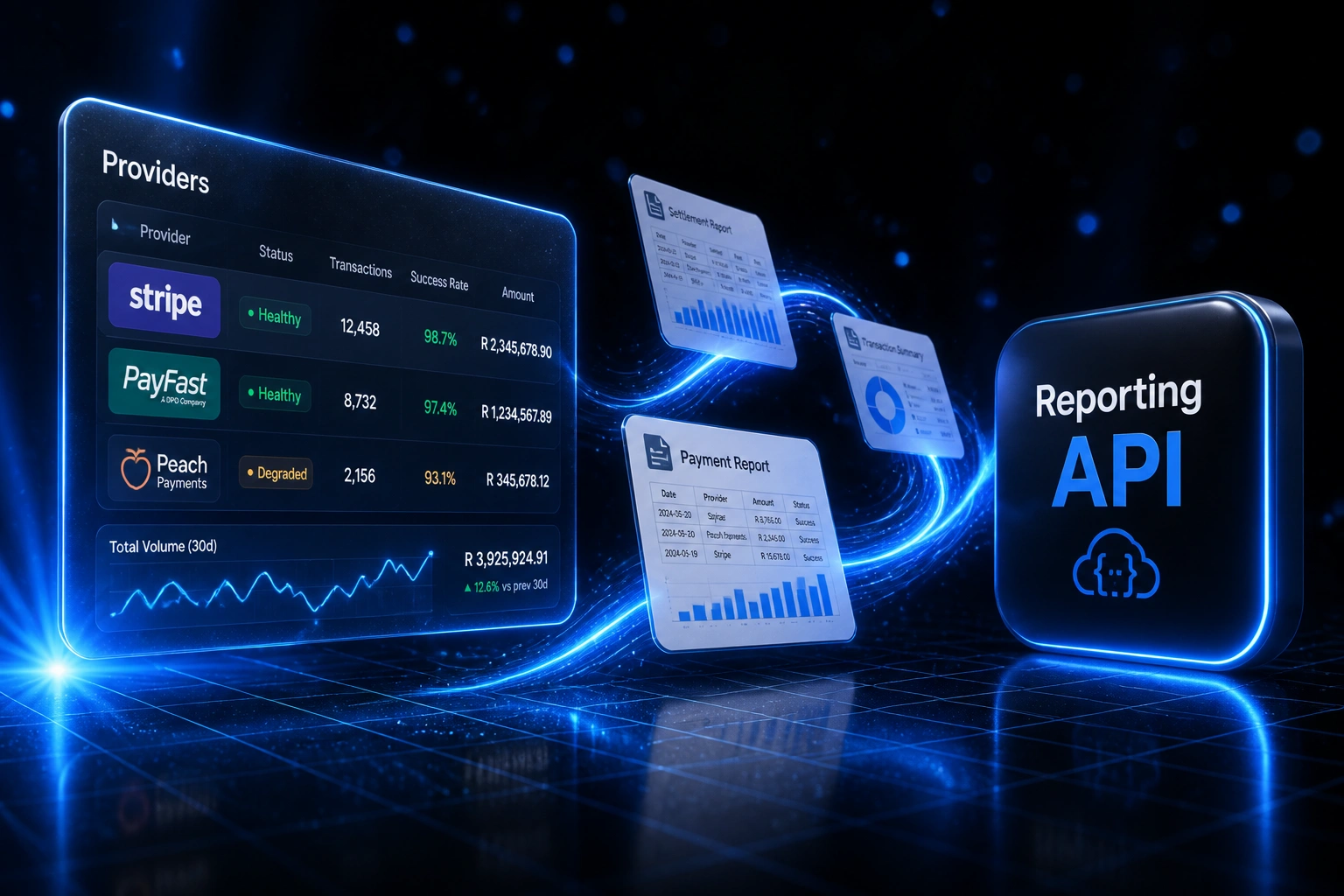
Your finance team exports Stripe for international, PayFast for SA, and Peach on the side every Monday, then pastes those files into Excel. Status, fees, FX, and settlement dates never mean the same thing twice, so Power BI and Looker never get a clean feed.
We build the unified reporting API that normalises payment data once.
Sound Familiar?
These are the exact issues CFOs and Heads of Data describe before a unified payment reporting API:
- Finance exports Stripe, PayFast, and Peach CSVs every Monday and pastes them into Excel for the board pack
- Status labels, fee lines, FX, and settlement dates mean different things in each provider file
- Power BI and Looker sit idle because nobody trusts a stitched workbook as a live payment data source
- Month-end close slips by two or more days for every extra gateway on the stack
- Fee leakage and FX margins hide inside lump totals until someone rebuilds the file from scratch
Stripe, PayFast, and Peach do not share a reporting vocabulary. Pending vs available, hold periods, fee line items, and FX conversion all land in different shapes. Stitching CSVs in Excel is not a data strategy, and every new gateway multiplies the Monday ritual.
What the Unified Reporting API Actually Does
Providers push → fields normalise → BI refreshes → board pack reads one feed. No human copying payment data between portals.
Providers Export
Stripe, PayFast, Peach, and Yoco settlement and transaction feeds land on schedule
Fields Normalise
Status, fees, FX, and settlement dates map into one finance-facing schema
BI Tools Refresh
Power BI, Looker, or Metabase pull the payment reporting API on your cadence
Board Pack Ready
EXCO figures come from one clean feed, not a Monday spreadsheet glue job
Everything You Need for Unified Payment Data
Unified Reporting Schema
Status, fees, FX, and settlement dates from every gateway land in one clean contract. Your BI team queries payment data once, not three times.
Multi-Provider Ingestion
Stripe for international cards, PayFast for SA checkout, Peach and Yoco on the side. Each feed normalises into the same reporting API without rebuilding reports.
Fee and FX Normalisation
Gross, net, MDR, and FX conversion sit on every row in the same shape. Margin leakage stops hiding inside a provider-specific CSV column.
Settlement-Aware Dates
Stripe T+2, PayFast holds, and Peach settlement clocks stay labelled as expected timing. Board figures stop treating cash-in-transit as banked funds.
BI and Board Pack Feeds
Power BI, Looker, Metabase, and Sheets read one payment reporting API. Monday CSV glue becomes a scheduled refresh your CFO can trust.
Audit-Ready Attribution
Every pull is timestamped and attributable to a provider source. When auditors ask how a board figure was built, you point at the API, not a forgotten workbook.
Providers and BI Tools We've Connected
From 16 Hours/Week to Under 3
How a multi-market SA merchant stopped Monday CSV glue across Stripe, PayFast, and Peach, and got board packs out two days earlier.
The Manual Process
- Finance exported Stripe, PayFast, and Peach CSVs every Monday morning
- Analysts remapped status, fees, FX, and settlement dates into one workbook by hand
- Board pack financials waited until mid-week while the file was still being rebuilt
- Power BI models refreshed from a stitched sheet nobody fully trusted
- Month-end routinely slipped past day 10 while multi-gateway figures still would not tie
The Automated Process
- One payment reporting API ingests Stripe, PayFast, and Peach on a schedule
- Status, fees, FX, and settlement dates land in a single normalised schema
- Power BI refreshes from the API; board packs use the same feed as ops
- Finance reviews exceptions only, not full multi-provider exports
- Month-end starts from figures the team already reconciled through the week
Before vs After a Payment Reporting API
How It Works
From first conversation to a live payment reporting API in 3–7 weeks.
Map Your Reporting Stack
Which gateways you run, which CSVs finance still exports, and which BI tools should consume the unified payment reporting API.
Free Scoping Call
30-minute call to design the normalised schema, settlement rules, and the first board-pack metrics that matter.
Build and Parallel-Test
We build the reporting API, backfill history, and run parallel against your next close until figures match the manual pack.
Go Live and Monitor
Switch Power BI, Looker, and board packs onto the feed. Monitoring flags schema drift before the next EXCO meeting.
Frequently Asked Questions
How long does a unified payment reporting API take to build?
A focused payment reporting API covering Stripe plus one SA gateway and one BI consumer typically takes 3 to 5 weeks from scoping to go-live. Multi-provider setups with fee, FX, and settlement normalisation for Power BI or Looker usually take 5 to 7 weeks.
How is this different from a payment dashboard or a generic payment data API?
A dashboard is a screen for cash position. A generic payment data API can feed many tools. This build is the reporting contract itself: one normalised schema for status, fees, FX, and settlement dates so Power BI, Looker, and board packs stop depending on Monday CSV glue. We often wire a dashboard on top, but the reporting API is what keeps the numbers honest.
Will this replace our Stripe or PayFast portals?
No. Provider dashboards stay for disputes, payouts, and support. What changes is how finance and data get aggregate payment reporting without logging into each portal and pasting CSVs into Excel.
Which providers and BI tools can connect?
We regularly normalise Stripe, PayFast, Peach Payments, Yoco, and Ozow into one schema, then feed Power BI, Looker, Metabase, Google Sheets, or any tool that can call a documented REST feed. If a provider exposes settlements, fees, and transaction state, we can include it.
How do you handle different status labels and settlement clocks?
Each provider keeps its own vocabulary and timing. The reporting API maps Stripe pending/available, PayFast holds, and Peach settlement states into one finance-facing status model, and labels cash-in-transit separately from settled funds so board packs never confuse the two.
How much does a unified payment reporting API cost?
Focused two-provider reporting APIs with one BI consumer start from around R40,000. Multi-provider builds with fee, FX, and settlement normalisation for Power BI or Looker typically range from R60,000 to R110,000. Teams burning 60+ hours a month on multi-gateway CSV reporting usually see ROI within 2 to 3 months.
Stop Pasting Payment CSVs Into Excel
If your CFO still waits on Monday exports from Stripe, PayFast, and Peach before Power BI or Looker can refresh, you are spending money on a reporting problem that already has a clean answer.
Tell us which providers you run, which BI tools should consume the feed, and where board packs still break. We will show you exactly how a unified payment reporting API would look for your stack.