Build a Payment Status Tracking API: One Answer Across Every Gateway
Your customer portal still says Pending while PayFast already settled, Peach says Complete, and Stitch says Settled. Support fields the WhatsApp. Finance opens three dashboards. Nobody has a single source of truth.
We build the Status API that portals, CRM, and finance all trust.
Sound Familiar?
These are the exact issues product and ops leads bring us when payment tracking breaks down:
- The customer portal still shows Pending hours after PayFast or Peach already settled the payment
- Support answers the same WhatsApp every day: "Has my payment gone through?"
- Each gateway uses different status words, so ops cannot trust a single screen
- Finance reconciles from three dashboards because there is no shared source of truth
- Failed payments stay invisible until a customer complains or month-end blows up
Every new gateway adds another status language. Modern Treasury notes that one provider's "completed" may mean another's "processed" or "settled." Without a translation layer, your portal and support team are stuck guessing.
What the Payment Status API Actually Does
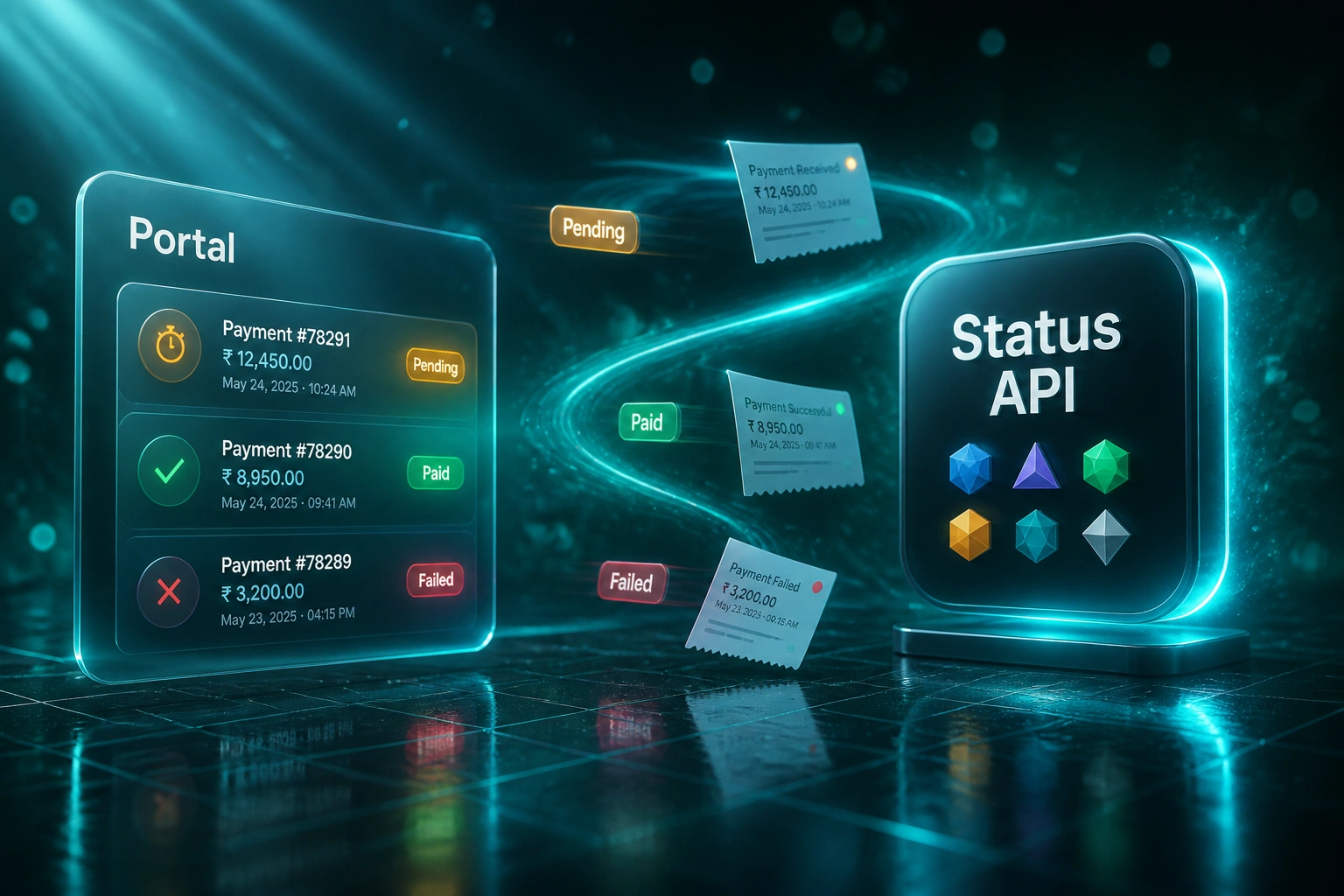
Gateway confirms → status normalised → portal and CRM update. One answer, every system.
Payment Hits a Gateway
Customer pays via PayFast, Peach, Stitch, Ozow, or Stripe as they always have
Status Normalised
Provider-specific labels map into Pending, Paid, Failed, or Refunded
Portal and CRM Update
Customer portal, deal records, and invoices read the same Status API
Support Stays Quiet
Customers see the answer themselves. Finance trusts one ledger of status history
Everything You Need for Reliable Payment Tracking
Unified Status Language
PayFast, Peach, Stitch, Ozow, Stripe, and Netcash statuses map into one clear vocabulary: Pending, Paid, Failed, Refunded. Portals and CRM stop inventing their own labels.
Portal-Ready Status Feed
Your customer portal reads one payment status API. Members see the truth within seconds, not after a support agent digs through gateway dashboards.
CRM and Finance Sync
Deals, invoices, and membership records update from the same status layer. Sales and finance stop chasing each other for "is this paid?"
Failed Payment Visibility
Declines, returns, and abandoned checkouts surface in one ops view with enough context to act. Failed money stops hiding until month-end.
Multi-Gateway Coverage
Add or swap gateways without rewriting every screen that shows payment status. The Status API stays the contract; providers become interchangeable adapters.
Ops Source of Truth
Support, product, and finance query the same status history. WhatsApp fire drills shrink because the portal already answers the payment tracking question.
Gateways We've Unified Into One Status Layer
From Hours of Pending to Under 30 Seconds
How a SA membership business cut payment-status tickets by 72% and gave members a portal that finally tells the truth.
The Fragmented Process
- Portal stuck on Pending while PayFast and Peach already settled
- Support answered 45+ "has my payment gone through?" WhatsApps a week
- Agents opened three gateway dashboards to answer one status question
- Failed card payments stayed invisible until members complained
- Finance reconciled memberships from screenshots and export CSVs
The Unified Status Layer
- One Status API maps every gateway into Pending, Paid, Failed, Refunded
- Portal refreshes from the same source finance and CRM read
- Status lag dropped from hours to under 30 seconds for confirmed payments
- Failed payments surface in an ops queue the same day
- WhatsApp volume on payment status collapsed because the portal answers first
Before vs After a Unified Payment Status API
How It Works
From first conversation to a live Status API in 2 to 4 weeks for a focused build.
Map Your Status Chaos
Which gateways you run, where Pending gets stuck, and which systems need a clean payment status answer.
Free Scoping Call
30-minute call to design the unified status model, portal consumers, and CRM or finance sync points.
Build and Parallel-Test
We build the Status API, map each provider, and run parallel against live traffic until portal and ops screens match reality.
Go Live and Monitor
Cut over portal and internal tools to the unified layer. Monitoring flags status drift before customers notice.
Frequently Asked Questions
How long does a payment status tracking API take to build?
A focused Status API covering two gateways and a portal feed typically takes 2 to 4 weeks from scoping to go-live. Multi-gateway setups that also sync CRM and finance usually take 4 to 6 weeks.
How is this different from fixing webhooks or adding retries?
Webhook reliability keeps events from disappearing. A payment status tracking API is the customer-facing and ops-facing layer on top: one consistent answer for Pending, Paid, and Failed across every gateway your portal, CRM, and finance tools call.
Will customers notice a change at checkout?
No. Checkout stays on your existing gateways. What changes is how quickly and accurately your portal and internal systems reflect what already happened at the provider.
Which systems can consume the Status API?
Customer portals, CRM, membership platforms, finance tools, and support desks. Anything that today logs into PayFast, Peach, or Stitch dashboards to answer "has this payment cleared?" can read the unified status instead.
What happens when gateways disagree or a webhook is late?
The Status API keeps a clear lifecycle per payment, reconciles late updates, and prefers confirmed provider state over a stuck Pending label. Ops gets an exception list when something still cannot be resolved automatically.
How much does a payment status tracking API cost?
Focused two-gateway status layers with a portal feed start from around R25,000. Multi-gateway Status APIs with CRM and finance sync typically range from R45,000 to R90,000. Teams burning 30+ payment-status tickets a week usually see ROI within 2 to 3 months.
Stop Answering "Has My Payment Gone Through?"
If your portal still shows Pending while gateways have already settled, you are paying for support tickets a Status API would retire.
Tell us which gateways you run, where the portal and CRM read status today, and which "Pending" delays hurt members most. We will show you how a unified payment status tracking API would work for your stack.