Payroll Journal to Accounting Sync: Automate Pay-Run Posting
Your pay run is done. Cash has left the bank. Yet someone still sits with a payroll report open beside Xero, Sage, or QuickBooks, typing salary, PAYE, UIF, SDL, medical aid, and garnishee lines by hand. One wrong digit and the ledger lies until month-end.
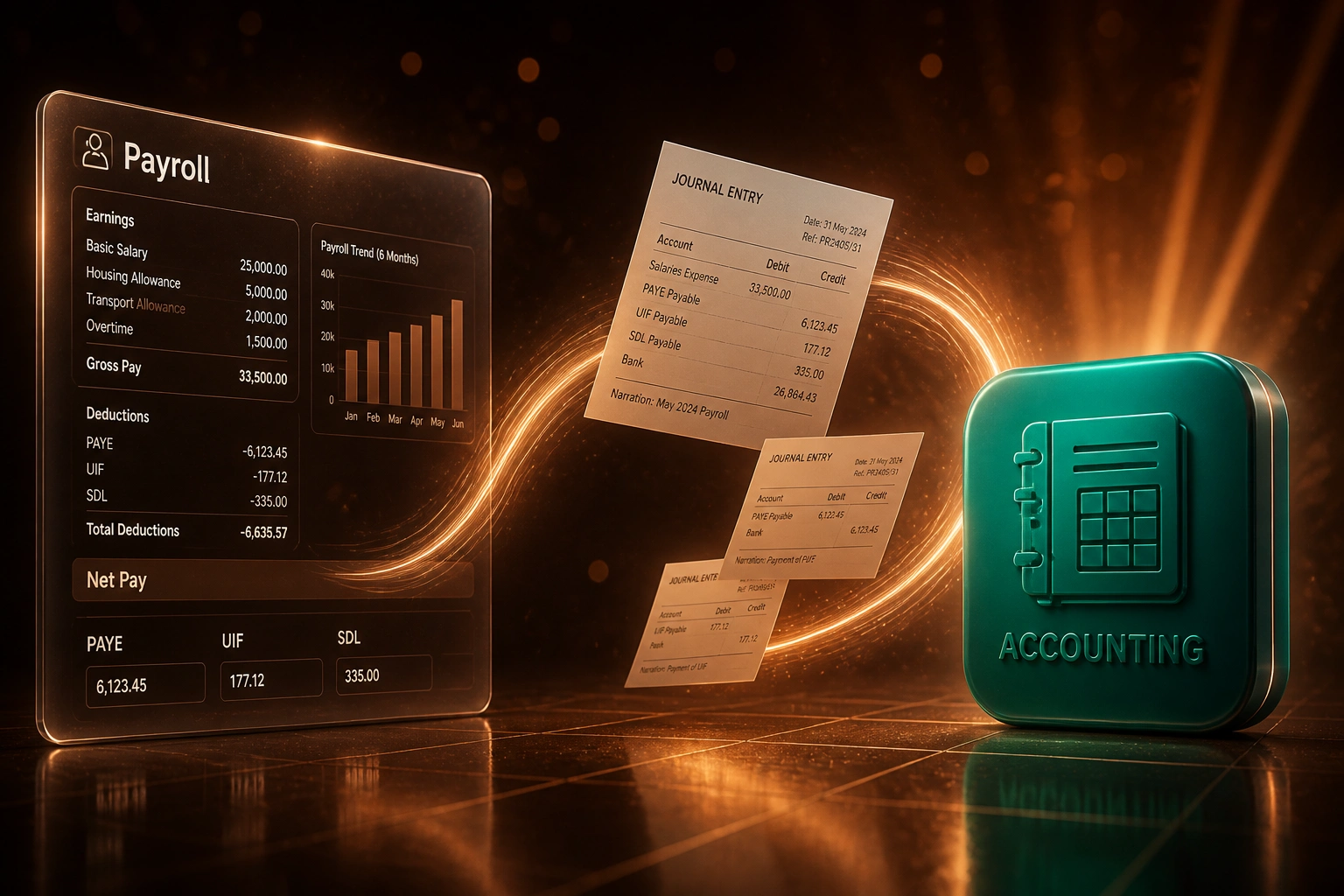
We build the payroll journal sync that posts accurate journals the same day as the pay run.
Sound Familiar?
These are the exact issues finance managers faced before payroll posting automation:
- After every pay run, someone rekeys salary, PAYE, UIF, SDL, medical aid, and garnishee lines into Xero, Sage, or QuickBooks by hand
- Transposition errors send the wrong amount to a cost centre or leave a liability account unbalanced until month-end
- Payroll journals land days after the pay run, so the ledger is always behind the cash that already left the bank
- Multi-cost-centre splits get flattened into one salary expense line, then finance rebuilds the allocation in a spreadsheet
- Month-end close stalls while the accountant ties payroll liabilities to EMP201 figures and the bank payment batch
Only 31% of organisations have automated GL payroll journals, according to Deloitte's 2025 Global Payroll Survey. If auditors keep finding payroll liability drift, or your EMP201 prep starts with a spreadsheet rebuild of what already ran in payroll, manual posting is the bottleneck, not your accountant.
What Payroll Journal Sync Actually Does
Pay run finalises → journal drafts in accounting → finance approves → books match. No human retyping between systems.
Pay Run Finalises
Payroll locks the run in SimplePay, Sage Payroll, PaySpace, or Xero Payroll
Journal Built Automatically
Salary, PAYE, UIF, SDL, medical aid, garnishees, and cost-centre splits map to your GL
Finance Reviews & Posts
Draft lands in Xero, Sage, or QuickBooks for a short approval, not a rekey
Books Close Cleaner
Liabilities already tie to the pay run, so month-end stops waiting on payroll
Everything You Need for Reliable Payroll Posting Automation
Same-Day Journal Posting
When the pay run finalises, the full payroll journal posts into Xero, Sage, or QuickBooks the same day: salary, PAYE, UIF, SDL, and net pay lines included.
SA Statutory Line Mapping
PAYE, UIF, SDL, medical aid, pension, and garnishee deductions map to the correct liability and expense GL accounts every cycle, not a different spreadsheet each month.
Multi-Cost-Centre Splits
Department, project, and cost-centre allocations from payroll land as split journal lines, so departmental P&Ls stay trustworthy without a weekend rebuild.
Exception Alerts Before Close
Unmapped pay codes, failed posts, and unbalanced journals surface before you rely on the numbers for EMP201 or month-end, not after the auditor asks.
Stable Chart-of-Accounts Mapping
Each payroll earning and deduction code maps once to your ledger. Structure drift stops, so this month's journal is comparable to last month's.
Faster Month-End Close
Payroll liabilities already match the pay run and the bank batch. Finance stops treating payroll as the recurring close blocker.
Payroll and Ledgers We've Connected
From 6.8 Days Behind to Same-Day Posting
How a 220-person Gauteng manufacturer stopped rekeying payroll journals and closed the books three days sooner.
The Manual Process
- Bookkeeper exported the SimplePay pay-run report and rebuilt the journal in Xero line by line
- Eight hours per cycle covering salary, PAYE, UIF, SDL, medical aid, garnishees, and six cost centres
- Transposition mistakes left liability accounts drifting until EMP201 prep exposed them
- Journals typically posted four to six days after the bank payment batch
- Month-end stalled while finance tied payroll liabilities to the ledger and SARS draft
The Automated Process
- Pay run finalises → draft journal appears in Xero the same day with every statutory line mapped
- Finance manager reviews totals against the pay-run report and approves in minutes
- Cost-centre splits post as separate lines, so departmental P&Ls stop needing a weekend rebuild
- Payroll liabilities match the bank batch before close starts
- EMP201 prep begins from a ledger that already agrees with payroll
Before vs After Accounting Integration
How It Works
From first conversation to live payroll journal sync in 2–4 weeks.
Tell Us Your Setup
Which payroll and ledger you use, how journals are built today, and which cost centres and statutory lines cause the most rework.
Free Scoping Call
30-minute call to map pay-run trigger → journal lines → GL accounts, and design the review step your finance manager keeps.
Build & Test
We build the payroll journal sync, lock the chart-of-accounts map, and run parallel for one full pay cycle against your manual journals.
Go Live & Monitor
Switch off the rekey. Monitoring flags unmapped codes and failed posts before the next close.
Frequently Asked Questions
How long does payroll journal to accounting sync take to set up?
A focused one-way payroll journal sync into Xero, Sage, or QuickBooks typically takes 2–4 weeks from scoping to go-live. Setups with multi-cost-centre splits, many deduction codes, and parallel-cycle validation usually land closer to 3–5 weeks.
Which payroll and accounting systems can you connect?
We have posted pay-run journals from SimplePay, Sage Payroll, PaySpace, and Xero Payroll into Xero, Sage Accounting, and QuickBooks Online. If your payroll can export a structured pay-run file or expose an API, we can map it to your ledger.
How is this different from SimplePay's native Xero or QuickBooks connector?
Native connectors cover a standard journal for those two ledgers. They often fall short when you need Sage Accounting, multi-cost-centre splits, custom garnishee or medical-aid codes, or a review-and-approve step before posting. Custom payroll posting automation fills those gaps without returning to CSV rekeying.
Will this change how we review journals before they hit the ledger?
No. Most clients keep a short finance review: draft journal appears, finance manager checks totals against the pay-run report, then approves. The rekey disappears; the control stays.
How do you handle South African statutory lines and cost centres?
Salary, PAYE, UIF, SDL, medical aid, pension, and garnishee lines map to the GL accounts your chart of accounts already uses. Cost-centre, tracking-category, or department dimensions from payroll carry through so departmental reporting stays intact.
How much does payroll journal accounting integration cost?
Simple one-way journal syncs start from around R15,000. Multi-cost-centre mapping with custom statutory codes and approval workflows typically ranges from R25,000 to R60,000. Most mid-market teams spending a full day rekeying after each pay run recover that within a few months.
Stop Rekeying Payroll Journals Every Pay Run
If your finance team still rebuilds payroll journals by hand after every cycle, you are spending skilled accountant hours on a problem that accounting integration already solves.
Tell us which payroll and ledger you use, how cost centres and statutory lines are coded today, and where month-end gets stuck. We will show you exactly how automated posting would work for your books.