Purchase Order Approval Workflow: Sign-Off by Value and Category
Unsigned or rubber-stamped POs blow budgets before finance sees them. A multi-level purchase approval workflow catches overruns by value band and category before the supplier is notified, with mobile and chat paths so procurement sign-off does not sit in someone's inbox for days.
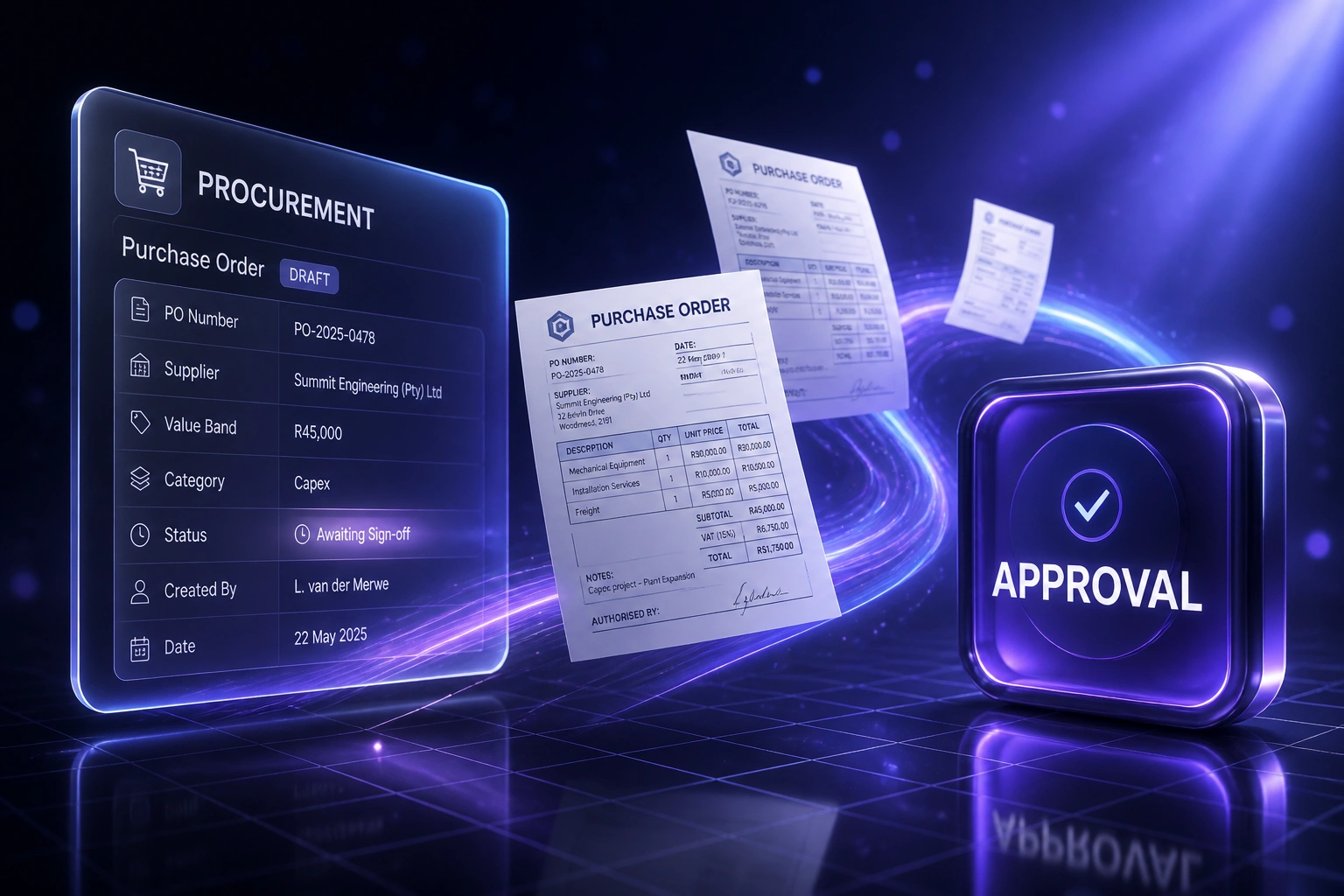
We build the PO approval chain that governs every draft before it leaves.
Sound Familiar?
These are the exact issues CFOs and procurement leads faced before a governed PO approval workflow:
- POs leave for the supplier after a rubber-stamp reply-all, with no check against budget or category policy
- A R8,000 stationery buy and a R480,000 Capex line follow the same single-approver path
- Approvals sit in email for days while buyers chase CFOs and plant managers on WhatsApp
- Nobody can show an auditor who authorised a PO, when, or against which value band
- Draft POs from ERP, reorder automation, or manual entry still ship without governed procurement sign-off
Native ERP approval limits often break across multi-entity South African groups. Shared services, Capex vs Opex, and BBBEE preferential-procurement checks need value-and-category routing with an immutable audit trail. Email threads will not satisfy a POPIA access review or an internal auditor asking who authorised a PO.
What the Purchase Approval Workflow Actually Does
Draft PO arrives → routed by value and category → mobile sign-off → released only when the chain completes.
Draft PO Submitted
Manual, ERP, or reorder-automation draft enters the same approval queue
Routed by Rules
Value band and category decide buyer, manager, CFO, or compliance steps
Approve on Any Device
Email, Slack, Teams, or WhatsApp with one-tap approve, reject, or edit request
Release or Block
Approved POs release to the supplier; overruns and policy breaches stay blocked
Everything You Need for Governed Procurement Sign-Off
Value-Band Routing
Thresholds in Rand decide the chain: buyer only under R10,000, procurement manager to R75,000, CFO or MD above that. Capex and Opex can use different bands.
Category-Based Escalation
IT hardware, fleet, raw materials, and professional services each route to the right budget owner. Preferential-procurement categories can require an extra compliance check before release.
Mobile & Chat Approve Paths
Approvers get email, Slack, Teams, or WhatsApp with one-tap approve, reject, or request changes. Sign-off does not wait for someone to open a desktop inbox.
Source-Agnostic Draft Intake
Manual POs, ERP drafts, and reorder-automation drafts all enter the same purchase approval workflow. Nothing reaches a supplier until the chain completes.
Budget Hold & Overrun Block
Each approval step can re-check remaining budget and open commitments. Over-budget lines stop before the PO is released, not after the invoice arrives.
Immutable Audit Trail
Every approve, reject, and escalation is timestamped with who acted and why. Ready for internal audit, POPIA access reviews, and BBBEE preferential-procurement evidence.
Systems We've Wired for PO Approval
From 5 Days to Same-Day Procurement Sign-Off
How a Midrand industrial manufacturer stopped rubber-stamped Capex POs and cut approval cycle time from five days to hours.
The Email Chain
- Every PO, from R2,000 stock to R600,000 Capex, sat in the same CFO inbox
- Approvals averaged 4–6 business days; buyers chased plant managers on WhatsApp
- Two Capex lines shipped without budget cover in one quarter (R2.1M combined)
- Audit could not reconstruct who authorised which PO from email threads
- Reorder automation drafts and manual POs bypassed different informal paths
The Governed Workflow
- Value bands route low-value catalogue POs to buyers; Capex escalates to CFO
- Approvers sign off on mobile or Teams within hours, with SLA escalation
- Budget hold blocks over-commitment before the supplier is emailed
- Full audit trail of every approve and reject, ready for POPIA and internal audit
- All draft sources enter one purchase approval workflow before release
Before vs After PO Approval Workflow
How It Works
From first conversation to live purchase approval workflow in 2–4 weeks.
Tell Us Your Setup
Which ERP or purchasing system, how value bands and categories work today, and where approvals stall.
Free Scoping Call
30-minute call to map multi-level chains, escalation SLAs, and how drafts from every source should enter the workflow.
Build & Test
We wire value and category rules, mobile approve paths, and ERP write-back, then run parallel for a week against real POs.
Go Live & Monitor
Switch off email rubber-stamping. Monitoring catches stalled approvers and policy exceptions before suppliers are notified.
Frequently Asked Questions
How long does a PO approval workflow take to set up?
A focused multi-level purchase approval workflow with email and mobile approve paths usually takes 2–4 weeks from scoping to go-live. Multi-entity Rand bands, category rules, Slack/Teams/WhatsApp paths, and ERP write-back typically take 4–6 weeks.
How is this different from purchase order automation?
Purchase order automation creates draft POs when stock hits reorder thresholds. A PO approval workflow governs who must sign off before any draft (manual, ERP, or automation-generated) leaves for the supplier. Many clients need both: generation upstream, governed procurement sign-off before release.
Can we keep our existing ERP approval limits?
Native ERP limits often break across multi-entity South African groups, shared services, and category exceptions. We keep your ERP as the system of record and layer value-and-category routing, escalation, and an audit trail on top so policy matches how you actually buy.
Will low-value POs still need CFO approval?
No. You set the bands. Catalogue buys under a threshold can auto-release or stop at the buyer. Capex, restricted categories, and preferential-procurement suppliers escalate. The point of a purchase approval workflow is the right sign-off for the risk, not more bureaucracy.
How do you handle POPIA and audit evidence?
Every decision is logged with actor, timestamp, PO value, category, and outcome. That gives finance and compliance an immutable trail for internal audit and POPIA access reviews, without rebuilding history from email threads.
How much does a PO approval workflow cost?
Value-and-category routing with email approve paths starts from around R15,000. Multi-level chains with mobile/Slack/Teams, multi-entity bands, budget holds, and ERP sync typically range from R25,000 to R60,000. Teams issuing 30+ POs a week usually see payback within 1–3 months from avoided overruns and recovered approval time alone.
Stop Letting Unsigned POs Blow the Budget
If Capex and catalogue buys still share one email inbox, you are paying for overruns that a multi-level PO approval workflow would have blocked before the supplier was notified.
Tell us which ERP you use, how value bands and categories should work, and where approvals stall today. We will show you exactly how a purchase approval workflow would route procurement sign-off for your business.