POPIA Responsible Party Obligations: Prove the Measures, Not the Hope
POPIA does not forgive "we outsourced IT". As the responsible party, you stay accountable for how personal information moves through CRM, marketing tools, and cloud storage, and fines climb to R10 million when you cannot prove the controls.
We wire accountability, section 19 safeguards, and section 21 operator agreements into those systems so obligations are evidenced, not hoped for.
Sound Familiar?
These are the gaps CEOs and Information Officers discover when responsible-party duties suddenly matter:
- You are the named responsible party, yet CRM, email, and cloud storage still run without documented POPIA obligations
- Section 19 security safeguards exist on paper; nobody regularly verifies they still work in live systems
- Operator agreements with HubSpot, Mailchimp, or Google Workspace are missing, unsigned, or years out of date
- Purpose specification lives in a legal memo while further processing for marketing happens without a fresh check
- When the Information Regulator asks for proof, the Information Officer spends weeks assembling screenshots and email trails
The Information Regulator's enforcement is accelerating. In FY2024/25 it issued multiple Enforcement and Infringement Notices, including a R5 million notice and fines for security-compromise notification failures. Cloud vendors are also tightening DPA and operator terms. Unsigned section 21 agreements and unverified section 19 safeguards are no longer a quiet gap.
What Responsible Party Tooling Actually Does
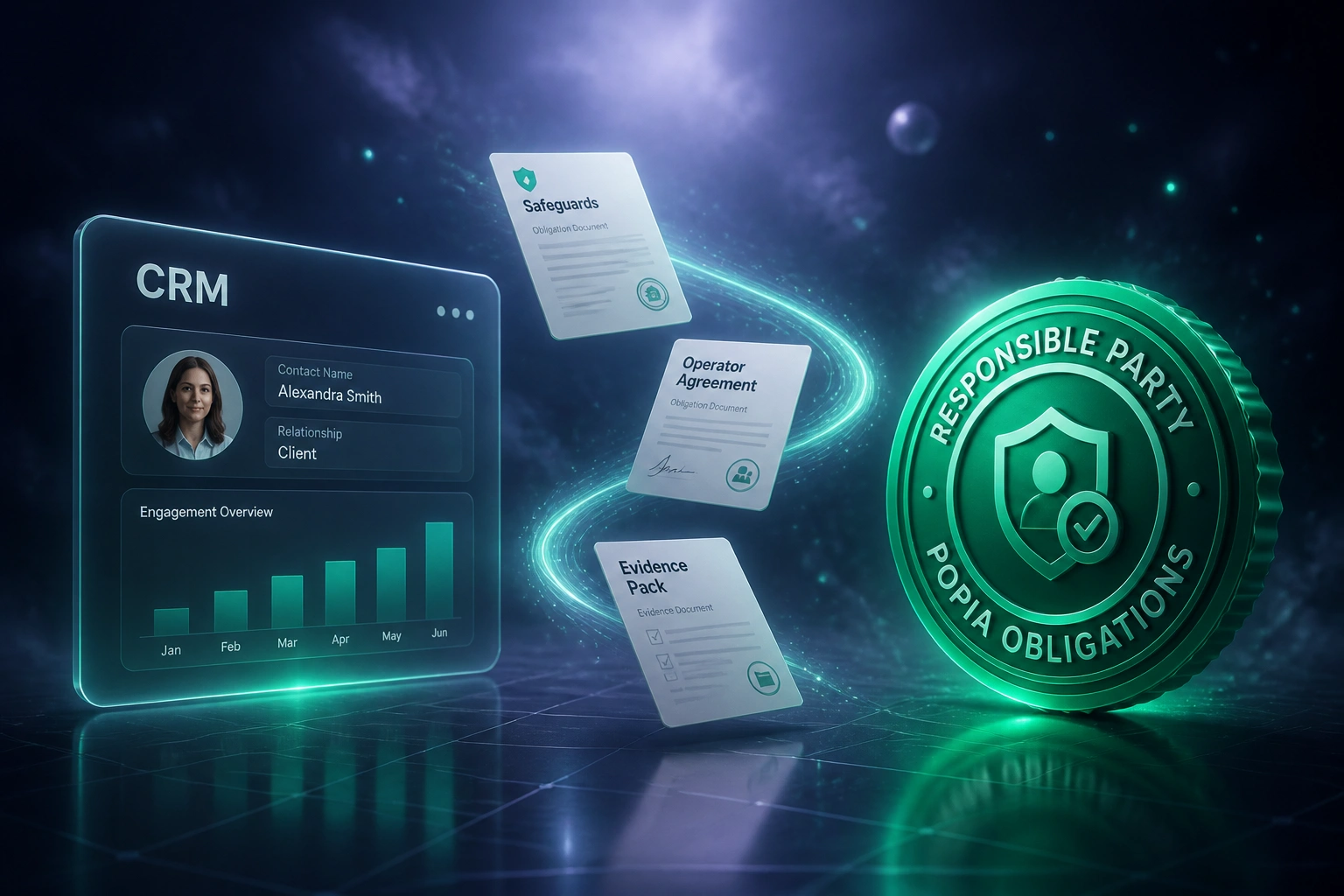
Obligations mapped → safeguards verified → operators contracted → evidence exported. No Friday-afternoon reconstruction.
Map Accountability
Every processing purpose in CRM and connected tools links to a responsible-party control
Wire Section 19
Safeguards, risk checks, and verification schedules land where personal information is stored
Close Section 21 Gaps
Operator agreements tracked against live CRM, email, and storage integrations
Export Evidence
The Information Officer produces a Regulator-ready pack instead of rebuilding from inboxes
Everything a Responsible Party Needs to Prove POPIA Obligations
Accountability Register
Every CRM contact, mailbox, and storage folder maps to a processing purpose and a named responsible-party control so accountability is operational, not theoretical.
Section 19 Safeguard Wiring
Risk identification, access controls, encryption flags, and verification schedules sit where personal information actually lives, with logs that prove safeguards are checked and updated.
Section 21 Operator Tracking
Written operator agreements for CRM, ESP, and cloud vendors are tied to live integrations. Missing or expired contracts surface before a Regulator assessment does.
Purpose and Further Processing
Purpose tags and further-processing gates stop marketing or analytics reuse from drifting beyond the original lawful basis without an explicit decision trail.
Evidence Pack Automation
Technical and organisational measures export as timestamped evidence packs: safeguard checks, operator status, purpose registers, and access logs ready for the Regulator.
Information Officer Console
Open obligations, overdue verifications, unsigned operators, and fine-exposure risks in one view so the named responsible party can prove control without rebuilding the story.
Systems We've Hardened for Responsible Party Duties
From 42 Hours per Evidence Pack to Under 2
How a Cape Town professional services firm stopped treating POPIA responsible party duties as a legal memo and made them visible in the CRM.
The Manual Burden
- Fourteen cloud and marketing operators ran without signed section 21 agreements
- Section 19 safeguards were an annual PDF; no live verification schedule
- Purpose specification sat in a legal memo while CRM tags stayed blank
- Each Regulator-style evidence pack took about 42 hours across IO, IT, and ops
- Further processing for newsletters happened without a documented check
The Operational Controls
- Operator register tied to live HubSpot, Google Workspace, and ESP integrations
- Section 19 verification logs run on a schedule with deficiency alerts
- Every contact purpose carries a specification tag and further-processing gate
- Evidence packs export in under two hours with timestamped measure history
- Information Officer console shows open obligations before the Regulator asks
Before vs After Responsible Party Controls
How It Works
From first conversation to live obligation tooling in 3–6 weeks.
Map Your Obligations
Where personal information moves, which section 19 and section 21 gaps exist, and how you prove measures today.
Free Scoping Call
30-minute call with your CEO, COO, or Information Officer to prioritise accountability, operator terms, and evidence tooling.
Wire Measures In
We build registers, safeguard verification, operator tracking, and purpose controls into your CRM and connected tools.
Prove It Continuously
Staff keep using the same systems. The responsible party gets verification schedules, alerts, and evidence packs on demand.
Frequently Asked Questions
What are POPIA responsible party obligations in practice?
As the responsible party (data controller), you determine the purpose and means of processing and remain accountable even when IT or marketing is outsourced. That means section 19 technical and organisational security safeguards with regular verification, section 21 written operator agreements, purpose specification, limits on further processing, and the ability to prove those measures in live CRM, email, and storage systems.
Does outsourcing IT or using a cloud CRM transfer POPIA liability?
No. POPIA does not forgive "we outsourced IT". Operators process on your instruction; you remain the responsible party. Section 21 requires a written contract that binds them to section 19 safeguards and immediate breach notification. Missing operator agreements are one of the first gaps assessments uncover.
What fines and enforcement risk does a responsible party face?
Section 109 allows administrative fines up to R10 million. The Information Regulator has already issued infringement notices including R5 million (Department of Basic Education, December 2024), R500,000 (Blouberg Local Municipality), and R100,000 (Lancet Laboratories for section 22 notification failures). Ignoring an enforcement notice is an offence. Separately, IBM's 2025 Cost of a Data Breach Report puts the average South African breach at R44.1 million.
How long does assembling compliance evidence usually take without tooling?
Manual privacy and compliance operations commonly consume 550 to 600 staff hours per year when evidence is gathered from inboxes and spreadsheets. A single Regulator-style evidence pack for operator agreements, safeguard checks, and purpose registers often takes our clients 35 to 45 hours before tooling. Gartner has estimated roughly US$1,400 per manual data subject request (about R23,000 at current rates), which compounds the same evidence problem.
Can we keep HubSpot, Salesforce, or Google Workspace?
Yes. We wire obligation registers, section 19 verification, section 21 tracking, and evidence exports onto the systems you already run. A platform change only makes sense when the tools cannot store purpose history, operator status, or an auditable safeguard trail.
How much does responsible-party obligation tooling cost?
Focused section 19 verification, section 21 operator tracking, and evidence packs on an existing CRM typically start around R55,000. Full Information Officer consoles with purpose controls, further-processing gates, and multi-system cascades usually land between R75,000 and R120,000. Against R10 million fine exposure and R23,000-plus per manual evidence scramble, most mid-market teams see payback inside one Regulator enquiry avoided or a handful of automated packs.
Stop Hoping Your POPIA Obligations Hold
If your team is still assembling section 19 and section 21 evidence from email threads, you are spending money on a problem tooling already solves.
Tell us which CRM and cloud tools you run, who the named responsible party is, and where operator or safeguard gaps worry you most. We will show you how obligation controls would work in your stack.