Automate Pro-Rata Billing for Mid-Cycle Plan Changes
Customers upgrade or downgrade mid-billing cycle and finance recalculates prorated charges in spreadsheets. Wrong credits, missed upgrade revenue, and dispute refunds pile up every month.
We build the automation that calculates the credit and the charge the moment the plan changes.
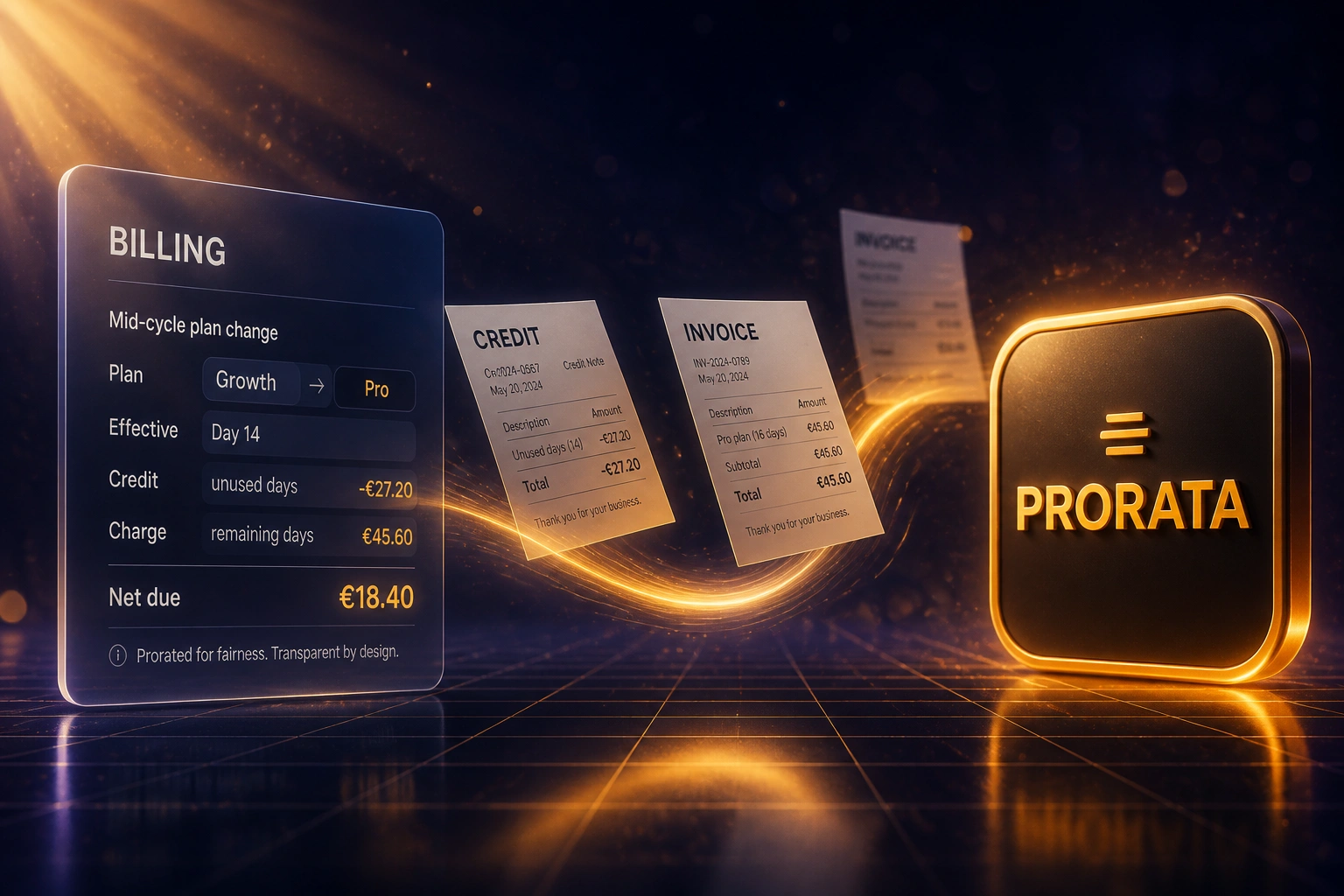
Sound Familiar?
These are the exact issues our clients faced before pro-rata automation:
- Customers upgrade or downgrade mid-cycle and finance recalculates partial charges in spreadsheets
- Wrong day-count denominators underbill in 31-day months and overbill in February
- Unused-plan credits are calculated against list price instead of the discounted rate the customer actually paid
- Overcharges trigger refunds, support tickets, and Stripe disputes that cost more than the original error
- MRR and deferred revenue drift because prorated amendments never update the revenue schedule
Stripe's default proration behaviour can invoice the net mid-cycle immediately, which surprises customers who expected the new price next month. Those surprise charges drive support tickets and disputes that cost R245 in fees alone, before the disputed amount leaves your balance.
What Pro-Rata Automation Actually Does
Plan changes mid-cycle → credit and charge calculated → ledger updated. No spreadsheet maths.
Plan Change Triggered
Customer upgrades, downgrades, or adds seats in your product, CRM, or billing portal
Proration Calculated
Unused days credited at the paid rate; remaining days charged at the new plan rate
Documents Issued
Credit note and prorated invoice post to your ledger with clear line items
Revenue Aligned
MRR and deferred revenue update from the effective date, ready for close
Everything You Need for Accurate Mid-Cycle Billing
Instant Pro-Rata Calculation
A plan change on day 14 credits unused days on the old plan and charges remaining days on the new plan, using actual calendar days, not a fixed 30-day assumption.
Upgrade & Downgrade Rules
Configure whether upgrades invoice immediately, downgrades credit the next invoice, or changes wait until period end, so policy stays consistent across every account.
Credit Note & Charge Pairing
Every mid-cycle amendment produces the matching credit note and prorated charge together, with clear line items your customer can actually understand.
Ledger & Gateway Sync
Prorated amounts post to Xero, Sage, or QuickBooks and collect through Stripe or PayGate without finance re-keying the net due.
Discount-Aware Credits
Credits use the rate the customer actually paid, including negotiated discounts and tax treatment, so you stop systematically over-crediting upgrades.
Revenue Schedule Updates
Deferred revenue and MRR adjust from the effective date of the change, keeping month-end close and audit packs aligned with the subscription reality.
Platforms We've Connected for Pro-Rata Billing
From 8 Hours/Week to Under 1 Hour
How a SaaS finance team stopped undercharging mid-cycle upgrades and recovered R360,000 in year one.
The Manual Process
- Finance recalculated every upgrade and downgrade in a shared spreadsheet
- About 20 minutes per change across roughly 90 mid-cycle amendments a month
- Fixed 30-day denominators quietly underbilled in long months
- Credits often used list price, so upgrades were systematically over-credited
- Customer disputes over unexplained prorated charges tied up support and finance
The Automated Process
- Plan change in Stripe or the CRM triggers credit note and prorated invoice together
- Finance reviews exceptions only; routine upgrades post without spreadsheet maths
- Actual calendar days and paid rates used on every calculation
- Clear line items cut surprise-charge tickets and dispute volume
- MRR and deferred revenue update from the effective date automatically
Before vs After Pro-Rata Automation
How It Works
From first conversation to live pro-rata automation in 2–4 weeks.
Tell Us Your Setup
Which billing and ledger tools you use, how plan changes are requested today, and where prorated credits go wrong.
Free Scoping Call
30-minute call to map upgrade and downgrade policy, day-count rules, tax treatment, and approval thresholds.
Build & Test
We build the proration engine, test against your real mid-cycle amendments, and run parallel until figures match your policy.
Go Live & Monitor
Switch off spreadsheet proration. Exception alerts catch only the edge cases finance still needs to review.
Frequently Asked Questions
How long does pro-rata billing automation take to set up?
A standard mid-cycle proration workflow takes 2–4 weeks from scoping to go-live. Simple one-way upgrade charges can be live within a week. Setups with discount-aware credits, multi-currency, and ledger revenue schedules typically take 4–6 weeks.
Which billing platforms and ledgers does this work with?
We have connected Stripe Billing, Chargebee, HubSpot, and Salesforce to Xero, Sage Business Cloud, Sage Pastel, and QuickBooks. If your product records plan changes and your ledger accepts invoices and credit notes via API, we can automate the proration handoff.
Will this change how we invoice recurring subscriptions?
No. Recurring invoices keep running on their normal schedule. This automation only handles the mid-cycle delta: the credit for unused time and the charge for the new plan for the remaining days. Your renewal invoices stay untouched.
How do you avoid the fixed 30-day rounding errors?
We calculate daily rates from the actual number of days in the billing period, including February and 31-day months. Credits use the price the customer paid, not list price, so discounted accounts are not systematically over-credited on every upgrade.
What about customers who dispute a prorated charge?
Clear line items on the credit note and the prorated invoice reduce surprise charges that drive Stripe disputes. When a dispute still lands, you have an audit trail of the effective date, day count, and rates used, which is the evidence Stripe expects.
How much does pro-rata billing automation cost?
Simple upgrade-charge syncs start from around R15,000. Full upgrade and downgrade workflows with ledger posting and discount-aware credits typically range from R25,000 to R60,000. Teams processing dozens of mid-cycle changes a month usually see ROI within 2–3 months against leakage and labour cost.
Stop Losing Revenue on Mid-Cycle Plan Changes
If finance is still calculating prorated charges by hand, you are undercharging upgrades, over-crediting discounts, and funding disputes you did not need to have.
Tell us which billing and ledger tools you use, how plan changes are requested today, and where the spreadsheet maths breaks. We will show you exactly how automated pro-rata billing would work for your business.