Purchase Order Automation: POs Ready When Stock Hits the Threshold
Your buyers still build purchase orders from Excel reorder reports every Monday. By the time the PO is approved and emailed, a hero SKU is already on backorder and customers are buying elsewhere.
We build the automated procurement loop that generates ready-to-approve POs the moment stock hits thresholds.
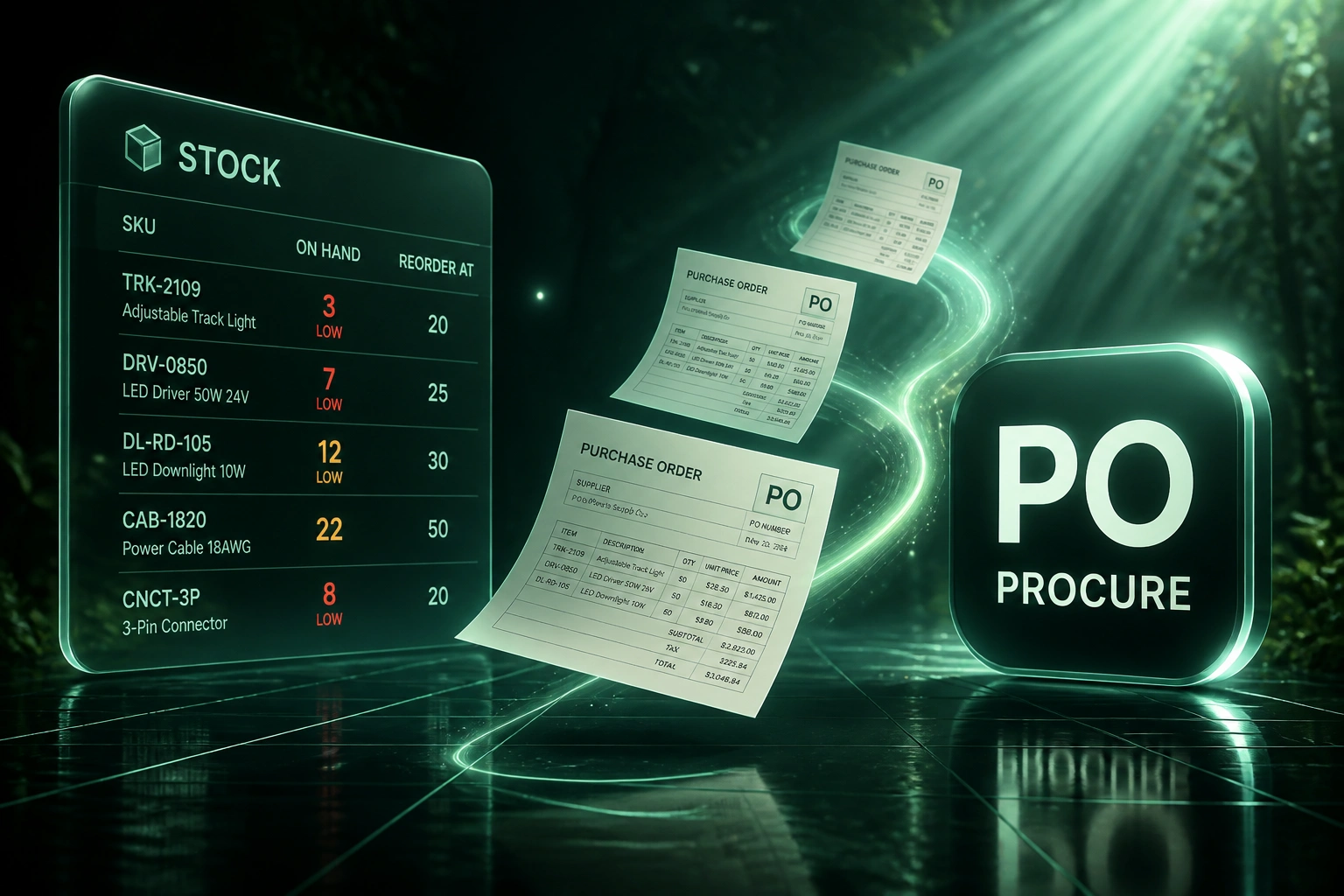
Sound Familiar?
These are the exact issues procurement and ops directors faced before automated PO generation:
- Buyers rebuild purchase orders from Excel reorder reports every Monday morning
- Stock hits the threshold on Tuesday, but the PO only goes out after Friday approvals
- Wrong supplier, quantity, or unit price slips into 1–4% of manually keyed line items
- Multi-warehouse reordering means three spreadsheets and three sets of buyer judgement
- Supplier MOQs and lead times change, and nobody recalculates before the next stockout
Supplier lead times and MOQs are stretching while buyer headcount is flat. Manual PO generation from weekly reorder reports cannot keep pace with multi-warehouse demand. Every day of delay on an A-SKU compounds stockout risk that already sits near an 8% industry average.
What Purchase Order Automation Actually Does
Stock hits threshold → PO generated → approved → sent to supplier. No Monday Excel rebuild.
Stock Hits Threshold
Available qty crosses the reorder point for a SKU at a warehouse or DC
PO Generated
Supplier, quantity (MOQ-aware), unit price, and delivery date pre-filled as a draft
Routed for Approval
Buyer or procurement manager reviews, edits if needed, and approves
Sent to Supplier
Email or EDI to the supplier; acknowledgement syncs back into your ERP
Everything You Need for Automated Procurement
Threshold-Triggered PO Generation
When available stock hits the reorder point, a purchase order is generated with preferred supplier, suggested qty, unit price, and expected delivery date already filled.
Approval Routing
Draft POs route to the right buyer or procurement manager by value band, warehouse, or category. Approvers get Slack, Teams, email, or WhatsApp with one-click approve or edit.
Supplier Send (Email / EDI)
Once approved, the PO emails the supplier or posts via EDI / supplier portal. Acknowledgements write back so buyers are not chasing confirmations in inboxes.
MOQ & Lead-Time Rules
Order quantities honour supplier MOQs, pack sizes, and current lead times so buyers are not reworking every automated draft by hand.
Multi-Warehouse Procurement
Each DC or warehouse keeps its own thresholds and preferred suppliers. Inter-warehouse transfer suggestions appear before a new PO is raised when stock exists elsewhere.
ERP Sync & Audit Trail
Approved POs land in Sage, Xero, NetSuite, or your ERP with a full log of who approved what, when stock triggered it, and when the supplier was notified.
Systems We've Wired for PO Generation
From 16 Hours/Week to 2 Hours/Week
How a Johannesburg electrical distributor stopped rebuilding POs from Excel and cut A-SKU stockouts in half.
The Manual Process
- Two buyers spent Monday mornings rebuilding POs from warehouse reorder reports
- ~10 minutes per PO across 80+ lines a week: supplier lookup, MOQ, price check
- Approvals sat in email for 2–4 days; lead-time SKUs often stocked out first
- 1–4% of keyed line items needed correction after supplier confirmation
- Three warehouses meant three spreadsheets and inconsistent judgement
The Automated Process
- Stock threshold → draft PO with supplier, qty, and price within minutes
- Buyers approve or edit on mobile; no spreadsheet rebuild
- Approved POs email or EDI to suppliers the same day
- Line-item errors dropped because prices and MOQs pull from the supplier master
- Each warehouse keeps its own thresholds with transfer suggestions first
Before vs After Purchase Order Automation
How It Works
From first conversation to live automated procurement in 2–4 weeks.
Tell Us Your Setup
Which stock and purchasing systems, how buyers build POs today, and which A-SKUs hurt most when reordering lags.
Free Scoping Call
30-minute call to map thresholds, supplier rules, approval bands, and how POs should reach suppliers.
Build & Test
We wire stock thresholds to draft POs, run parallel for a week, and validate quantities, prices, and approval routing.
Go Live & Monitor
Switch off the Monday Excel ritual. Monitoring keeps MOQs, lead times, and thresholds honest as suppliers change.
Frequently Asked Questions
How long does purchase order automation take to set up?
A focused A-SKU pilot with threshold-triggered draft POs and email approval usually takes 2–4 weeks from scoping to go-live. Multi-warehouse rules, MOQ logic, EDI supplier send, and ERP write-back typically take 4–6 weeks.
Which inventory and purchasing systems can you connect?
We have built purchase order automation against Sage, Xero, NetSuite, Shopify, WooCommerce, Takealot seller stock, and custom ERP or WMS databases. If available stock, supplier records, and price lists are accessible, we can generate ready-to-approve POs.
Will buyers still approve every purchase order?
Yes, unless you choose auto-release for low-value catalogue POs within policy. The default is draft generation plus approval routing. Buyers keep control of quantity, supplier, and price; they stop rebuilding the PO from a spreadsheet every Monday.
How is this different from reorder point alerts?
Alerts tell someone to act. Purchase order automation generates the PO with supplier, quantity, and price, routes it for approval, then emails or EDI-sends it to the supplier. Alerts alone still leave hours of buyer admin on the table.
How do you handle MOQs, pack sizes, and multi-warehouse stock?
During setup we encode supplier MOQs, pack multiples, and preferred lead times into the quantity suggestion. Where stock exists at another warehouse, we can suggest a transfer before raising a new PO, so you do not buy what you already own.
How much does purchase order automation cost?
Threshold-to-draft PO setups for a focused SKU set start from around R15,000. Full automated procurement with approval routing, supplier email or EDI, multi-warehouse rules, and ERP sync typically ranges from R25,000 to R60,000. Teams issuing 40+ POs a week usually see payback within 1–3 months from buyer hours and avoided stockouts alone.
Stop Building Purchase Orders from Spreadsheets
If your buyers are still turning reorder reports into POs by hand, you are paying for delayed replenishment and admin hours that automated procurement already solves.
Tell us which stock and purchasing systems you run, how many POs you issue a week, and where stockouts hurt most. We will show you exactly how threshold-triggered PO generation would work for your warehouses.