Set Up Recurring Card Payments With Tokenised Billing
If you still email invoice links every month or type card numbers into a gateway by hand, you are leaving renewals to chance. Cards expire, emails go unread, and members who meant to stay quietly disappear.
We build the card tokenisation setup that charges reliably, month after month.
Sound Familiar?
These are the exact issues our clients faced before proper card-on-file setup:
- You email a fresh invoice link every month because card details were never stored safely
- Finance re-enters cards over the phone when a member says "just charge me again"
- Renewals fail when cards expire, and nobody notices until the member complains
- Revenue swings month to month because collection depends on who opens the email
- Storing raw card numbers in a spreadsheet or CRM field puts you in full PCI scope
Storing raw card numbers is a PCI and POPIA risk. Merchants who touch cardholder data land on SAQ D (360+ controls). Hosted tokenisation keeps you on SAQ A (about 22). UK SME benchmarks put that gap at roughly R176,000–R330,000 versus R880,000–R2 million a year in compliance effort, before you count breach exposure.
What Tokenised Recurring Billing Actually Does
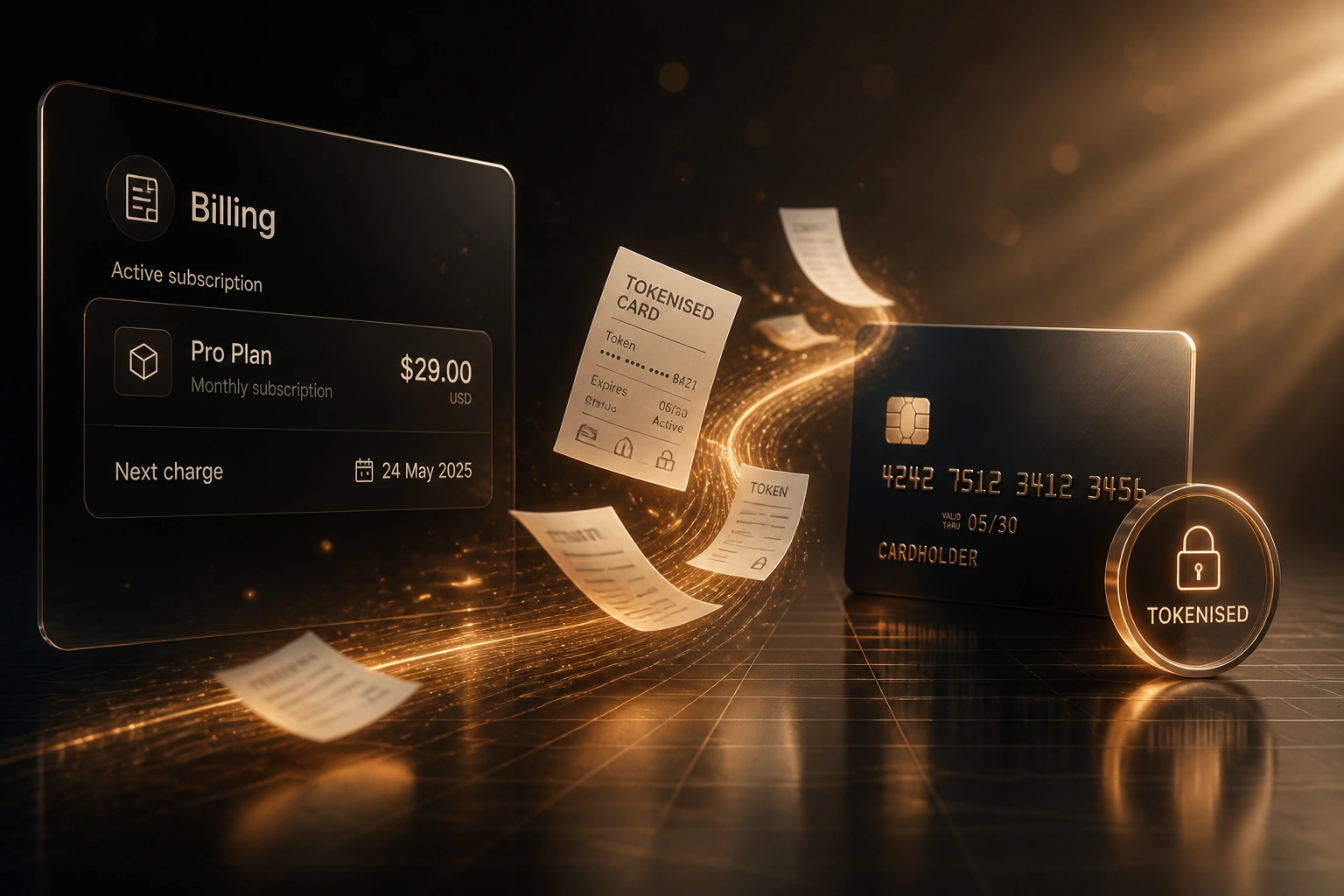
Member saves a card once → gateway returns a token → renewals charge on schedule. No retyping, no emailed links.
Secure Card Capture
Member enters details on a hosted field or page. Your app never sees the PAN.
Token Stored
Gateway vaults the card and returns a token your billing system keeps on file.
Scheduled Charge
On renewal day the token is charged automatically for the plan amount.
Access Unlocked
Success keeps the membership active. Soft declines alert ops before churn.
Everything You Need for Reliable Card-on-File Billing
Tokenised Card Capture
Members enter card details once on a hosted field or page. Your systems never see the PAN. The gateway returns a token you charge month after month.
Scheduled Recurring Charges
Billing runs on the plan cadence you define: monthly, quarterly, or annual. Next charge date, amount, and status live in one place.
PCI Scope Reduction
Proper tokenisation keeps raw card data off your servers, so you stay on a light SAQ A path instead of the full SAQ D questionnaire.
Failed Renewal Alerts
Soft declines surface before the membership lapses. Your team (or a light retry) recovers the charge while the member still intends to stay.
Card-on-File Lifecycle
Expired or reissued cards update through network tokenisation where the gateway supports it, so renewals keep authorising without a support call.
Membership & CRM Sync
Successful charges unlock access in your app or membership system. Failed ones pause entitlements and notify ops, without spreadsheet gymnastics.
Gateways We've Wired for Recurring Card-on-File
From Emailed Invoice Links to Predictable Renewals
How a Cape Town membership brand recovering R85,000 MRR cut involuntary churn from 9% to under 2% with tokenised card-on-file billing.
The Manual Process
- Ops emailed a PayFast pay-now link to every member on renewal day
- Roughly one in ten cards failed when members did re-enter details
- About R7,650 of MRR slipped each month to unpaid renewals
- Card numbers sometimes lived in a shared inbox or CRM note
- Finance spent Friday afternoons chasing "I thought I paid" replies
The Tokenised Process
- Members save a card once on a hosted Peach field at signup
- Renewals charge the token on schedule with no email step
- Failed soft declines alert ops the same day for a retry
- Raw PANs never touch the membership app or CRM
- Network token updates keep many reissued cards working
Before vs After Tokenised Recurring Setup
How It Works
From first conversation to live tokenised billing in 2–4 weeks.
Map How You Collect Today
Invoice links, phone capture, which gateway, how many renewals fail, and where card data currently lives.
Free Scoping Call
30-minute call to design the tokenisation path, plan catalogue, and PCI-safe capture flow for your stack.
Build & Parallel Run
We wire hosted capture, tokens, and scheduled charges, then run one billing cycle alongside your current process.
Go Live & Monitor
Switch off emailed invoice links for renewals. Monitoring catches failed charges before they become churn.
Frequently Asked Questions
What is tokenised recurring card payment setup?
It is the first-time architecture that lets a customer save a card securely once, then lets you charge that card on a schedule without storing the real card number yourself. The payment gateway holds the sensitive data and gives you a token. That is different from dunning (recovering failed charges later) or a payment-method update flow (when a member changes their card).
How is this different from subscription payment management or dunning?
This page is about getting card-on-file billing right from day one: capture, tokenisation, scheduling, and PCI scope. Subscription payment management is about unifying status across multiple gateways once you already collect. Dunning and recovery pages cover what happens after a charge fails. Many businesses need the setup first, then recovery and multi-provider views as they grow.
Which South African gateways support recurring card-on-file?
We regularly set up tokenised recurring billing on PayFast and Peach Payments for SA-domiciled merchants. Stripe works well when you have an eligible entity for international cards. Typical card fees sit around 3.2% + R2 on PayFast Aggregation and about 2.95% + R1.50 on Peach Growth, with volume pricing available as you scale.
Does tokenisation really reduce PCI scope?
Yes, when capture is fully outsourced through hosted pages or hosted fields so your servers never store, process, or transmit the PAN. Merchants in that posture complete SAQ A (about 22 controls). Merchants who touch cardholder data fall into SAQ D (360+ controls). UK SME benchmarks put SAQ A compliance in the R176,000–R330,000 range per year versus R880,000–R2 million for SAQ D (converted from £8–15k and £40–90k at roughly R22/£). Architecture is what decides which path you are on.
Will members still need to re-enter their card every month?
No. After the first successful tokenised capture, renewals charge the stored token on schedule. Where the gateway supports network tokens or account updater, expired or reissued cards often keep working without the member doing anything. That is the point of setting this up properly once.
How much does recurring card payment setup cost?
A focused tokenised capture and scheduled billing integration typically starts around R25,000. Setups with plan catalogues, membership entitlements, failed-charge alerts, and CRM or accounting sync usually range from R40,000 to R75,000. Most clients losing even a few renewals a month to emailed invoice links see payback inside one to two billing cycles.
Stop Losing Members to Failed Card Charges
If renewals still depend on emailed links or retyped cards, you are funding involuntary churn and carrying unnecessary PCI risk.
Tell us which gateway you use, how members pay today, and how many renewals fail each month. We will show you exactly how tokenised card-on-file billing would work for your business.