Retainer Hours Tracking and Billing: Live Balances Before Hours Run Out
Account directors discover retainer hours are exhausted only after the client complains, or give away free work because prepaid balances were invisible. Spreadsheet retainer tracking cannot keep pace with daily time logs.
We build live hour balances and low-hour alerts that protect margin and the relationship.
Sound Familiar?
These are the exact issues account and ops leads faced before live retainer hours tracking:
- Account leads discover a retainer is exhausted only after the client asks why work stopped mid-month
- Hours burn in Harvest or Clockify while the prepaid balance lives in a spreadsheet nobody opens until invoice day
- Teams keep delivering past the hour block and write off the overage rather than raise an awkward invoice
- Low-hour warnings never fire, so top-up conversations start after capacity is already gone
- Finance and ops argue about remaining hours because each keeps a different version of the balance
PMI's 2024 Pulse of the Profession found 37% of professional services projects hit scope creep that was only flagged at billing review, after the hours were already gone. Prepaid and hour-block retainers face the same lag unless balances deplete in real time.
What Retainer Hours Tracking Actually Does
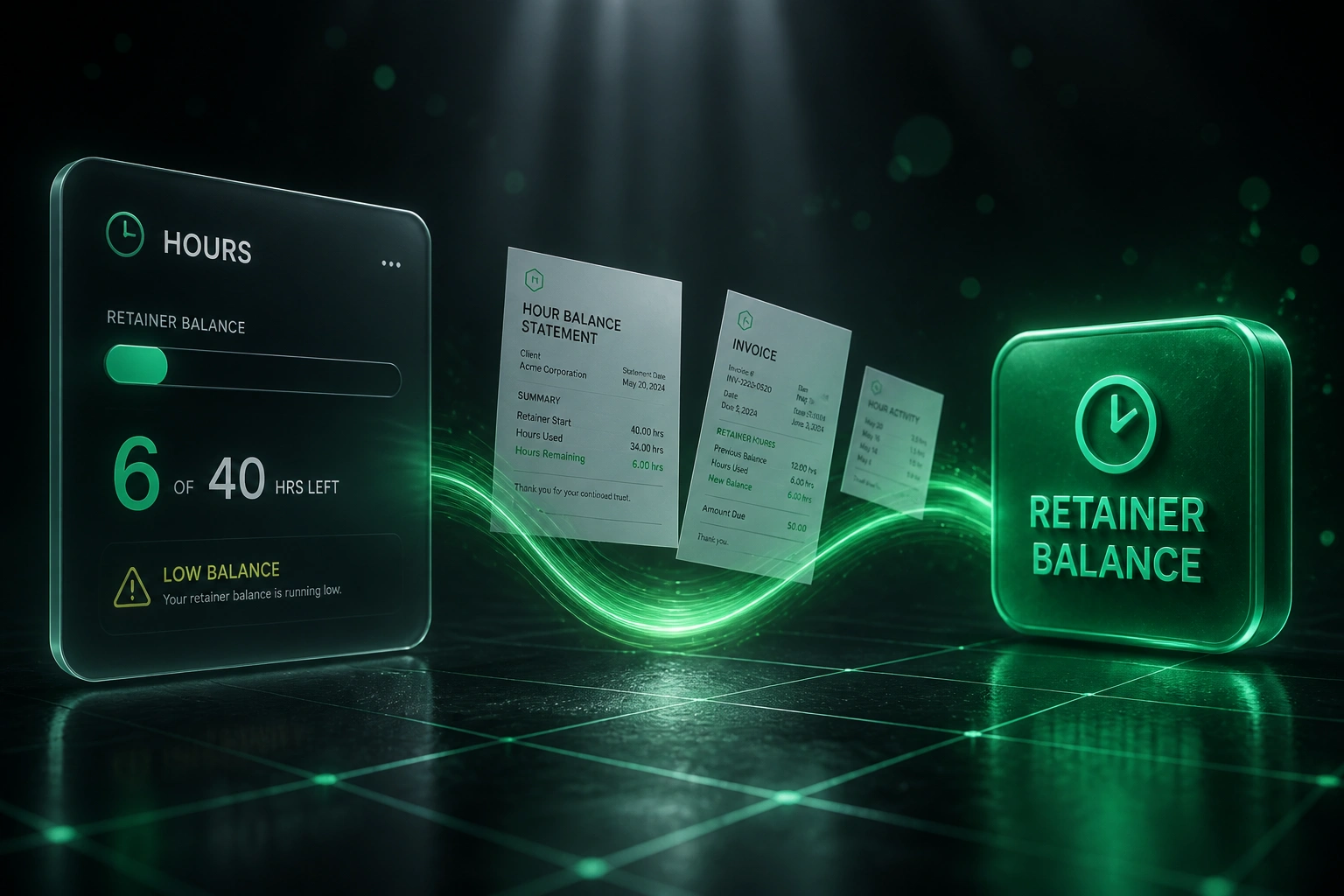
Hours log → balance depletes → low-hour alert → top-up or overage, before service stalls mid-month.
Hours Logged
Consultants stop timers in Harvest, Clockify, or Toggl against the retainer project
Balance Depletes
Purchased hours reduce live; remaining balance and burn rate update for ops
Low-Hour Alert
At 80% consumed, the account lead gets hours left and a prompt to talk scope
Top-Up or Overage
Approved top-up or overage draft protects margin without a surprise invoice fight
Everything You Need for Retainer Billing Management
Live Retainer Hour Balances
Every logged hour depletes the purchased block in real time. Account directors see hours used, hours remaining, and burn rate without rebuilding a sheet.
Low-Hour Threshold Alerts
When a client crosses 75% or 80% of their bank, Slack, email, or Teams warns the account lead with hours left and days remaining in the period.
Top-Up and Overage Triggers
At or beyond the cap, the system drafts a top-up quote or overage invoice line at the contracted rate, ready for approval before more work ships.
Prepaid Block Depletion Ledger
Opening balance, draws, remaining hours, and rollover rules stay in one ledger so prepaid packages never go dark between billing cycles.
Client Balance Statements
Share a clear hour-balance statement mid-cycle so clients see usage before a surprise invoice, which protects renewals and trust.
Write-Off Prevention Rules
Pause non-essential work, require overage approval, or escalate to the managing partner before free hours quietly eat the month's margin.
Platforms We've Wired for Retainer Hours Tracking
From 54 Hours/Month to 2 Hours/Month
How a 14-retainer Johannesburg digital agency stopped writing off exhausted hour blocks and started topping up before work stalled.
The Spreadsheet Chase
- Account managers reconciled Harvest exports against a shared balance sheet once a month
- Roughly 4.5 hours per retainer, about 54 hours across the book, every billing cycle
- Overages surfaced 25 to 30 days late, after capacity was already burned
- Unbilled overage sat near 9% of retainer revenue; most hours were written off to keep the peace
- Clients complained when work paused without warning that the bank was empty
Live Depletion and Alerts
- Every timer stop depletes the purchased block; remaining hours are always current
- 80% alerts hit Slack with hours left so account leads open the top-up conversation early
- Month-end review dropped to about 2 hours across all 14 retainers
- Unbilled overage fell toward 2.5% as approved overages and top-ups replaced write-offs
- Clients receive mid-cycle balance statements before any surprise invoice
Before vs After Live Retainer Tracking
How It Works
From first conversation to live hour balances in 2–4 weeks.
Map Your Hour Banks
Tell us which time tracker you use, how prepaid blocks and monthly retainers are structured, and where balances go dark.
Set Alert and Billing Rules
30-minute call to define 75%/80%/100% thresholds, overage rates, top-up flows, and who gets notified when hours run low.
Build and Validate
We wire time entries to live balances, test with your real retainer book, and run parallel for a cycle so every alert matches your contracts.
Go Live and Monitor
Switch off the spreadsheet chase. Monitoring keeps depletion accurate, with exception handling for paused or disputed retainers.
Frequently Asked Questions
How is this different from monthly retainer invoicing?
Monthly retainer billing automation creates the recurring invoice. Retainer hours tracking watches the prepaid or monthly hour block deplete in real time, alerts when hours run low, and triggers top-up or overage billing so service is not interrupted mid-month. Many agencies need both: day-1 invoicing plus live balance visibility.
Which time trackers and tools can feed live retainer balances?
We have connected Harvest, Clockify, Toggl Track, Productive, and Float for hour draws, with alerts into Slack or Teams and optional invoice drafts in Xero or QuickBooks. Client and agreement context can pull from HubSpot or Pipedrive. If your stack has an API, we can connect it.
When should low-hour alerts fire?
Best practice is a warning at 75% or 80% of the bank while there is still time to pause non-essential work, approve a top-up, or agree overage rates. A second alert at 100% stops silent giveaways. Alerting only at month-end is too late: the hours are already spent.
Can different clients have different hour blocks and overage rules?
Yes. Each agreement carries its own purchased hours, period, rollover policy, overage rate, and alert recipients. A 20-hour prepaid package and a 40-hour monthly retainer can run side by side with the correct depletion and billing rules applied per client.
How long does setup take?
A standard retainer hours tracking build takes 2 to 4 weeks from scoping to go-live. Simple one-way depletion with Slack alerts can be live within 2 weeks. Portfolios with mixed prepaid packages, rollover, and automated overage drafts take 4 to 6 weeks. We always run a parallel cycle before switching off spreadsheets.
What does this cost and when do we see ROI?
Simple balance sync and low-hour alerts start from around R15,000. Full depletion ledgers with top-up triggers, client statements, and overage drafts typically range from R25,000 to R60,000. Agencies with 10 or more active hour-bank retainers usually see full ROI within 8 to 12 weeks from recovered overages and staff time alone.
Stop Discovering Empty Retainers After the Client Calls
If your team still learns a prepaid block is empty from a complaint or a write-off, you are paying for a visibility problem that live balances already solve.
Tell us which time tracker you use, how your hour blocks are sold, and where balances go dark. We will show you exactly how retainer hours tracking and low-hour alerts would work for your book.