Revenue Leakage Prevention in Time Billing: Catch the Money Before It Leaves
Unbilled hours, wrong rate cards, and forgotten expenses are already on your books as work delivered. Firms that only reconcile at month-end discover the gap too late to recover it. Billing accuracy is not a spreadsheet problem; it is an unbilled revenue detection problem.
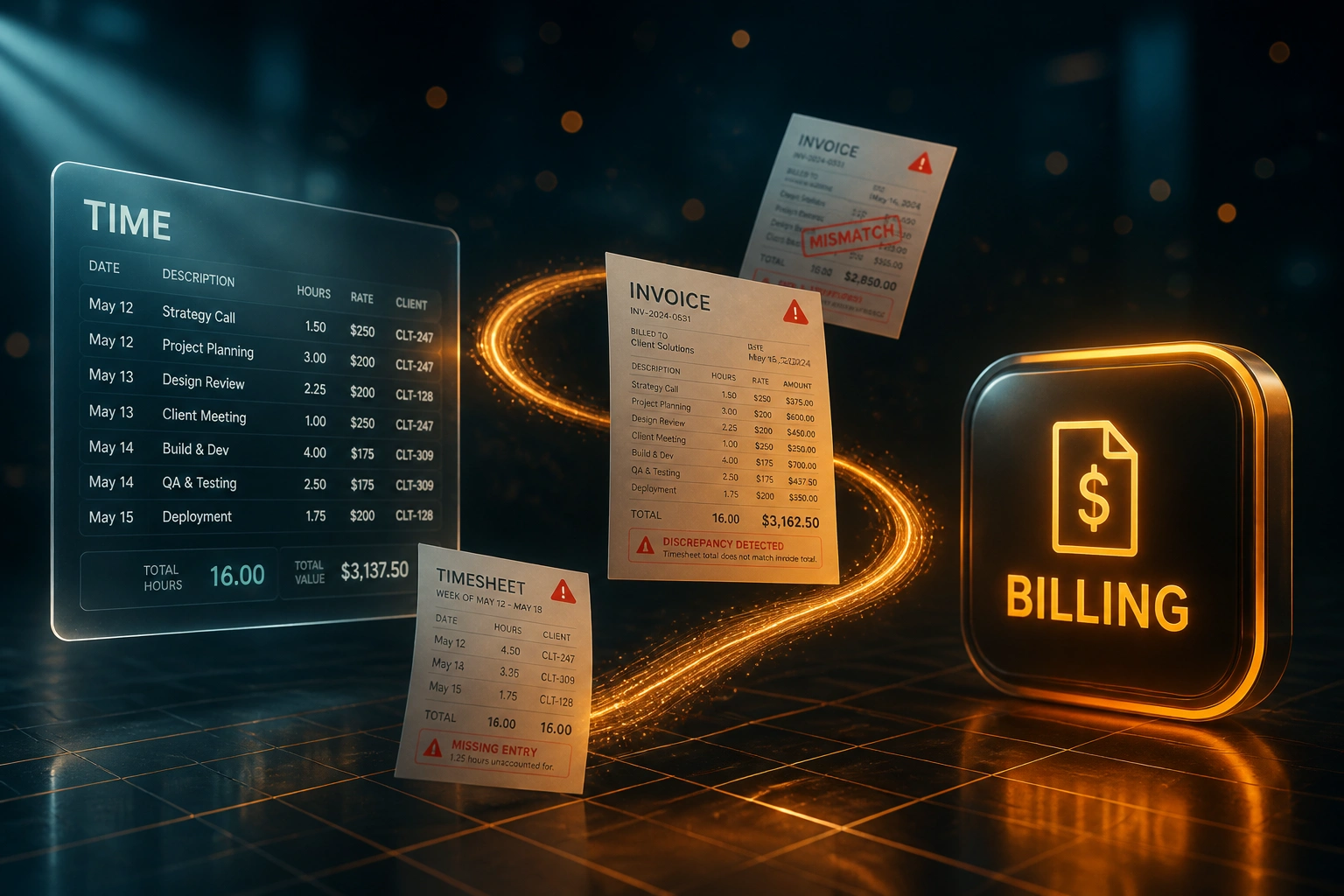
We build automated discrepancy checks between tracked time and issued invoices.
Sound Familiar?
These are the exact patterns we see when CEOs and finance leads suspect billing accuracy has slipped:
- Approved hours sit in Harvest or Clockify while invoices go out without them, and nobody notices until the WIP report ages past 60 days
- Rate cards live in a spreadsheet that was last updated two clients ago, so senior work bills at junior rates
- Expenses and disbursements never make the invoice pack because they live in a separate inbox
- Finance only reconciles timesheets to invoices at month-end, when the client relationship window to recover fees has already closed
- Partners write down lines on the draft invoice with no flag that tracked time and billed time no longer match
Month-end reconciliation is too late. Industry research puts average professional services leakage at roughly 4.5% of revenue, and weak billing controls push that closer to 10%. On a R20M practice, that is R900,000 to R2M already earned and never collected. Waiting until the books close means most of it is already written off.
What Revenue Leakage Detection Actually Does
Tracked time and expenses are compared to issued invoices continuously, so mismatches surface while fees are still recoverable.
Hours & Expenses Approved
Consultants log time and costs in Harvest, Toggl, Clockify, or your PSA; managers approve as usual
Invoices Issued
Finance sends bills from Xero, Sage, or QuickBooks on your normal cycle
Discrepancy Checks Run
Automated rules compare tracked time, rate cards, and expenses to invoice lines
Exceptions Reach Finance
Unbilled hours, wrong rates, and missing expenses land in a review queue while recovery is still possible
Everything You Need for Billing Accuracy Checks
Timesheet-to-Invoice Discrepancy Checks
Every billing cycle, automated checks compare approved tracked time against issued invoices and flag hours that never made a line item.
Rate Card Validation
Invoice rates are checked against the living rate card for role, client, and project. Wrong rates surface before the bill leaves, not after the client pays.
Unbilled Hours Alerts
Approved billable time that has sat past your WIP threshold triggers a finance or partner alert while recovery is still realistic.
Forgotten Expense Detection
Logged expenses and disbursements that never appear on an invoice get flagged so travel, software, and third-party costs stop leaking.
Realisation Gap Reporting
See billed value versus logged billable value by client, matter, and owner so write-downs and silent concessions stop hiding in averages.
Exception-Only Review Queue
Clean matches pass quietly. Your team only reviews mismatches: missing hours, wrong rates, orphaned expenses, and capped retainers.
Systems We've Connected for Leakage Detection
From Month-End Write-Offs to Continuous Recovery
How a 24-person Cape Town consultancy recovered R840,000 in year one by catching unbilled hours and wrong rates before the books closed.
Month-End Archaeology
- Finance reconciled Harvest exports to Xero invoices once a month, after most bills had already gone out
- Average R70,000 per month in approved hours never appeared on any invoice
- Senior rates were still applied as junior rates on three long-running retainers
- Travel and software expenses sat in email folders and were written off rather than re-billed
- Realisation sat at 71%, well below the top-quartile 85%+ benchmark
Continuous Discrepancy Checks
- Nightly checks compare approved time and expenses to Xero invoice lines
- Unbilled hours and rate mismatches alert finance within 24 hours, not 30 days
- Rate card validation stopped the junior-rate bleed on retainers in the first cycle
- Expense flags recovered disbursements that used to vanish into write-offs
- Partners review an exception queue instead of rebuilding the WIP report from scratch
Before vs After Leakage Detection
How It Works
From first conversation to live discrepancy checks in 2 to 4 weeks.
Tell Us Where Revenue Leaks
Which time tracker, which ledger, how rate cards are maintained, and where month-end surprises usually appear.
Free Scoping Call
30-minute call to map discrepancy rules, WIP ageing thresholds, rate-card sources, and who should receive leakage alerts.
Build & Test
We wire the checks, run them against recent billing cycles, and show finance every flag against the invoices you already issued.
Go Live & Monitor
Switch from month-end archaeology to continuous detection. Monitoring keeps thresholds tight as your rate cards and clients change.
Frequently Asked Questions
How is revenue leakage prevention different from time-to-invoice automation?
Time-to-invoice automation creates invoices from approved hours. Revenue leakage prevention sits beside that path: it compares what was tracked to what was actually billed, and flags unbilled hours, wrong rates, and forgotten expenses. Many firms need both. Automation moves hours onto invoices; discrepancy checks catch the money that still slips through.
What kinds of discrepancies do you detect?
Typical flags include approved billable hours with no matching invoice line, invoice rates that do not match the contracted rate card, expenses logged but never billed, write-downs that drop realisation without a reason code, and WIP that ages past your recovery window. Rules are tuned to your billing model during setup.
Which time trackers and accounting systems can you connect?
We regularly connect Harvest, Toggl Track, Clockify, Float, and Productive into Xero, Sage Business Cloud, Sage Evolution, and QuickBooks Online. If your PSA or ledger has an API, we can usually bridge it. Alerts can land in Slack, Teams, or email.
Will consultants have to change how they log time?
No. Teams keep logging time the way they already do. Detection runs after approval and after invoices are drafted or sent. Finance and partners review exception queues; consultants are only pulled in when a missing entry or rate question needs a human answer.
How long does setup take?
A standard discrepancy-check build takes 2 to 4 weeks from scoping to go-live. Simple unbilled-hours alerts against one ledger can be live within 2 weeks. Multi-rate cards, multi-entity ledgers, and expense recovery checks usually sit closer to 4 to 6 weeks. We always validate against recent billing cycles before switching on live alerts.
How much does this cost and when do we see ROI?
Simple unbilled-hours and rate-mismatch checks start from around R15,000. Full leakage prevention with rate-card validation, expense detection, realisation reporting, and alert routing typically ranges from R25,000 to R60,000. Practices leaking even 2% of a R15M book often recover the build cost in the first billing cycle once flags start catching fees that would otherwise be written off.
Stop Discovering Unbilled Revenue After It Is Gone
If your finance team only reconciles timesheets to invoices at month-end, you are finding leakage after the recovery window has closed.
Tell us which time tracker and ledger you use, how rate cards are maintained, and where write-offs usually hide. We will show you exactly which discrepancy checks would catch fees before they leave the building.