Invoice Compliance for South African Small Businesses: Get the SARS Fields Right
Small businesses in South Africa often miss mandatory invoice fields required by SARS. One missing field can void a buyer's VAT input claim, delay your payment, and leave you exposed when verification letters arrive.
We automate the SA invoice requirements checklist from the CRM and accounting tools you already use.
Sound Familiar?
These are the exact issues small-business owners and bookkeepers bring to us:
- You send invoices from Word, Excel, or a basic template and hope the fields are right
- A buyer's bookkeeper returns your invoice because the recipient VAT number or Tax Invoice wording is missing
- Supplier invoices land incomplete, so you cannot claim input tax when you become (or already are) VAT-registered
- The owner or part-time bookkeeper spends evenings fixing invoice errors before every VAT201
- SARS eFiling verification letters arrive asking for invoices you thought were fine
SARS is building multi-year e-invoicing and real-time VAT reporting through 2026–2029. Small businesses that still rely on Word templates and incomplete supplier packs will feel the pressure first when structured invoice data becomes the default audit trail.
From Deal to SARS-Ready Invoice
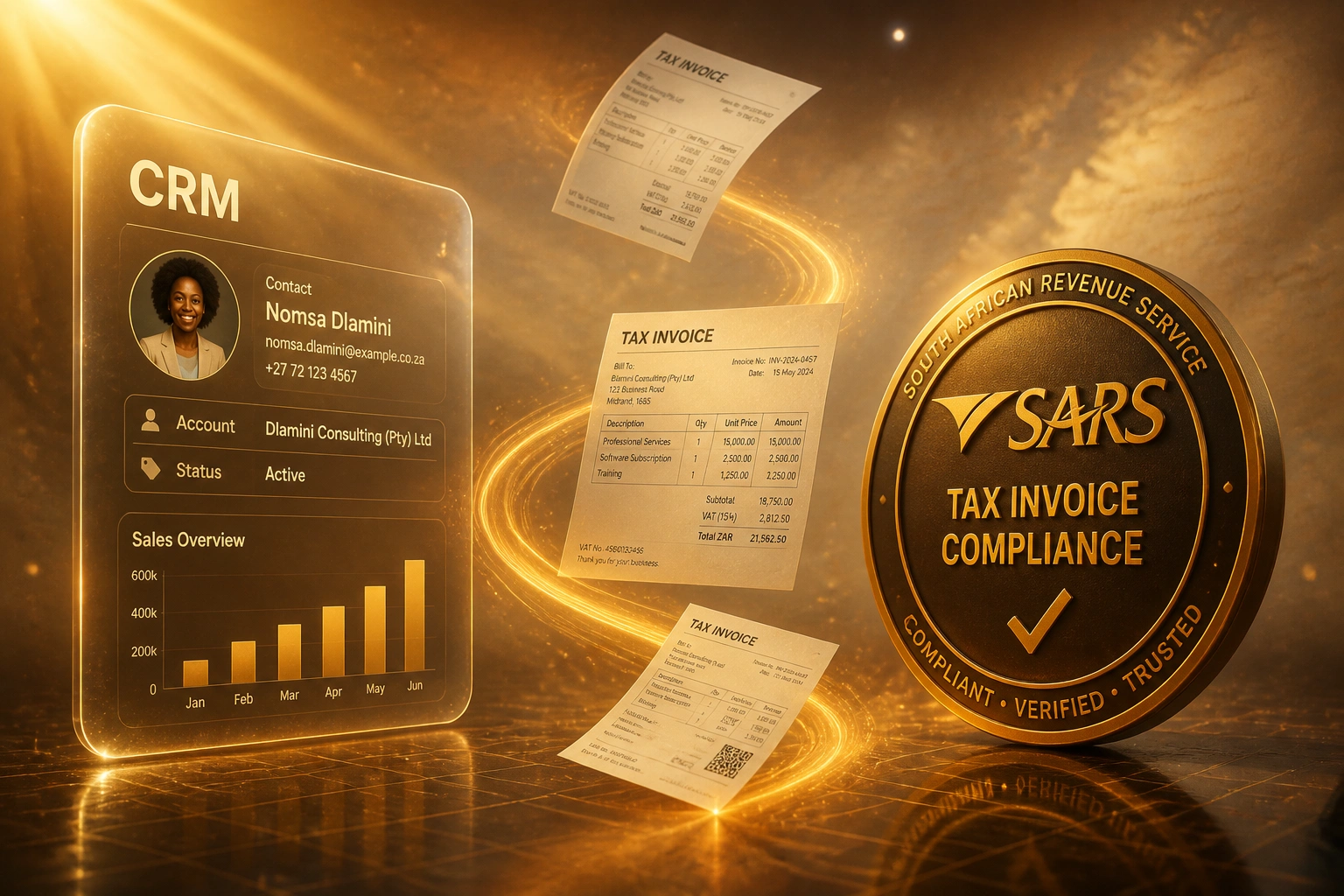
CRM wins the job → checklist fills every mandatory field → accounting issues a compliant tax invoice → supplier invoices are screened before you claim.
Job Closes in CRM
Sales or ops marks the deal won; client name, address, and VAT number are already on the record
Checklist Validates
Section 20 fields are checked: wording, serial, dates, amounts, and full vs abridged rules
Invoice Issued
Xero, Sage, or QuickBooks creates a tax invoice buyers can actually use for input claims
Inbound Guard
Supplier invoices are screened before the VAT201, so incomplete docs never become claimed input
Everything You Need for SARS Invoice Rules
Mandatory Field Checklist
Every draft invoice is checked against Section 20 before it leaves: Tax Invoice wording, supplier name, address, VAT number, serial, date, description, quantity, value, VAT, and total.
Full vs Abridged Logic
Supplies over R5,000 force a full tax invoice with recipient name, address, and VAT number. Smaller supplies use the abridged set. R50 and under follows the till-slip rules.
CRM to Compliant Invoice
Won deals and jobs in HubSpot, Pipedrive, or your CRM become tax invoices in Xero, Sage, or QuickBooks with every SARS field already filled from mapped client data.
Supplier Invoice Guard
Screen inbound supplier invoices before you claim input tax. A missing supplier VAT number or serial never becomes a disallowed claim on the VAT201.
Pre-Send Hold & Alert
Non-compliant drafts are blocked before email. Your bookkeeper gets a short list of missing fields instead of a customer rejection two weeks later.
Audit-Ready Trail
Each validated invoice keeps a pass record: which fields were checked and when. When SARS asks for supporting documents, you already have the pack.
Systems We've Connected for Small-Business Invoicing
From Five Hours of Rework to Under One
How a Cape Town services firm, newly VAT-registered, stopped losing input claims and closed SARS queries without hiring a full-time bookkeeper.
The Manual Process
- Owner copied job details from Pipedrive into Xero, then patched fields from memory
- Roughly one in four outbound invoices came back for missing recipient VAT or Tax Invoice wording
- Supplier invoices were filed as PDFs with no field check before the VAT201
- Two SARS verification letters in six months asked for invoices that failed Section 20
- Part-time bookkeeper spent five hours a week fixing invoice errors and chasing suppliers
The Automated Process
- Won jobs create draft tax invoices in Xero with every mandatory field mapped from the CRM
- Pre-send checklist blocks incomplete drafts before the client ever sees them
- Inbound supplier invoices are screened; gaps go back to the supplier before claim
- Verification responses use the audit trail pack instead of a weekend scramble
- Bookkeeper reviews exceptions only: under one hour a week
Before vs After Automation
How It Works
From first conversation to live compliance checks in 2–4 weeks.
Tell Us How You Invoice
Where invoices are created today, typical values above and below R5,000, and whether you are newly VAT-registered or about to register.
Free Scoping Call
30-minute call to map the Section 20 checklist to your CRM and accounting stack, and decide where validation should block send.
Build & Test
We encode the checklist, connect CRM fields to invoice templates, and test against your real invoices before go-live.
Go Live & Monitor
Only compliant invoices leave the system. Alerts surface edge cases; monitoring keeps the rule set current as SARS modernises.
Frequently Asked Questions
What are the SA invoice requirements for a small business?
Section 20 of the VAT Act sets the particulars. Tax invoices need the words Tax Invoice, VAT Invoice, or Invoice; the supplier's name, address, and VAT number; a serialised number and date; a clear description and quantity; plus the value, the tax charged, and the consideration. For supplies over R5,000 you also need the recipient's name, address, and VAT number if they are a vendor. A tax invoice must be issued within 21 days of the supply. Even if you are not yet VAT-registered, getting these fields right now means you do not rebuild templates the day you register.
What happens if a supplier invoice is missing a mandatory field?
Without a valid tax invoice you cannot claim input tax on that purchase. SARS may disallow the claim during a verification or audit. The shortfall then attracts a 10% late payment penalty plus prescribed interest, and often an understatement penalty. Tax practitioners in South Africa typically charge R5,000 to R25,000+ to resolve a SARS dispute, on top of the VAT you lose.
We are a small business and not yet VAT-registered. Do we still need this?
Yes, if you invoice VAT-registered customers, or if you expect to cross the voluntary or compulsory registration threshold. Buyers need compliant tax invoices to claim their own input tax. Incomplete invoices delay payment, damage trust, and force a scramble when you register. Building the checklist into your CRM and accounting stack now costs less than fixing years of bad templates later.
How is this different from the VAT rate and field deep-dive for larger vendors?
Larger VAT-registered teams often need rate mapping, zero-rated lines, and inbound claim guarding at volume. This page is aimed at small-business owners and bookkeepers: the mandatory field checklist, what a non-compliant supplier invoice costs you, and automating compliant invoice generation from the CRM and accounting tools you already use, without hiring a full-time bookkeeper.
Will the owner or bookkeeper have to become a VAT expert?
No. They keep creating invoices the way they do today. The validation layer checks the mandatory fields automatically and only asks a human when something is missing. You see a short exception list instead of rebuilding every invoice by hand before each VAT201.
How much does small-business invoice compliance automation cost?
A pre-send checklist on one billing or accounting system typically starts from around R15,000. CRM-to-invoice automation with inbound supplier screening usually falls between R25,000 and R55,000. Teams issuing 20+ invoices a month, or facing repeated verification letters, usually see payback within 2–4 months against rework time, lost input claims, and dispute fees.
Stop Losing Claims Over Missing Invoice Fields
If you are still patching invoices by hand, or claiming input tax on supplier documents you have never checked, you are carrying a risk that automation already solves.
Tell us which CRM and accounting tools you use, whether you are newly VAT-registered or heading that way, and where the rework hurts most. We will show you how a Section 20 checklist and CRM-to-invoice flow would work for your business.