Automate Tax Invoice Generation for SARS Compliance
If your team still builds tax invoices in Word, Excel, or a poorly configured accounting pack, you are gambling with every client's ability to claim input VAT. One missing field can invalidate the document under Section 20 of the VAT Act.
We lock the mandatory fields, VAT maths, and PDF format so every invoice is SARS-ready.
Sound Familiar?
These are the issues South African finance leads bring us before we automate tax invoice compliance:
- Tax invoices still leave Word or Excel templates with fields filled by hand
- Recipient VAT numbers and addresses go missing on supplies over R5,000
- Clients call back because they cannot claim input VAT on your invoice
- Finance reworks PDFs after the fact, then reissues under time pressure
- VAT treatment (standard, zero-rated, exempt) depends on whoever typed the line
Without a proper tax invoice, a business cannot deduct input tax. SARS is clear: missing the words Tax Invoice, a VAT registration number, a recipient address on a full invoice, or a correct VAT breakdown can each invalidate the claim. Your clients feel that first, then they call you.
What Tax Invoice Automation Actually Does
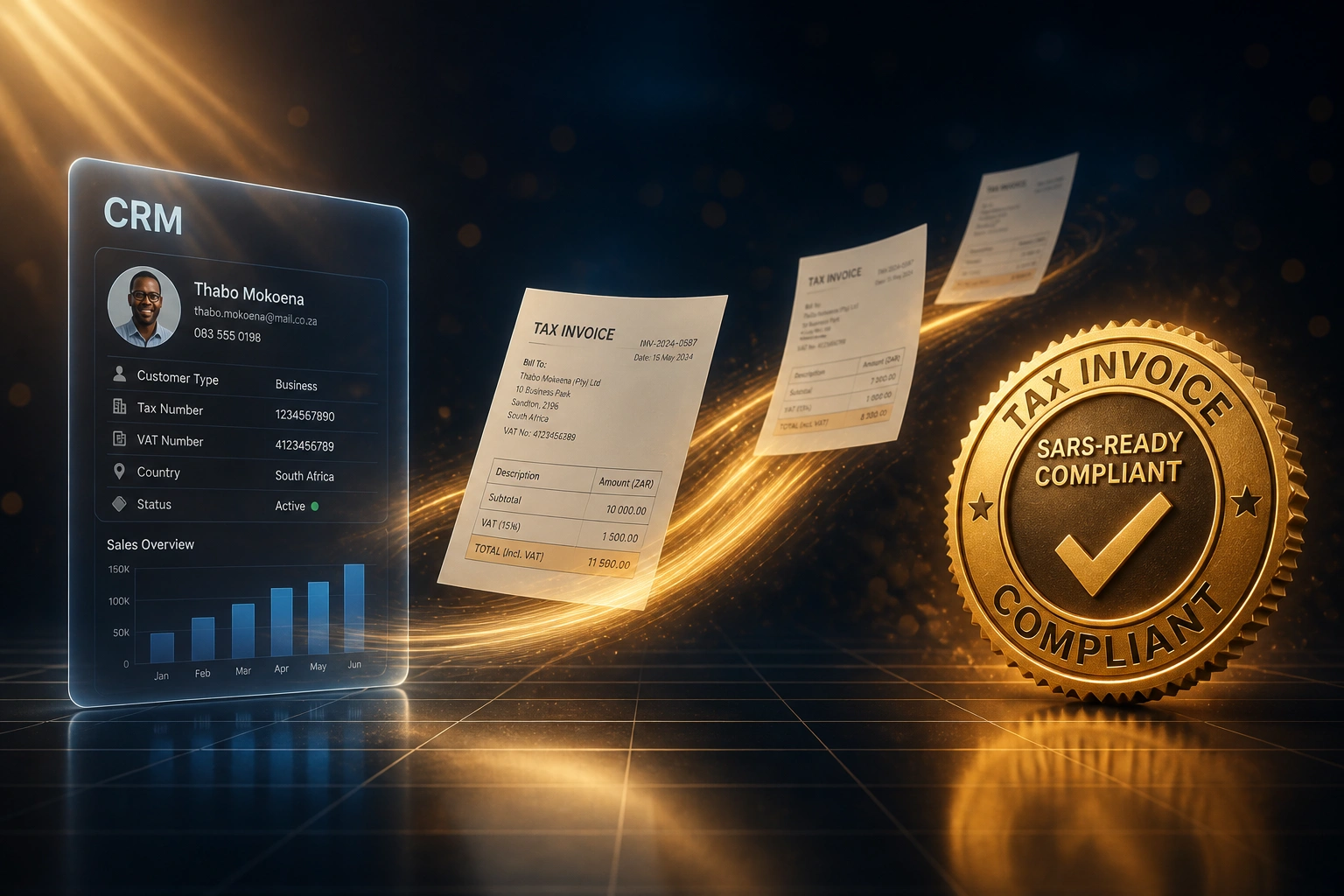
Deal or order confirmed → Section 20 fields locked → VAT calculated → compliant PDF issued. No Word template in the middle.
Trigger from Source
CRM deal closes, order confirms, or billing event fires with client and line data
Lock Section 20 Fields
Supplier and recipient details, VAT numbers, serial, date, description, quantity
Calculate VAT Correctly
15% standard, zero-rated, or exempt mapped per line; value, tax, and total reconcile
Issue Compliant PDF
Draft in accounting, optional approve, then a SARS-ready tax invoice your clients can claim on
Everything You Need for SARS Tax Invoice Compliance
Section 20 Field Lock
Every tax invoice carries the mandatory SARS fields: the words Tax Invoice, supplier and recipient details, VAT numbers where required, serial number, date, description, quantity, and a clear VAT breakdown.
Correct VAT Calculation
Line items map to the right tax treatment at 15% standard, zero-rated, or exempt. The value, tax amount, and consideration always reconcile before the PDF goes out.
Full vs Abridged Rules
Supplies over R5,000 automatically get a full tax invoice with recipient name, address, and VAT number. Smaller supplies use the abridged set without dropping required fields.
CRM to Accounting Sync
Deal or order data feeds Xero, Sage, or QuickBooks so finance stops retyping from Word. Contact VAT numbers and addresses stay the source of truth.
Compliant PDF Formatting
Serialised numbers, ZAR amounts, and layout that survives a SARS audit sample. No more "looks fine in Word" documents that fail on the recipient's VAT201.
Pre-Send Validation
Missing VAT numbers, blank addresses, or wrong tax codes are flagged before the invoice is issued. Your team reviews exceptions, not every line.
Systems We Connect for SA Invoicing
From One in Eight Rejected to Zero Non-Compliant
How a Johannesburg professional services firm stopped Word-based tax invoices and protected their clients' input VAT claims.
The Manual Process
- Bookkeeper copied deal details into a Word tax invoice template
- About 18 minutes per invoice checking VAT numbers, addresses, and 15% maths
- Roughly one in eight invoices missing a recipient VAT number or address on supplies over R5,000
- Clients emailed for corrected invoices before they could claim input VAT
- Average 3 to 5 business days from delivery to a compliant document in the client's hands
The Automated Process
- Closed deal feeds Xero with every Section 20 field locked from CRM data
- Finance reviews a compliant draft and approves in under two minutes
- Full vs abridged rules apply automatically at the R5,000 threshold
- Zero non-compliant tax invoices in the first six months after go-live
- Same-day issue inside the 21-day legal window, every time
Before vs After Tax Invoice Automation
How It Works
From first conversation to live, compliant tax invoices in 2 to 4 weeks.
Show Us Your Invoice Today
Send a sample tax invoice and tell us where it is built: Word, Excel, or a loosely configured accounting pack.
Free Scoping Call
30-minute call to map Section 20 fields, VAT treatments, and the systems that should own each field.
Build & Parallel Test
We lock the compliance rules, generate drafts from live deals, and compare them to your current Word or Excel output.
Go Live & Monitor
Switch off the templates. Validation alerts catch missing fields before clients try to claim input VAT.
Frequently Asked Questions About SA Tax Invoices
What makes a SARS tax invoice valid under Section 20?
A full tax invoice (consideration over R5,000) must show the words Tax Invoice, VAT Invoice, or Invoice; the supplier's name, address, and VAT number; the recipient's name, address, and VAT number where they are a vendor; a unique serial number and issue date; a proper description and quantity; and the value, tax charged, and consideration in rand. Abridged invoices (R5,000 or less) drop the recipient block but keep the other mandatory fields. Without a valid tax invoice, the recipient cannot claim input tax.
How is this different from bulk invoicing automation?
Bulk invoicing is about volume: hundreds of distinct invoices in one run. Tax invoice automation is about compliance: locking every mandatory Section 20 field, VAT calculation, and PDF format so each document is valid for input claims. Many clients need both, but this page addresses the SARS risk first.
Can we keep reviewing invoices before they go out?
Yes. Most finance leads keep a draft-and-approve step. The automation builds a compliant draft in Xero, Sage, or QuickBooks; your team spot-checks exceptions and releases. You stop rebuilding the document from scratch, not oversight.
What happens if we issue a non-compliant tax invoice?
Your customer may be unable to deduct input tax on that supply. During a SARS audit, deficient invoices can reverse claims, add a 10% penalty on the additional VAT payable, interest, and in serious cases understatement penalties. Suppliers also carry risk for issuing documents that fail Section 20. Rework and relationship damage usually start long before the audit letter.
How long does setup take and what does it cost?
A focused tax invoice compliance build takes 2 to 4 weeks from scoping to live. Simple one-way generation from CRM to accounting starts from around R15,000. Setups with full vs abridged rules, multi-rate VAT mapping, PDF template work, and exception alerts typically range from R25,000 to R60,000. Teams raising 40 or more tax invoices a month usually see payback within 2 to 4 months against manual labour and reissue cost.
Which systems can you connect?
We generate compliant tax invoices into Xero, Sage Business Cloud, Sage Pastel, QuickBooks Online, and Zoho Books, fed from HubSpot, Pipedrive, Salesforce, or your billing source. If you still rely on Word or Excel templates, we replace that path rather than patching the template forever.
Stop Gambling With SARS Tax Invoice Fields
If your clients still chase corrected invoices because a VAT number or address was missing, you are spending money on a compliance risk that automation already solves.
Tell us how you raise tax invoices today, which accounting system you use, and where the errors show up. We will show you exactly how Section 20 field lock and VAT automation would work for your business.