Meet South Africa's VAT Invoice Requirements Without the Headache
SARS requires specific fields on every tax invoice, and the penalties for non-compliance are real. Missing a VAT number, the Tax Invoice wording, or recipient details on a supply over R5,000 can block input VAT claims and invite understatement penalties.
We automate the Section 20 checklist so every invoice is validated before it goes out.
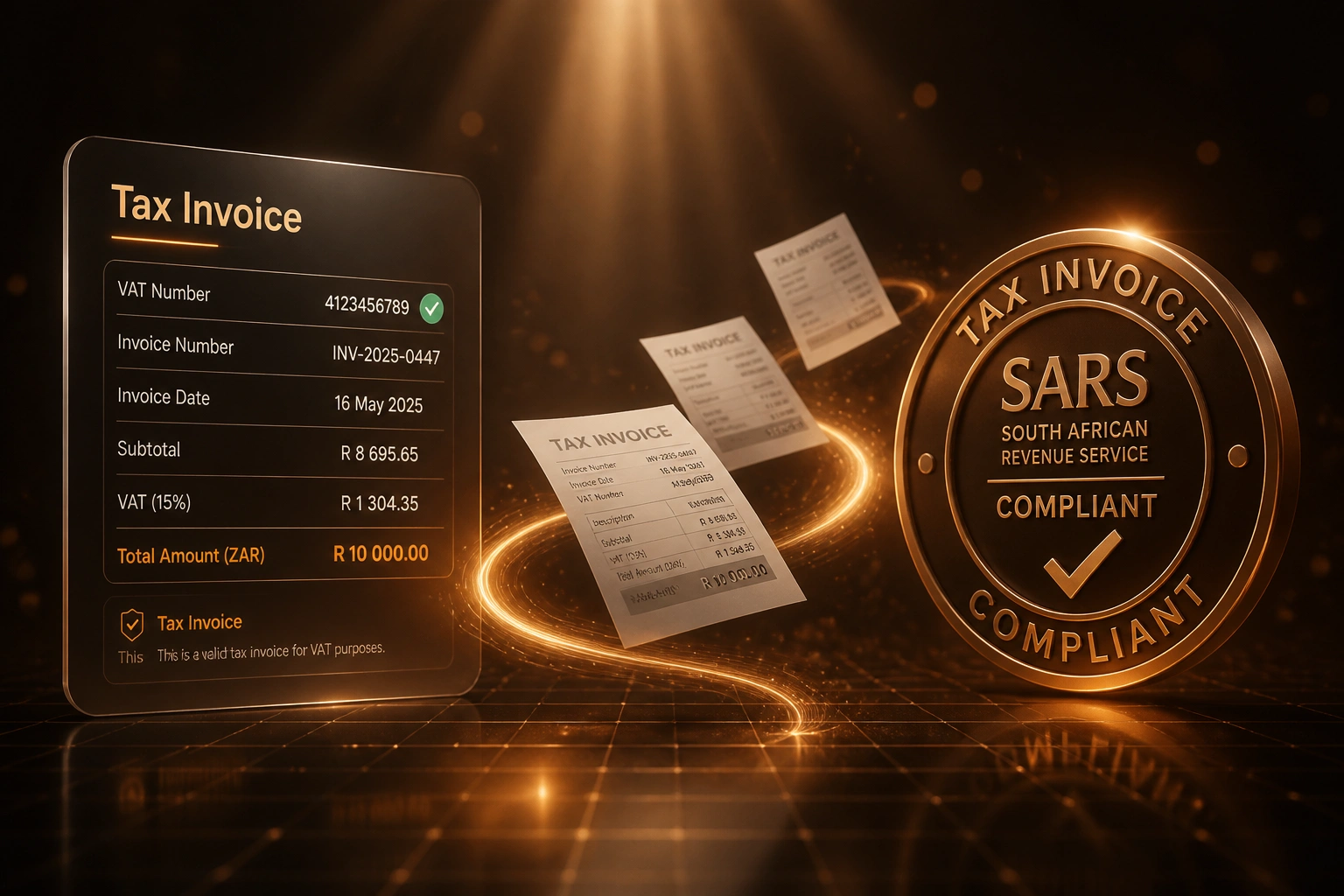
Sound Familiar?
These are the exact issues our clients faced before automated tax invoice validation:
- Tax invoices leave without the words Tax Invoice, VAT Invoice, or Invoice in a prominent place
- Supplier VAT number, address, or serialised invoice number is missing on documents over R50
- Supplies above R5,000 go out as abridged invoices without recipient name, address, and VAT number
- VAT amount is not shown separately at 15%, so customers and SARS treat the document as invalid
- Finance only discovers field gaps when a customer rejects the invoice or SARS opens a verification
SARS Project AmaBillions is driving a surge in VAT audits and verifications toward a reported R70-billion collections target, with hundreds of new enforcement staff already recruited. Incomplete or non-compliant tax invoices remain one of the fastest ways for an input claim to be reversed.
What Tax Invoice Validation Actually Does
Invoice drafted → Section 20 checklist → pass or block → only compliant documents leave.
Invoice Is Drafted
Billing, CRM, or accounting creates a draft tax invoice as usual
Fields Are Checked
Wording, VAT numbers, R5,000 full-invoice rules, amounts, and dates run automatically
Gaps Are Blocked
Missing fields hold the send and list exactly what finance must fix
Compliant Invoice Sent
Only SARS-ready tax invoices leave, with a validation record for audit
Everything You Need for SARS Compliance Checks
Section 20 Field Checklist
Every draft tax invoice is checked against the VAT Act particulars before send: wording, supplier details, serial number, date, description, quantity, value, tax, and consideration.
Full vs Abridged Rules
Consideration above R5,000 forces a full tax invoice with recipient name, address, and VAT number. Smaller supplies use the abridged set. R50 and under follows the till-slip rules.
Pre-Send Block & Alert
Non-compliant drafts are held before email or e-invoicing. Finance gets a clear list of missing fields instead of a customer complaint two weeks later.
15% VAT Split Validation
Value, 15% tax amount, and consideration must reconcile. Zero-rated and exempt lines are flagged so the wrong rate cannot slip through as a standard-rated invoice.
Inbound Claim Guard
The same checklist can screen supplier invoices before you claim input tax on the VAT201, so a missing recipient VAT number never becomes a SARS disallowance.
Audit-Ready Evidence Pack
Each validated invoice keeps a pass record: which fields were checked, when, and by which rule set. When SARS asks for your top five invoices, you already have the trail.
Systems We've Wired for Tax Invoice Validation
From 12% Invoice Returns to Zero Field Failures
How a Cape Town professional services firm stopped SARS field gaps leaving the building and got paid 11 days sooner.
The Manual Checklist
- About 60 tax invoices a month left Xero with spot checks by one bookkeeper
- Roughly one in eight came back: missing recipient VAT number or address on invoices over R5,000
- Customers' accountants rejected documents, delaying payment by 12–18 days
- A SARS verification on a key client asked them to reissue 23 invoices mid-quarter
- Finance spent about 5 hours a week chasing corrections and explaining Section 20 rules
The Automated Checklist
- Every draft tax invoice runs the Section 20 checklist before send
- Full vs abridged logic blocks incomplete invoices over R5,000 automatically
- Zero customer returns for missing Tax Invoice fields in the first 9 months
- Average payment cycle improved by 11 days once rejections stopped
- Finance reviews exceptions only: about 20 minutes a week
Before vs After Tax Invoice Validation
How It Works
From first conversation to live validation in 2–4 weeks.
Tell Us Your Invoice Mix
Where invoices are created, typical values above and below R5,000, and which SARS findings already hurt you.
Free Scoping Call
30-minute call to map Section 20 fields to your template, full vs abridged logic, and where validation should block send.
Build & Test
We encode the checklist, test against real invoices, and run parallel so every gap is caught before go-live.
Go Live & Monitor
Only validated tax invoices leave the system. Alerts surface edge cases; monitoring keeps the rule set current.
Frequently Asked Questions About VAT Invoice Compliance
What must a SARS tax invoice include in South Africa?
Section 20 of the VAT Act sets the particulars. All tax invoices need the words Tax Invoice, VAT Invoice, or Invoice; the supplier's name, address, and VAT number; a serialised number and date; a clear description and quantity; plus the value, the tax charged, and the consideration. For supplies over R5,000 you also need the recipient's name, address, and VAT number if they are a vendor. A tax invoice must be issued within 21 days of the supply.
What happens if a tax invoice is missing a mandatory field?
SARS can disallow the related input tax claim entirely. The vendor then faces the additional VAT payable, a 10% late payment penalty on the outstanding amount, prescribed interest, and often an understatement penalty under section 223 of the Tax Administration Act: 10% for a substantial understatement in a standard case, 25% where reasonable care was not taken, rising as high as 200% for intentional evasion.
Does this only check outbound invoices, or supplier invoices too?
The core build validates every tax invoice before it leaves your billing or accounting system. Most clients also run the same checklist on supplier invoices before claiming input tax on the VAT201, because SARS verifications routinely sample the largest input claims and disallow incomplete documents.
How is this different from mapping VAT rates in a CRM sync?
Rate mapping gets the 15%, zero-rated, or exempt treatment onto the right line. This page is about field compliance: confirming the document itself meets Section 20 before anyone can send or claim on it. Both matter. Validation is what stops a correctly rated invoice from still failing because the recipient VAT number or Tax Invoice wording is missing.
Will sales or ops have to become VAT experts?
No. They keep creating invoices the way they do today. The validation layer checks the mandatory fields automatically and only asks a human when something is missing. Finance sees a short exception list instead of rebuilding every invoice by hand.
How much does SARS tax invoice validation automation cost?
A pre-send checklist on one billing or accounting system typically starts from around R18,000. Full outbound plus inbound claim guarding with custom templates usually falls between R28,000 and R55,000. Teams issuing 40+ tax invoices a month, or facing repeated verification findings, usually see payback within 2–4 months against rework time and penalty exposure.
Stop Gambling With SARS Tax Invoice Requirements
If invoices still leave your system without a Section 20 check, you are exposing cash flow and input VAT claims to a problem automation already solves.
Tell us where invoices are created, how many you issue a month, and what SARS or customers have already flagged. We will show you exactly how pre-send validation would work for your templates.