South African VAT Number Verification: Catch Invalid Numbers Before They Cost You
Your finance team still opens SARS eFiling, runs a VAT Vendor Search, and pastes the result into a spreadsheet. Invalid or deregistered numbers on invoices create SARS audit exposure and put input tax claims at risk.
We automate VAT number verification at onboarding and before every invoice issues.
Sound Familiar?
These are the exact issues our clients faced before automating SARS VAT checks:
- Finance logs into SARS eFiling and runs VAT Vendor Search one number at a time during onboarding
- Supplier VAT numbers sit in the CRM for months without a re-check against the SARS register
- Deregistered or mistyped VAT numbers land on tax invoices before anyone notices
- Input tax claims get queried or disallowed when supplier invoices fail Section 20 particulars
- No audit trail shows when a VAT number was last verified, or against which SARS response
Invalid tax invoices are not a paperwork nicety. Without a valid tax invoice under Section 16(2) and Section 20 of the VAT Act, input tax cannot be claimed in that period. SARS has applied understatement penalties (from 10% for a substantial understatement to 25% where reasonable care was not taken) when VAT numbers on supplier invoices failed review.
What SARS VAT Validation Actually Does
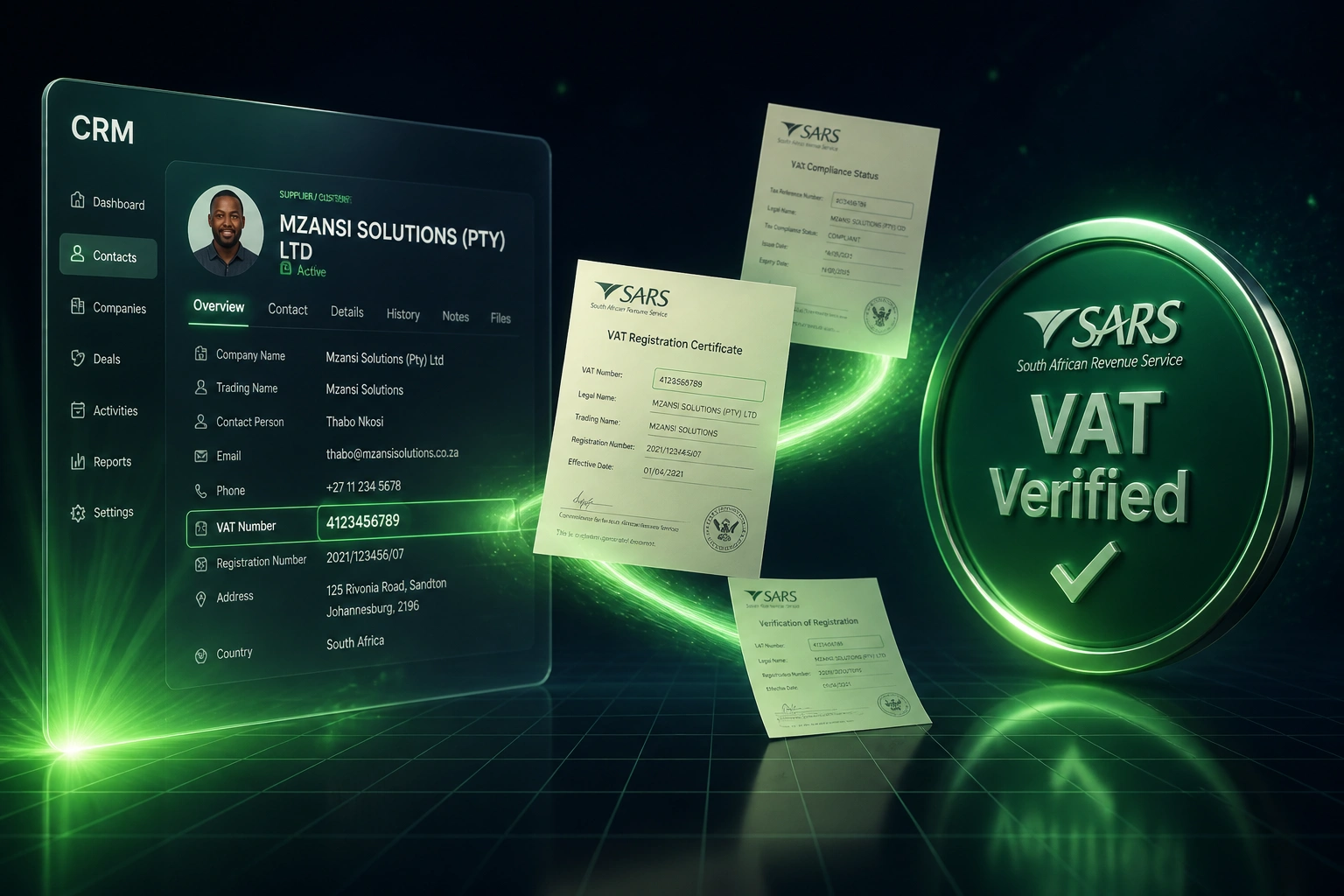
Record captured → SARS register checked → status synced → invoice gated. No one copy-pasting into eFiling.
VAT Number Captured
Sales or procurement saves a customer or supplier VAT number in the CRM
SARS Register Checked
Automated verification confirms the number is active and matches trading details
Status Synced Back
Verified or failed status writes to CRM and accounting with a dated audit trail
Invoice Gate Passes
Tax invoices only issue when the counterparty VAT number is verified and current
Everything You Need for Reliable VAT Validation
Onboarding VAT Validation
New customer or supplier records trigger an automatic SARS VAT check before the record goes live in the CRM.
Pre-Invoice Gate
Before a tax invoice issues, the integration confirms the counterparty VAT number is still active on the SARS register.
Verified Status Sync
Verified, invalid, or deregistered status writes back to CRM and accounting fields your finance team already uses.
Scheduled Re-Checks
Active vendors and customers re-validate on a cadence so deregistrations surface before the next VAT201 cycle.
Audit-Ready Evidence
Each check stores timestamp, result, and trading-name match so SARS reviews have a clear verification trail.
Exception Queues
Failed or mismatched numbers open a review queue instead of silently posting into Xero, Sage, or Pastel.
Systems We've Wired for SARS VAT Checks
From 7 Hours/Week to 20 Minutes
How a Gauteng wholesale distributor stopped manual SARS eFiling lookups, flagged 214 bad VAT numbers, and cut input-tax exposure before the next VAT201.
The Manual Process
- AP clerk opened SARS eFiling VAT Vendor Search for every new supplier
- Roughly 10 minutes per check once login, search, and spreadsheet logging were included
- Existing 1,180 supplier VAT numbers were almost never re-checked after onboarding
- Deregistered numbers only surfaced when SARS queried a VAT201 or a reclaim failed
- No CRM field showed last-verified date or SARS result
The Automated Process
- New supplier records verify against SARS before the CRM status flips to Active
- Bulk sweep of master data found 214 invalid or deregistered numbers (18% of the book)
- Pre-invoice gate blocks tax invoices until status is verified
- Quarterly re-checks catch the ~10% annual churn in tax IDs before VAT filing
- Finance reviews a short exception queue instead of living in eFiling
Before vs After VAT Number Verification
How It Works
From first conversation to live SARS VAT checks in 2–4 weeks.
Tell Us Your Setup
Which CRM and ledger, how many customer and supplier VAT numbers you hold, and where checks happen today.
Free Scoping Call
30-minute call to map onboarding, pre-invoice gates, and the SARS verification path that fits your volume.
Build & Test
We wire verification into your systems, run a bulk sweep of existing master data, and review exceptions with finance.
Go Live & Monitor
Manual eFiling lookups stop. Monitoring catches failed checks and status changes before invoices go out.
Frequently Asked Questions
How do you verify South African VAT numbers against SARS?
We automate checks against the SARS VAT vendor register path your finance team already uses on eFiling (VAT Vendor Search), and where volume justifies it we design for bulk TRN confirmation patterns SARS documents for authorised institutions. Each result is stored with a timestamp and written back to CRM or accounting as verified, invalid, or deregistered.
Why does VAT number verification matter for input tax claims?
Section 16(2) of the VAT Act requires a valid tax invoice before you claim input tax. Section 20 requires supplier and recipient VAT particulars on full tax invoices. RSM South Africa has reported SARS disallowing inputs and applying understatement penalties where invoices lacked a valid VAT number. Catching invalid or deregistered numbers at onboarding and before invoice issue protects those claims.
How often should we re-check existing VAT numbers?
Fonoa's tax data analysis shows roughly 10% of business tax identification data changes every year through deregistration, restructuring, and related events. Most clients run onboarding checks in real time, plus a quarterly re-validation of active customers and suppliers so stale numbers do not sit until a SARS review finds them.
Will sales or procurement have to learn SARS eFiling?
No. They keep capturing VAT numbers in the CRM as they do today. The integration runs the SARS check in the background, flags failures for finance, and blocks invoice issue when status is invalid until someone corrects the record.
What happens to our existing customer and supplier master data?
We run a bulk verification sweep at go-live. Industry analyses of customer and vendor master data typically find 5% to 25% of VAT numbers incorrect or invalid. Your first sweep usually surfaces typos, cancelled registrations, and trading-name mismatches that manual spot checks miss.
How much does SA VAT number verification automation cost?
Onboarding and pre-invoice verification wired into CRM and accounting typically starts from around R20,000. Bulk historical sweeps, scheduled re-checks, and bidirectional status sync usually fall between R30,000 and R65,000. Teams verifying dozens of new vendors a month, or holding 500+ active VAT numbers, usually see payback within 2–4 months against staff time and input-tax risk.
Stop Checking VAT Numbers by Hand on SARS eFiling
If your team still verifies customer and supplier VAT numbers one search at a time, you are carrying compliance risk and burning hours every week on a problem automation already solves.
Tell us which CRM and ledger you run, how many VAT numbers you hold, and where checks fall over today. We will show you how automated SARS VAT validation would work for your onboarding and invoicing flow.