School Fee Management and Collection System: Automate Your Finances
Spreadsheets and fragmented payment channels leave aged debt invisible until year-end. A unified school fee management system invoices correctly, reminds on schedule, reconciles payments, and gives the board a live debtors view.
We build the bursar workflow that turns fee structures into collected cash and clean books.
Sound Familiar?
These are the exact issues bursars and board treasurers brought to us before a unified fee finance system:
- Fee structures, sibling discounts, and bursaries live in separate spreadsheets that never quite match the ledger
- Statements go out late or with wrong balances, so parents dispute rather than pay
- Aged debt only becomes visible at year-end, when recovery odds have already collapsed
- EFT, cash, card, and debit-order receipts are reconciled by hand into Xero or Sage
- The board pack shows last month's debtor list, not a live view the treasurer can act on
On-time independent school collections fell from 75% to 66% in a year (TPN, Q1 2024). School fees sit at the bottom of the household payment stack, so delay is the default. Waiting until year-end to see aged debt means recovery has already slipped from the 70–90% window into the ≤30% zone.
What the School Finance System Actually Does
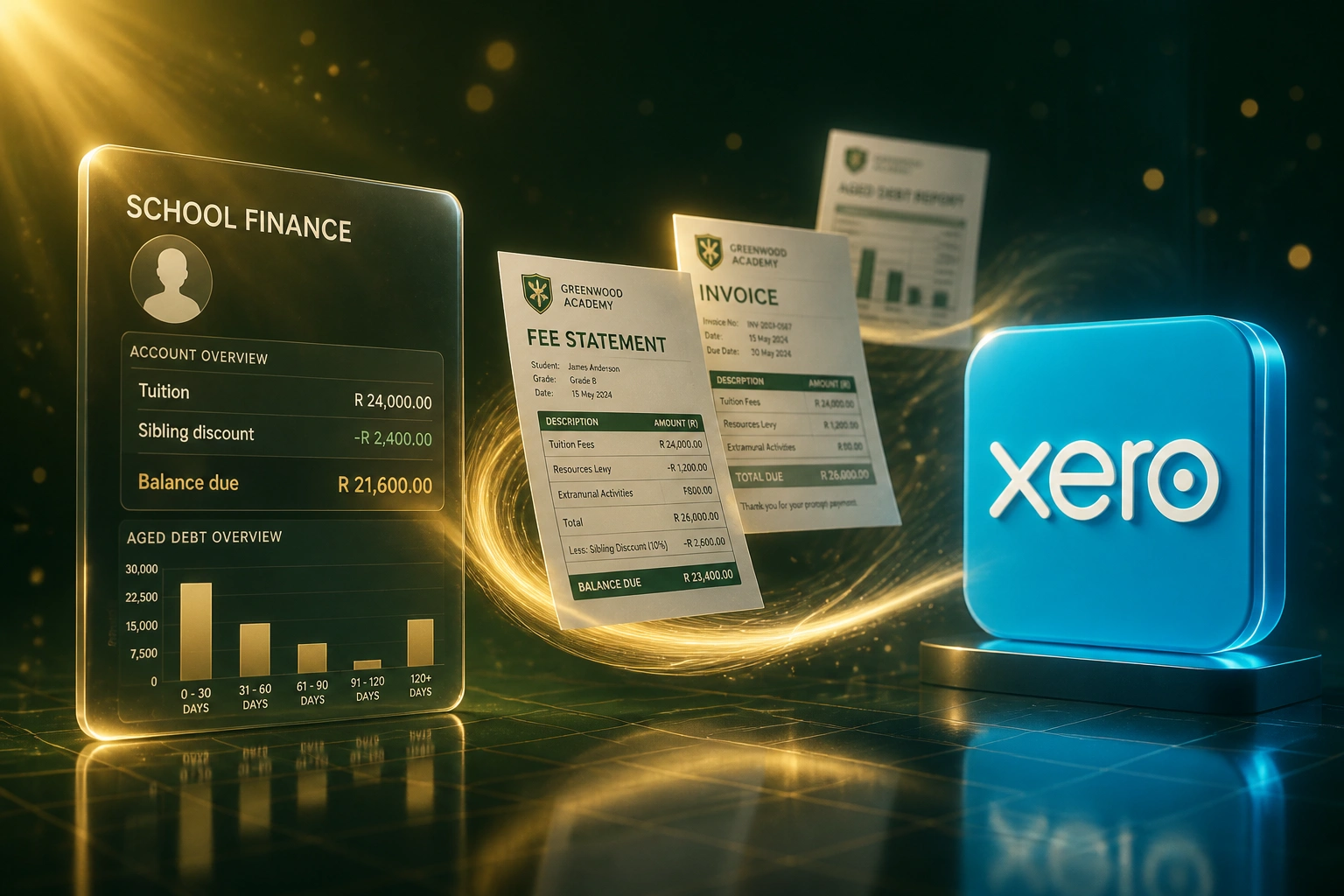
Fee rules invoice → reminders collect → payments reconcile → board sees live debtors. No bursar copying between spreadsheets.
Fee Run Generated
Structures, sibling discounts, and bursaries apply; invoices and statements go out correctly
Reminders Escalate
Ageing rules send friendly, firm, then final notices while recovery odds are still high
Payments Matched
EFT, card, cash, and debit orders reconcile to learner accounts automatically
Books & Board Updated
Xero or Sage posts cleanly; the treasurer sees live aged debt, not last term's pack
Everything You Need for Bursar Automation
Fee Structures & Sibling Rules
Grade bands, boarding vs day, levies, and sibling discounts apply automatically at invoice time. No more rounding errors on the second and third child.
Automated Invoicing & Statements
Term or monthly fee runs generate accurate invoices and parent statements from one source of truth, with bursary and credit note adjustments included.
Reminder & Escalation Sequences
Friendly, firm, and final notices fire on ageing rules you approve. Paid accounts drop off the queue the moment the balance clears.
Payment Reconciliation
Bank feeds, debit orders, and portal payments match to learner accounts, then post cleanly into Xero or Sage without re-keying.
Aged Debt & Board Reporting
Live 30/60/90/120+ ageing, debtor days, and collection rate sit in one view for the bursar and the board treasurer.
POPIA-Aware Guardian Records
Financial records of parents and guardians stay purpose-limited, access-controlled, and auditable under POPIA duties for children's related information.
Systems We've Connected for School Fee Collection
From 12 Hours/Week to 3 Hours/Week
How a 450-learner independent school replaced spreadsheet fee admin with a live school finance system and recovered R1.4 million in aged debt.
The Manual Process
- Bursar maintained fee structures and sibling discounts in Excel beside Edupac
- Statements went out days late; parents disputed balances before paying
- Aged debt only surfaced in the November board pack
- EFT references matched by hand into Xero every Friday
- Reminder lists rebuilt each month from a stale export
The Automated Process
- Fee runs apply sibling and bursary rules; invoices and statements go out on schedule
- Ageing sequences remind parents while accounts are still in the 60–90 day recovery window
- Payments reconcile to learner accounts and post into Xero without re-keying
- Board treasurer opens a live debtors view instead of waiting for year-end
- Bursar reviews exceptions and payment plans, not the whole chase list
Before vs After Fee Collection Automation
How It Works
From first conversation to live school fee management in 4–8 weeks.
Tell Us Your Setup
Fee structures, sibling and bursary rules, payment channels, and whether month-end lands in Xero or Sage.
Free Scoping Call
30-minute call with your bursar, business manager, or board treasurer to map the full fee lifecycle.
Build & Test
We configure structures, invoicing, reminders, and ledger sync, then run parallel for a fee cycle to validate accuracy.
Go Live & Monitor
Switch off the spreadsheet chase. Monitoring catches failed matches and missed reminders before debt ages another bucket.
Frequently Asked Questions
How is this different from debit-order or DebiCheck automation alone?
Debit-order automation focuses on collecting via mandate. A school fee management and collection system covers the full bursar workflow: fee structures, sibling discounts, invoicing, statements, reminder sequences, payment reconciliation, aged-debt reporting, and month-end posting into Xero or Sage. Mandates can sit inside it, but they are not the whole job.
Will this replace our school MIS or accounting package?
No. We design around what you already use. Fee rules and learner billing often live in Edupac, SA-SAMS, d6, or a custom MIS. Xero or Sage remains the financial ledger. The integration connects them so the bursar stops copying balances between three tools.
How do sibling discounts and bursaries get applied correctly?
Discount and bursary rules are defined once against family and award criteria, then applied automatically when invoices generate. Mid-year joiners, leavers, and credit notes are handled as exceptions your finance team reviews, not as silent spreadsheet drift.
How does aged-debt visibility change for the board?
Instead of a year-end surprise, the treasurer sees live ageing buckets, debtor days, and collection rate. That supports earlier payment arrangements and, where needed, timely hand-over while recovery rates are still in the 70–90% window rather than below 30% after six months.
Is this POPIA-compliant for guardian financial records?
Yes. Fee management processes parent and guardian financial information linked to enrolled learners. We limit fields to what billing and collections require, restrict access to agreed school staff, keep an audit trail, and honour messaging consent on reminders.
How much does a school fee management system cost?
A focused invoicing-and-reminder build starts from around R25,000. Full end-to-end fee management with structure rules, multi-channel collection, aged-debt dashboards, and Xero or Sage sync typically ranges from R40,000 to R90,000. Most schools recover the build cost inside one or two fee cycles through earlier collections and fewer bursar hours.
Stop Managing School Fees in Spreadsheets
If your bursar still rebuilds fee runs and reminder lists by hand, aged debt is growing quietly between board meetings. Independent schools that wait past 90 days leave recovery rates on the table.
Tell us how your fee structures work, which channels parents pay through, and whether month-end lands in Xero or Sage. We'll show you exactly how an end-to-end school fee management system would run for your campus.