SLA Tracking for Field Service: Stop Paying for Missed Windows
Your customer contracts promise response times, on-site arrival windows, and resolution deadlines. When those clocks run in a PDF instead of your field tools, every missed first-response window burns margin through service credits, overtime, and renewal risk.
We build automated SLA clocks that protect service level compliance before the penalty clause fires.
Sound Familiar?
These are the exact issues our field-service clients faced before automated SLA tracking:
- Response and resolution clocks live in the contract PDF, not in the dispatch system your technicians use
- Dispatchers only learn a first-response window was missed when the customer emails a penalty claim
- On-site arrival windows slip while jobs sit unacknowledged in a queue nobody is watching
- Compliance reports are rebuilt from spreadsheets at month-end, too late to stop the breach
- Penalty clauses and service credits quietly erode margin while overtime and rerouting hide the real cost
Customers increasingly insist on penalty clauses for non-performance. Industry research puts typical breach credits at 5–25% of the affected service charge, often capped near 10% of the monthly invoice. The credit on the statement is only the start: overtime, duplicate visits, and lost capacity commonly run three to five times higher than the fine you track.
What Field Service SLA Tracking Actually Does
Ticket opens → clocks start → breach risk surfaces → compliance holds. No spreadsheet reconstruction at month-end.
Job Opens
A field ticket is created in your FSM or dispatch tool against a contracted site
SLA Clocks Start
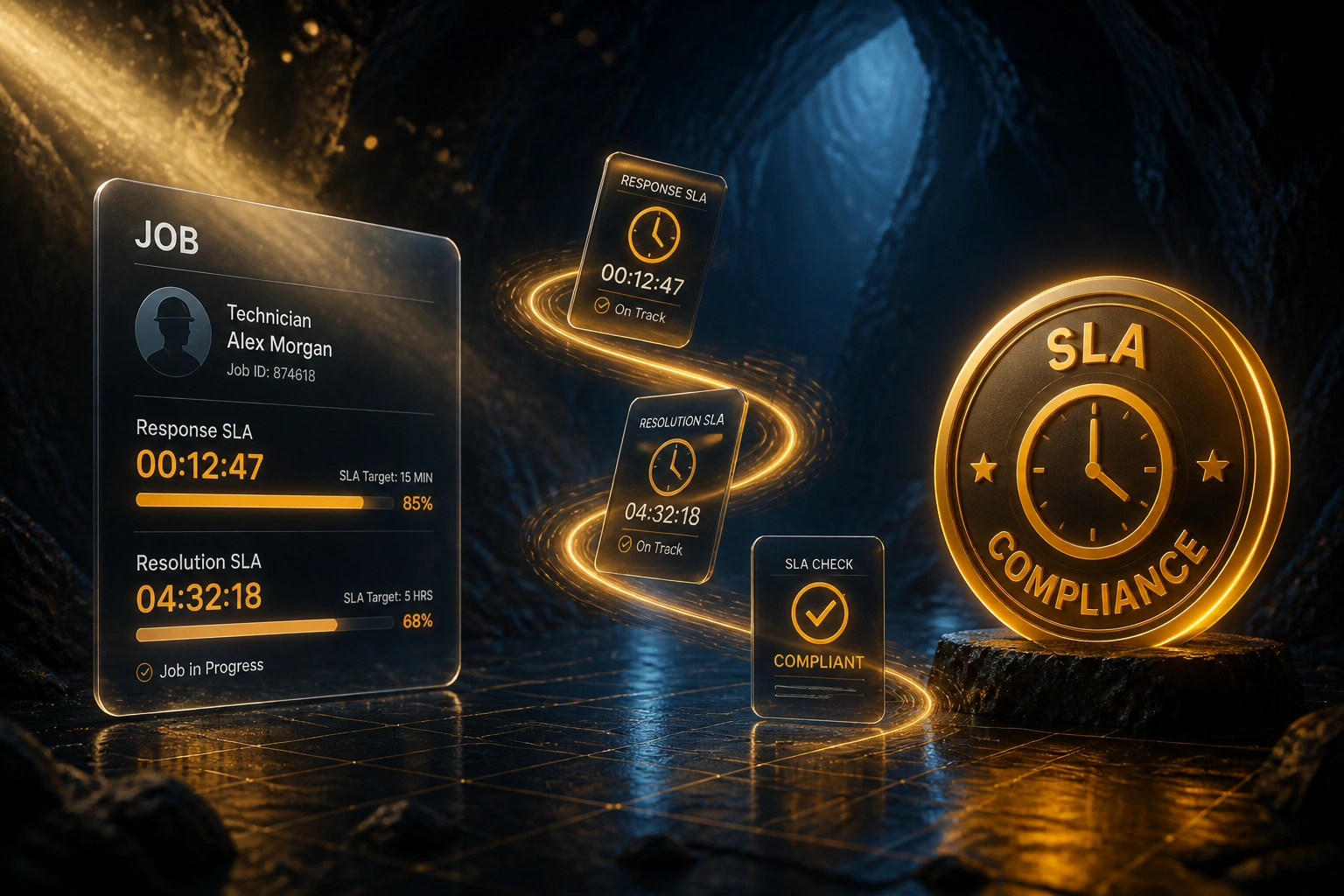
Response, acknowledgement, arrival, and resolution timers apply the contract rules automatically
Risk Escalates Early
Warning thresholds alert dispatch before the window closes; ownership never disappears
Compliance Logged
Arrive and resolve stamps feed live compliance rates and audit-ready renewal evidence
Everything You Need for Service Level Compliance
Automated SLA Clocks
Response, acknowledgement, on-site arrival, and resolution timers start the moment a field ticket opens. Contractual windows stop living only in the PDF.
Breach Alerts Before Penalties
Warning thresholds fire while there is still time to reassign or escalate. Ops directors see risk before the customer logs a service credit.
Multi-Stage Field Escalation
Missed acknowledgement escalates to dispatch, then to the area lead, then to the ops director. Every step is timed, logged, and auditable.
Contract-Aware SLA Rules
Different customers get different clocks: 2-hour critical response, 4-hour standard, next-business-day for non-urgent. Rules follow the contract, not a one-size default.
Compliance Dashboards
Live views of open jobs, time remaining, breach rate, and penalty exposure by contract. Leadership sees which sites and technicians are at risk this week.
Audit-Ready Breach History
Every pause, reassignment, arrival stamp, and resolution is recorded. Renewal conversations and penalty disputes stop being a reconstruction exercise.
Field Platforms We've Wired for SLA Tracking
From 87% Compliance to 97%
How a Gauteng HVAC contractor cut SLA credits from R885,000 to R148,000 a year and recovered R2.1 million including overtime and lost capacity.
Blind Contract Clocks
- Response and resolution windows lived in contract PDFs, not in Jobber
- Dispatchers learned about breaches when customers claimed service credits
- Visible credits ran about 3% of a R29.5 million SLA book: R885,000 a year
- Overtime, rerouting, and complaint handling pushed total SLA cost near R2.7 million
- Compliance sat around 87%, with no live view of jobs approaching breach
Live Field SLA Clocks
- Every ticket starts response, acknowledgement, arrival, and resolution timers
- Warning alerts reach dispatch 30–45 minutes before a contractual miss
- Visible credits fell to roughly 0.5% of SLA revenue: about R148,000 a year
- Hidden overtime and lost-capacity costs dropped in proportion
- On-site compliance climbed from 87% to 97%, with audit history for renewals
Before vs After Field Service SLA Tracking
How It Works
From first conversation to live SLA clocks in 2–4 weeks.
Map Your Contracts
Which SLA windows, penalty clauses, and arrival commitments sit in each customer contract.
Free Scoping Call
30-minute call to design timers, breach thresholds, and escalation chains against your real job volumes.
Build & Pilot
We wire SLA clocks into your FSM or ticket tools, pilot on one or two contracts, and tune thresholds with dispatch.
Go Live & Monitor
Roll out across the field book. Compliance dashboards and breach alerts keep penalty risk visible every day.
Frequently Asked Questions
How is field service SLA tracking different from internal task SLAs?
Internal task SLAs protect work between your own departments. Field service SLA tracking protects customer contracts: response time, technician acknowledgement, on-site arrival windows, and resolution time, with penalty clauses and renewal risk attached. The clocks measure what the customer paid for, not an internal queue.
Is this the same as job scheduling and dispatch automation?
No. Scheduling and dispatch assign the right technician to the right job. SLA tracking measures whether you hit the contractual clocks after the job exists: open → acknowledge → arrive → resolve. You need both, but they solve different problems. This page is about compliance measurement and breach prevention, not route assignment.
Which field service tools can you put SLA clocks on?
We have built SLA tracking across ServiceTitan, Jobber, FieldAware, Salesforce Field Service, Microsoft Dynamics 365 Field Service, ServiceNow FSM, and custom field-service platforms. If jobs already open somewhere with timestamps, we can usually put contractual clocks and escalations on that flow.
What happens when a job is about to breach?
A warning alert goes to the assigned technician and dispatcher before the contractual deadline. If the window still slips, the escalation chain kicks in automatically: dispatch lead, area manager, then ops director. Every step is timestamped for audit and renewal reporting.
How do you handle different contracts and priority tiers?
We map each customer or site to its contracted response and resolution windows, including critical versus standard tiers and business-hours rules where the contract requires them. Penalty exposure can be tracked per contract so finance sees the risk before month-end credits land.
How much does field service SLA tracking cost?
Simple timer-and-alert setups on one or two contract tiers start from around R15,000. Multi-contract tracking with escalation chains, compliance dashboards, and penalty exposure reporting typically ranges from R25,000 to R60,000. Most mid-size field teams recover that cost within one to two quarters through fewer credits, less overtime firefighting, and stronger renewal leverage.
Stop Losing Margin to Missed Field SLAs
If your response and resolution commitments still live in a contract PDF while technicians work from a separate system, you are paying for a problem that automated SLA tracking already solves.
Tell us which field platform you run, what your customer contracts promise, and where penalty clauses are biting. We will show you exactly how live clocks and breach alerts would work for your operation.