Recover Failed Subscription Payments With Automated Dunning
Every failed renewal is a customer at risk of churning, not because they chose to leave, but because a card expired or a soft decline went unanswered. Smart subscription dunning combines retries, notifications, and grace periods so payment recovery happens before the cancel sticks.
We build the full recovery programme that saves at-risk MRR.
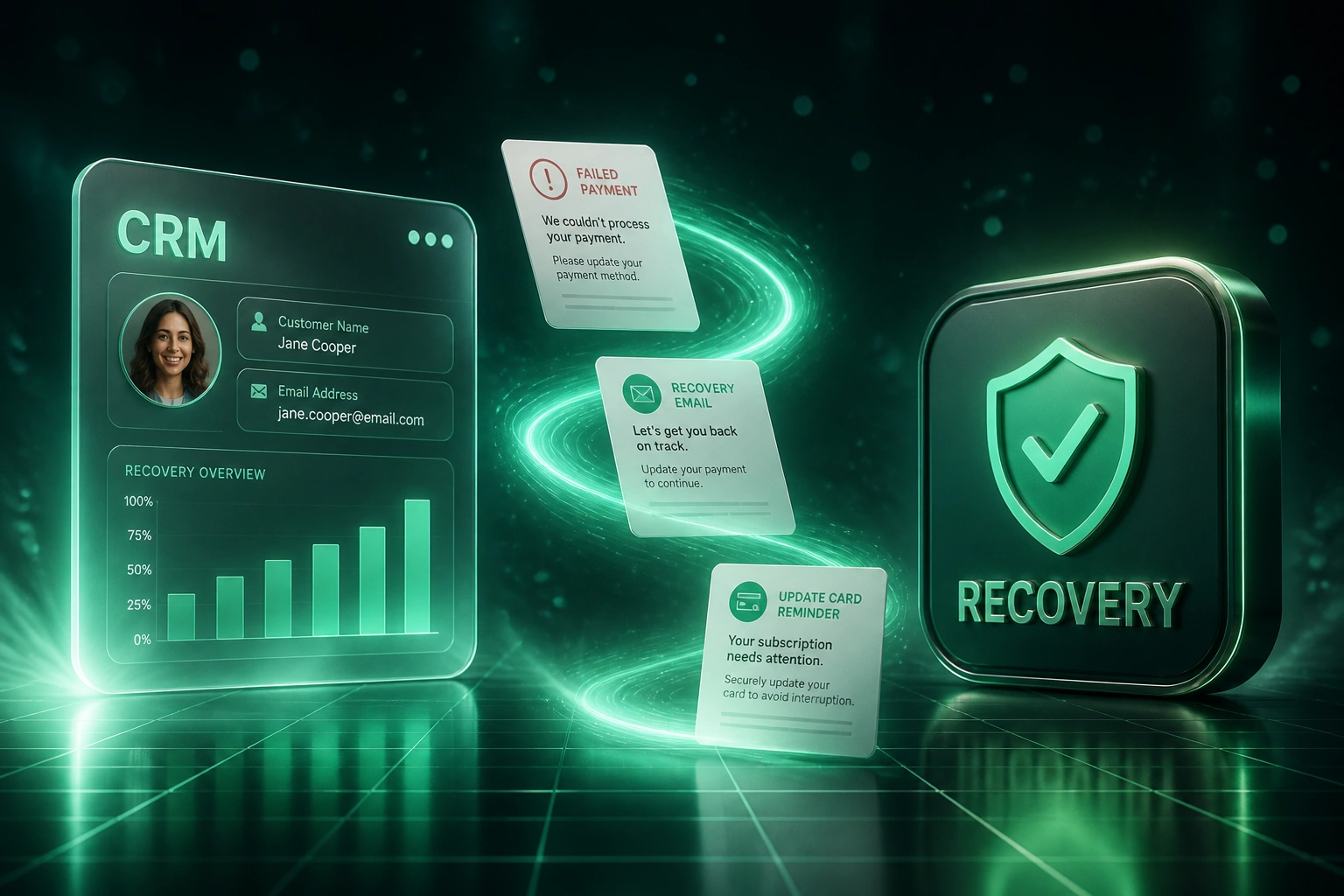
Sound Familiar?
These are the exact issues our clients faced before we built their payment recovery programme:
- Failed renewals sit in the billing dashboard for days before anyone notices a card has expired
- Finance only retries on a fixed schedule, then cancels the subscription when the last attempt fails
- Customers who still want the product never get a clear email, SMS, or in-app nudge to update their card
- Grace periods are inconsistent: some accounts lose access overnight while others linger unpaid for weeks
- Nobody can tell you how much MRR is recoverable versus already lost to involuntary churn
Visa estimates about 30% of card accounts change every year, and soft declines keep rising as banks tighten fraud filters. Card-expiry seasons alone can spike involuntary churn overnight if you only run your billing platform's default retry email.
What Automated Dunning Actually Does
Payment fails → smart retries and nudges → card updated → subscription saved. Churn prevention without a support ticket pile.
Charge Fails
Webhook catches the decline. Soft failures enter retry; hard failures escalate to the customer path immediately
Retries & Nudges
Smart retries run in the background while email and SMS ask the customer to update their card
Grace & Escalate
Access stays open for a set window. In-app walls and firmer messaging kick in before any cancel
MRR Recovered
Successful charge syncs back to CRM and billing. Finance sees recovered rand, not a silent cancel
Everything You Need for Payment Recovery That Sticks
Smart Retry Orchestration
Soft declines retry on timing that respects payday cycles and decline codes. Hard declines skip straight to customer outreach instead of burning network attempts.
Multi-Channel Dunning
Sequenced email and SMS with frictionless update-card links, plus in-app payment walls when the customer is already logged in. Every message leads to one action: fix the payment method.
Grace Periods & Escalation
Access stays open for a defined window while recovery runs. Escalation tightens messaging and, if needed, soft-walls the product before a final cancel, so you never surprise a loyal customer.
Pre-Dunning Card Alerts
Expiry warnings go out 30, 14, and 7 days before the card dies. Stripe-style pre-dunning cuts expired-card failures sharply before the charge ever fails.
CRM & Billing Sync-Back
Failed, recovering, and recovered statuses write back to HubSpot, Salesforce, or your CRM so success and finance see the same at-risk revenue list.
Recovery Analytics
Finance sees recovered rand by channel, days-to-recovery, and involuntary churn rate, so the programme proves itself every billing cycle.
Billing Platforms We've Wired for Dunning
From 28% Recovery to 71% Recovery
How a R7.2M ARR South African SaaS stopped losing customers to silent payment failures and recovered nearly half a million rand in year-one at-risk MRR.
Default Billing Retries
- Stripe default: four retries over seven days, one automated email
- No SMS, no in-app wall, no consistent grace period
- Finance discovered cancels in the monthly churn report, not in real time
- Average 14 days from first failure to final cancel
- Recovery stuck around 28% of failed renewals
Full Dunning Programme
- Smart retries plus sequenced email and SMS with one-click card update
- 10-day grace period with a soft in-app wall from day five
- Pre-dunning alerts before card expiry cut preventable failures
- CRM shows recovering and recovered statuses the same day
- Average recovery time dropped to five days
Before vs After Automated Dunning
How It Works
From first conversation to a live dunning programme in 2–4 weeks.
Map Your Leak
Current recovery rate, involuntary churn share, and which failed charges die silently versus which get a half-hearted email.
Free Scoping Call
30-minute call to design retry windows, grace periods, notification cadence, and cancel rules that fit your plans and pricing.
Build & Test
We wire webhooks, dunning sequences, and CRM sync, then run parallel on a sample of failed renewals before you flip the live switch.
Go Live & Tune
The programme goes live. We watch recovery by channel for the first two cycles and tighten messages that underperform.
Frequently Asked Questions
How is automated dunning different from payment retry schedule optimisation?
Retry schedule optimisation decides when soft declines get another charge attempt. Automated dunning is the full recovery journey: smart retries plus customer notifications, grace periods, escalation, update-card CTAs, and cancel rules. Timing alone recovers what a re-charge can fix. Dunning recovers what needs a human to update the card.
How much failed-payment revenue can we expect to recover?
Industry benchmarks put native gateway recovery around 15–25% on Stripe defaults, while multi-channel programmes (retries, email, SMS, in-app walls) routinely reach 70% of detected involuntary churn. Recurly analysis has found roughly 63% of failed initial charges recoverable with strong retry logic alone. Your lift depends on current cadence and decline mix.
Will this replace Stripe Smart Retries or Chargebee dunning?
Not necessarily. Where native tools already perform well, we tune windows, attempt counts, and notification templates. Where the platform only offers a thin default email, we layer a full dunning programme on top: grace periods, SMS, CRM sync, and escalation. The goal is recovered MRR, not a rip-and-replace of your billing stack.
How long should a grace period be before we cancel?
Most subscription businesses land between 7 and 14 days of continued access while recovery runs. Companies that offer a grace period see about 28% higher payment-update rates than those that suspend access immediately. We set the window from your average days-to-recovery and plan value so cash-flow risk stays controlled.
How long does a dunning programme take to set up?
A standard programme on one billing platform typically takes 2 to 4 weeks from scoping to go-live. Multi-gateway stacks, DebiCheck collections, or deep CRM entitlement sync take closer to 4 to 6 weeks.
How much does subscription dunning automation cost?
Full recovery programmes typically range from R25,000 to R60,000 depending on gateways, channels, and CRM sync depth. Operators leaving hundreds of thousands of rand a year in involuntary churn usually cover the build within one or two billing cycles from recovered MRR alone.
Stop Losing Subscribers to Failed Payments
If failed renewals still turn into silent cancels, you are funding churn that a structured dunning programme already knows how to prevent.
Tell us which billing platform you run, what your current recovery rate looks like, and how grace periods work today. We will show you exactly how automated dunning would recover at-risk MRR for your business.