Supplier Performance Management: Rate, Track and Improve Vendor Delivery
You renew underperforming vendors because delivery times, quality scores, and pricing live in different places. By the time someone notices a pattern, the contract has already rolled.
We build the supplier performance system that puts OTIF, quality, and price drift in one live view.
Sound Familiar?
These are the exact issues our clients faced before continuous supplier tracking:
- Delivery promises live in email threads while quality failures sit in a separate spreadsheet
- You renew underperforming vendors because nobody has a single OTIF and quality view
- Price creep of 2–5% per year goes unnoticed until the next tender
- Late and short deliveries force emergency buys and permanent safety stock
- Procurement spends hours chasing status instead of negotiating with evidence
South Africa's logistics strain is not optional noise. Industry estimates put missed trade from port, rail and infrastructure bottlenecks near R1 billion a day, while infrastructure inefficiency alone can add 10–15% to industrial operating costs. Rand swings on imports and multi-day port delays make untracked vendor delivery even more expensive to ignore.
What Supplier Tracking Actually Does
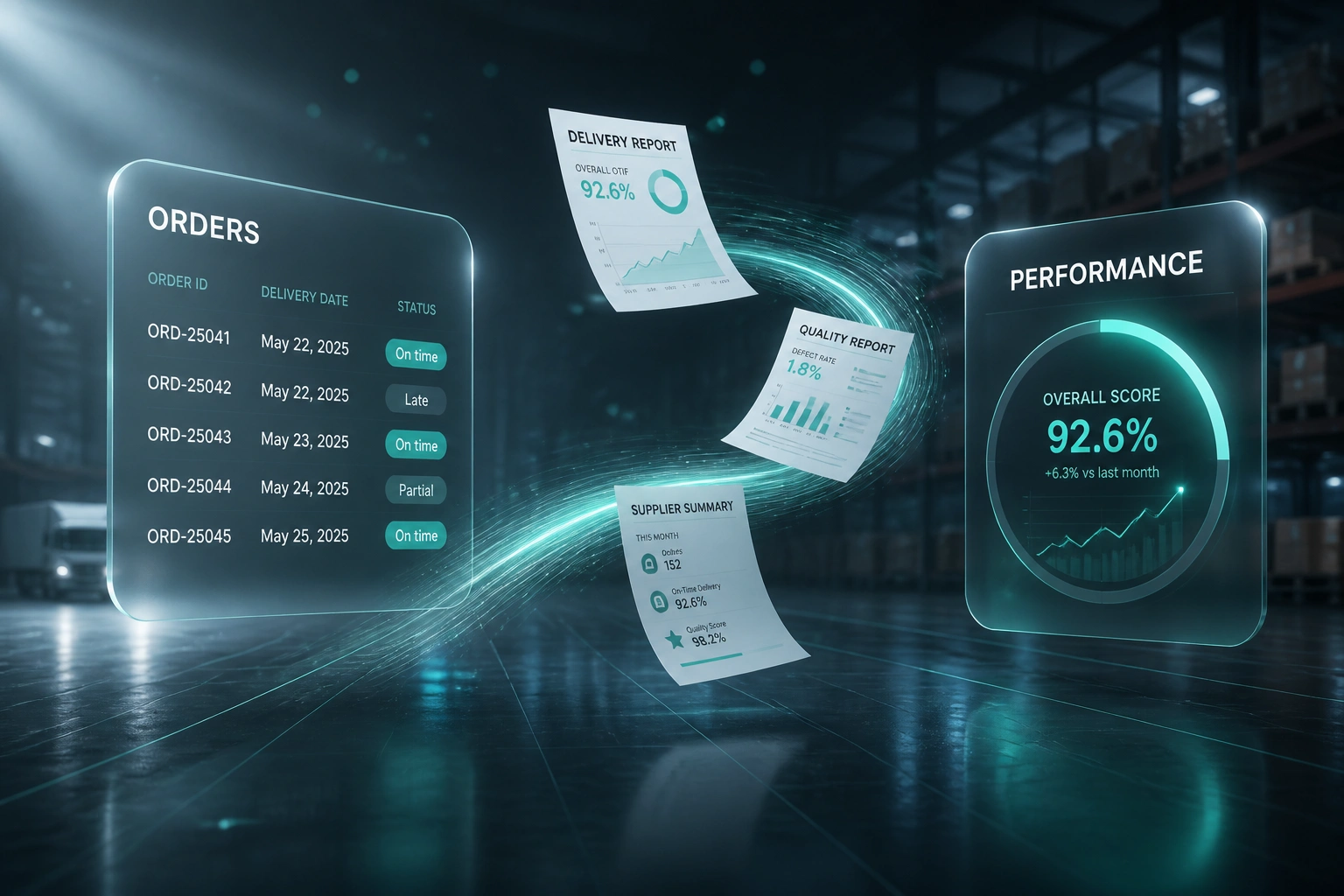
Goods arrive → scores update → actions fire → renewals rest on evidence. Continuous vendor management, not a once-a-year PDF.
Receipt Hits the System
GRN or warehouse receipt lands with promised date, quantity, and supplier ID
OTIF & Quality Scored
On-time, in-full, defect and return signals update the live supplier score
Alerts & Actions
Threshold breach opens an improvement action with owner, date, and vendor visibility
Evidence-Based Decisions
Renegotiate, dual-source, or exit with a trail of delivery, quality, and price data
Everything You Need for Ongoing Vendor Management
Live OTIF Tracking
Every receipt is scored on-time and in-full against the promised date and quantity, so supplier tracking updates week to week, not once a quarter.
Quality Trend Scores
Defect rates, returns, and inspection holds roll into a running quality score per vendor, so you see deterioration before it hits the customer.
Pricing Drift Alerts
Invoice prices are checked against contracted rates. Quiet increases surface as variance alerts instead of disappearing into the next PO.
Improvement Action Workflows
When a supplier drops below your OTIF or quality threshold, a corrective action is raised, assigned, and dated, with progress visible to ops and procurement.
Procurement Analytics Dashboard
One view of delivery times, quality scores, pricing, and spend rank. Better procurement decisions start with a single source of truth.
ERP and Warehouse Sync
Receipts, GRNs, and returns pull from your ERP or WMS automatically. Your team stops re-keying delivery data into a side spreadsheet.
Systems We've Connected for Supplier Tracking
From 83% OTIF to 96% in Nine Months
How a Gauteng manufacturer stopped renewing weak vendors on instinct and freed R4.1 million in working capital.
Scattered Vendor Management
- Delivery status chased by email; quality logged in a separate shared sheet
- Core suppliers averaging 83% OTIF with no weekly review cadence
- Roughly R6.2 million locked in extra safety stock to cover chronic late and short deliveries
- Price increases of 3–4% a year discovered only at renewal
- Procurement lead spending 8 hours a week chasing status instead of negotiating
Continuous Performance Management
- Every receipt updates live OTIF, quality, and price-variance scores
- Threshold breaches open dated improvement actions shared with vendors
- Two chronic underperformers dual-sourced; one exited with a full evidence pack
- Late deliveries down 28% within six months of go-live
- Weekly 45-minute score review replaced the eight-hour chase
Before vs After Supplier Performance Management
How It Works
From first conversation to live supplier dashboards in 3–6 weeks.
Map Your Vendors
Which suppliers matter most, what you already track, and where delivery and quality data currently lives.
Free Scoping Call
30-minute call to define OTIF windows, quality thresholds, pricing rules, and who acts when a score drops.
Build & Parallel Run
We connect receipts and invoices, build the scorecards, and run parallel for two weeks against your existing process.
Go Live & Govern
Dashboards replace the chase. Weekly review cadence and alerts keep vendor management continuous.
Frequently Asked Questions
How is this different from a quarterly supplier scorecard?
A quarterly rating sheet looks backwards once. A supplier performance management system tracks delivery times, quality trends, OTIF, and pricing every week, then triggers improvement actions while the relationship is still salvageable. You manage vendors continuously, not once at renewal.
What systems can you pull delivery and quality data from?
We typically connect to SAGE, Xero, SAP Business One, Syspro, NetSuite, warehouse systems, and custom ERPs. If goods receipts, returns, and invoice lines exist in a system with an API or export, we can score them.
Will this disrupt how buyers place orders today?
No. Buyers keep raising POs the way they already do. The system sits on top of receipts and invoices, scoring what actually arrived. We run parallel before switching off any manual tracking.
How do you define on-time and in-full for our business?
During scoping we set your on-time window (for example ±1 day), your in-full rule (exact quantity or agreed tolerance), and category-specific targets. Automotive-style lines often aim for 95–98% OTIF; mid-market buyers commonly start by lifting 85–89% performers toward 95%.
Can suppliers see their own scores?
Yes, when you want them to. Shared score views and dated improvement actions turn performance conversations into evidence-based reviews instead of opinion battles. You control what each vendor can see.
How much does a supplier performance system cost?
Focused dashboards for a core supplier set typically start around R35,000. Broader programmes with ERP sync, pricing variance, and action workflows usually sit between R50,000 and R95,000. Most clients recover the build cost within a few months once late deliveries and excess safety stock start falling.
Stop Renewing Vendors Without the Numbers
If delivery failures, quality holds, and price creep only surface at contract time, you are paying for a gap that continuous supplier tracking already closes.
Tell us which ERP or warehouse system you use, how many strategic suppliers you manage, and which KPIs matter most. We will show you exactly how a live performance system would look for your operation.