Three-Way Matching Automation: Block Payment Until PO, GRN, and Invoice Align
Your AP team still lines up purchase orders, goods receipt notes, and supplier invoices by hand before every payment run. Manual invoice matching burns hours, lets quantity and price discrepancies through, and leaves duplicate invoices one click from the bank.
We build automated three-way matching that holds payment until PO reconciliation clears within your tolerances.
Sound Familiar?
These are the exact issues finance directors and AP managers faced before automated three-way matching:
- Creditors clerks line-compare every PO, GRN, and supplier invoice in Pastel or Sage before each payment run
- Quantity shortfalls, price variances, and VAT mismatches only surface after the invoice is already in the batch
- Duplicate invoices slip through when the same PDF arrives twice from a supplier portal and email
- Exceptions sit for days while buyers and warehouse confirm what was actually received
- Month-end and SARS VAT claims stall because matching evidence is scattered across folders and ledgers
SARS input VAT claims need matching evidence, and Pastel or Sage AP queues only get longer as invoice volume grows. When clerks cannot prove that quantity, price, and tax align across PO, GRN, and tax invoice, refunds stall, queries multiply, and overpayments leave the business before anyone notices.
What Three-Way Matching Automation Actually Does
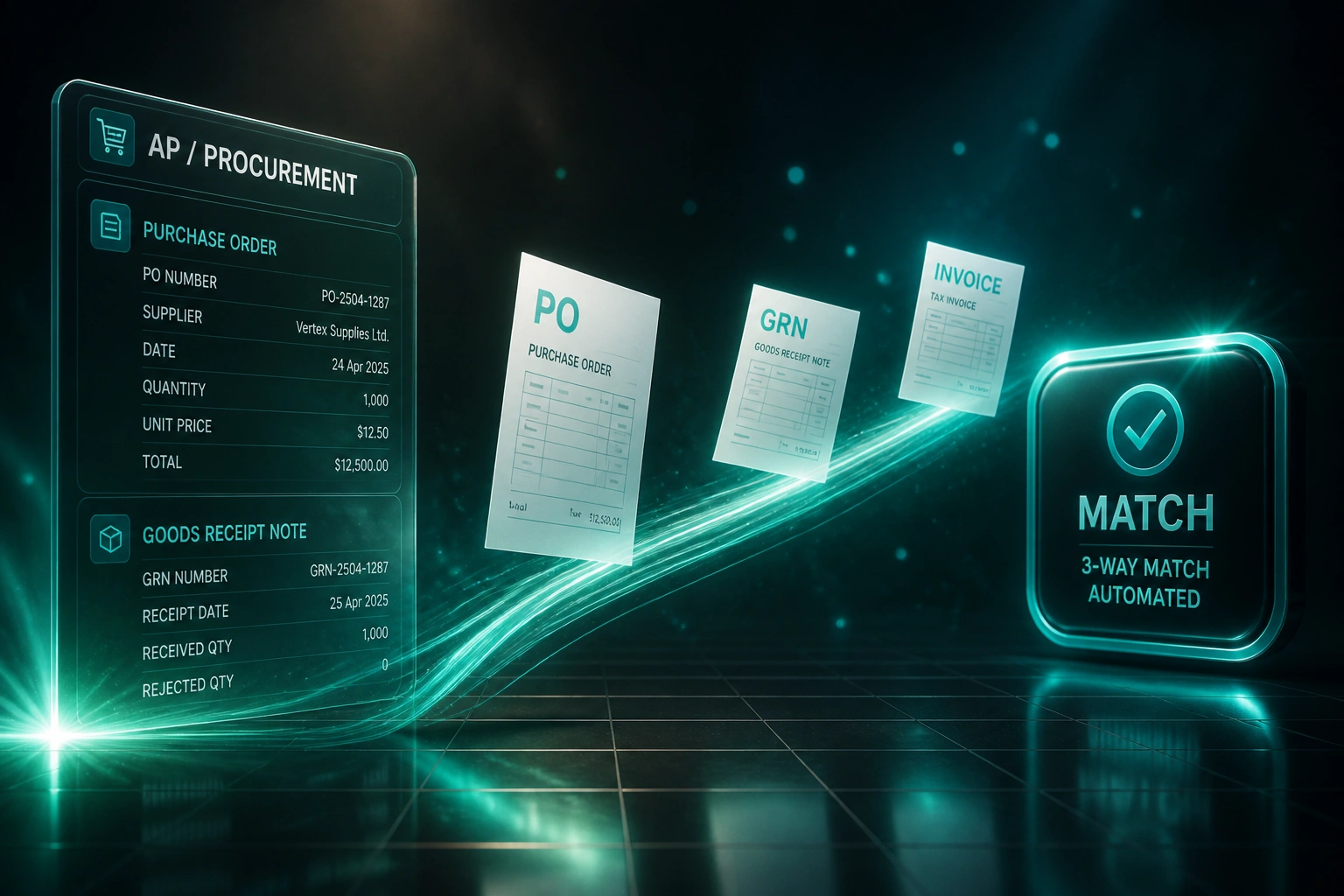
Invoice arrives → matched to PO and GRN → exceptions routed → payment released only on a clear match.
Invoice Captured
Supplier invoice lands from email, portal, or OCR into the AP queue linked to the open PO
Matched to PO & GRN
Quantity, unit price, and VAT compared automatically against the purchase order and goods receipt
Exceptions Routed
Mismatches go to buyer or warehouse with all three documents; clean matches move on
Payment Released
Only matched invoices enter the payment batch, with a full audit trail for SARS and auditors
Everything You Need for Reliable Invoice Matching
Automated Three-Way Match
Every supplier invoice is compared to the open PO and GRN for quantity, unit price, and VAT before it can reach the payment run.
Tolerance Rules
You set price, quantity, and VAT tolerances by supplier or category. Matches within tolerance release; everything else holds for review.
Exception Routing
Mismatches route to the buyer, warehouse, or AP manager with the PO, GRN, and invoice side by side so resolution stops bouncing between inboxes.
Duplicate Invoice Blocking
Once a PO line is consumed by a matched invoice, a repeat submission has nothing left to match and is held instead of paid.
Ledger Write-Back
Matched invoices post to Sage, Pastel, Xero, or your ERP with account codes, VAT treatment, and an audit trail of who cleared each exception.
Payment Gate Control
Payment batches only include invoices that have cleared three-way matching. Overpayments and short-ship invoices never reach the bank file by default.
Systems We've Connected for PO Reconciliation
From 15 Minutes per Invoice to Under 2
How a Gauteng wholesaler stopped overpaying on short-ships and freed more than 70 AP hours a month with automated three-way matching.
The Manual Process
- Two creditors clerks compared PO, GRN, and PDF invoices line by line in Pastel
- About 15 minutes per invoice once exceptions and supplier queries were included
- Roughly one in five invoices needed chasing with buyers or the warehouse
- Short-ship and price variances often cleared in the payment run before anyone noticed
- Duplicate PDFs from portal and email occasionally paid twice
The Automated Process
- Invoices match against open POs and GRNs within seconds of capture
- Clean matches release or sit in a one-click approve queue
- Exceptions arrive with the three documents side by side for the right owner
- Payment batches only include invoices that cleared matching
- Duplicate submissions hold because the PO line is already consumed
Before vs After Invoice Matching Automation
How It Works
From first conversation to live three-way matching in 2–4 weeks.
Tell Us Your Setup
Which ledger and receiving systems you run, how AP matches invoices today, and where exceptions pile up.
Free Scoping Call
30-minute call to map PO, GRN, and invoice sources, tolerance rules, and who should own each exception type.
Build & Test
We wire the match engine, run parallel against a live payment batch, and validate quantity, price, and VAT outcomes.
Go Live & Monitor
Switch off manual line comparison. Monitoring keeps tolerances honest as suppliers and volumes change.
Frequently Asked Questions
How long does three-way matching automation take to set up?
A focused pilot against one ledger and one receiving source usually takes 2–4 weeks from scoping to go-live. Multi-warehouse GRNs, supplier-specific tolerances, VAT edge cases, and ERP write-back typically take 4–6 weeks.
Which systems can you connect for invoice matching?
We have built three-way matching against Sage Pastel, Sage Business Cloud, Xero, NetSuite, custom ERPs, and warehouse or WMS receiving feeds. If purchase orders, goods receipts, and supplier invoices are accessible, we can reconcile them before payment.
Will AP still approve every invoice?
Yes for exceptions. Invoices that match the PO and GRN within your tolerances can release automatically or land in a one-click approve queue. Your team stops comparing every line by hand and focuses on the mismatches that actually need judgement.
How is this different from purchase order automation?
Purchase order automation creates and sends POs when stock hits thresholds. Three-way matching sits later in the cycle: it blocks AP payment until the supplier invoice, the PO, and the GRN align. You can run both, but they solve different problems.
How do you handle partial receipts, price variances, and VAT?
Partial GRNs match only the received quantity and hold the balance. Price and VAT variances outside tolerance route as exceptions with the three documents side by side. During setup we map standard-rated, zero-rated, and exempt treatments so SARS-ready tax invoices stay consistent with the ledger.
How much does three-way matching automation cost?
Single-ledger match setups with standard tolerances start from around R15,000. Full automated invoice matching with exception routing, duplicate blocking, multi-warehouse GRNs, and ERP write-back typically ranges from R25,000 to R60,000. Teams processing 200+ supplier invoices a month usually see payback within 1–3 months from AP hours and prevented overpayments alone.
Stop Paying Before the Documents Agree
If your AP team is still matching POs, GRNs, and invoices by hand, you are burning hours and leaving overpayments and duplicates one payment run away from leaving the business.
Tell us which ledger and receiving systems you run, how many supplier invoices you process a month, and where exceptions hurt most. We will show you exactly how automated three-way matching would work for your stack.