Automated User Provisioning and Deprovisioning: Close the Account Lifecycle Gap
Your new hire waits days for email and CRM access. Your ex-employee still has logins a week after they leave. Manual user provisioning across systems is costing IT hours every week and leaving security gaps your auditors will find.
We build the joiner-mover-leaver automation that makes account lifecycle automatic.
Sound Familiar?
These are the exact issues our clients faced before automated onboarding and offboarding:
- New hires wait days for email, CRM, and project tools while IT works through a ticket queue
- HR marks someone as started, but accounts still get created by hand across eight or more apps
- Role changes leave old permissions in place, so access creeps quietly over months
- Leavers keep active logins for days or weeks after their last day
- Audits keep finding orphaned accounts that nobody remembers creating
Nearly one in five organisations report that failure to deprovision former staff contributed to a data breach (OneLogin survey of IT decision makers). Manual checklists do not scale when every role touches 15–30 SaaS apps, and most of those apps still lack easy SCIM automation.
What Automated User Provisioning Actually Does
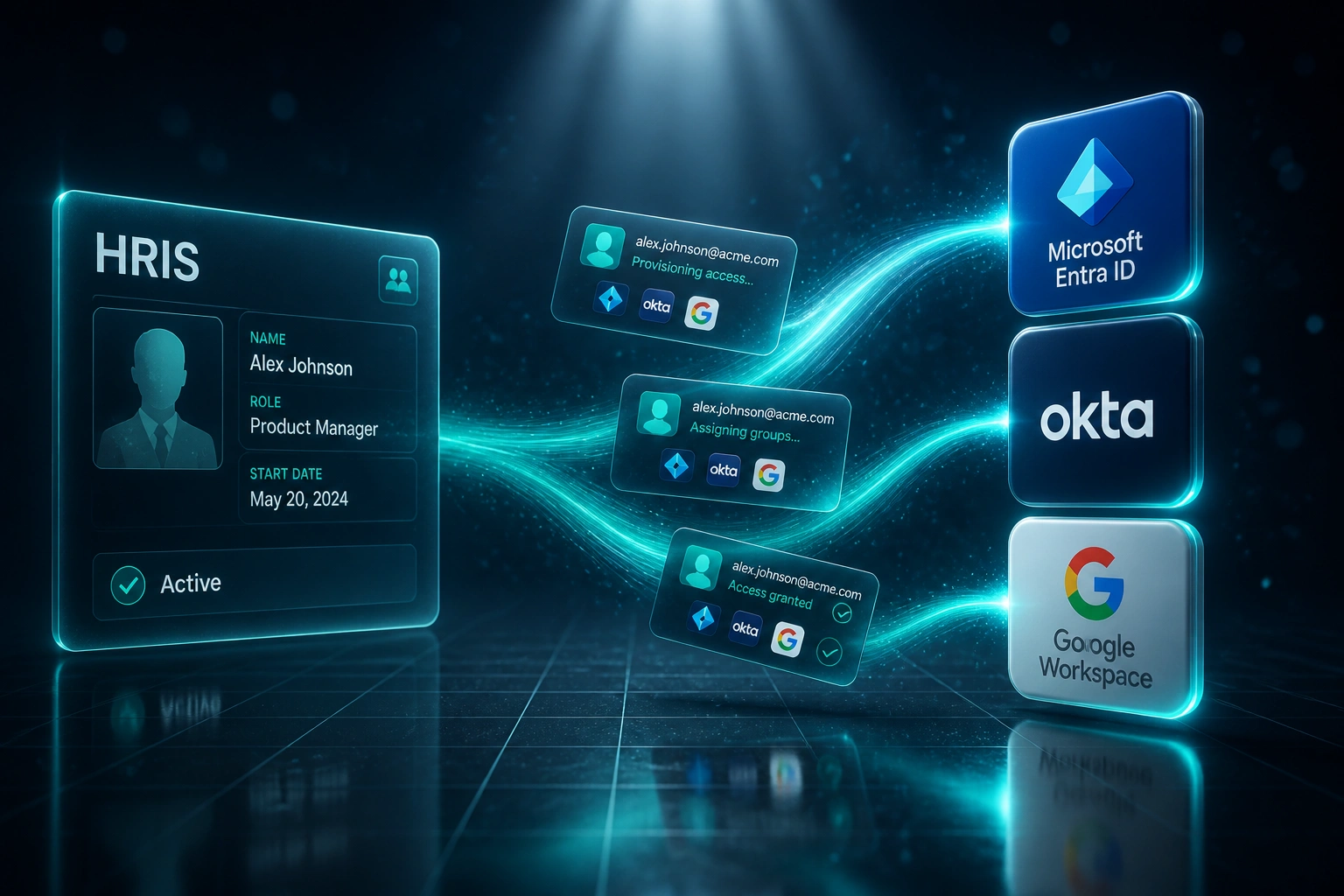
Hire recorded → accounts created → role updated → access revoked. No human copying names into every admin console.
HR Records the Event
Joiner, mover, or leaver is entered once in your HRIS with role and dates
Identity Provider Updates
Entra ID, Okta, or Google Workspace creates, adjusts, or disables the directory account
Apps Follow Automatically
SCIM and connectors push the right accounts and groups into CRM, email, Slack, and more
Access Matches Reality
Day-one productivity for joiners, least-privilege for movers, same-day cut-off for leavers
Everything You Need for a Reliable Account Lifecycle
Joiner Provisioning
HR records a start date and role. Accounts appear in your identity provider and connected apps before day one, with the right groups already assigned.
Mover Access Updates
When someone changes department or seniority, permissions follow the new role. Old entitlements drop off instead of piling up.
Leaver Deprovisioning
The moment HR marks someone as departed, connected apps lose access. Orphaned accounts stop being a week-long cleanup project.
HRIS as Source of Truth
BambooHR, Sage People, SimplePay, or your HR system drives the account lifecycle. IT stops retyping the same joiner form into every tool.
SCIM and Connector Coverage
Where SCIM exists we use it. Where it does not, we build reliable connectors so non-SCIM apps still join the same joiner-mover-leaver flow.
Audit-Ready Change Logs
Every grant and revoke is timestamped. When POPIA or a customer audit asks who had access and when, you have the answer without a spreadsheet hunt.
Systems We've Connected for Provisioning
From 7-Day Access Delays to Same-Day Accounts
How an 85-person Johannesburg professional services firm closed orphaned accounts, cut IT ticket load, and recovered R210,000 in year one.
The Manual Process
- IT created accounts by hand across Google Workspace, HubSpot, Slack, Xero, and project tools
- Average 7 hours of IT labour per joiner, spread across a week of tickets
- New hires typically waited 5–7 days for full access, sitting idle on day one
- Leavers took a week or more to fully revoke; a quarterly audit found 14 orphaned accounts
- HR, managers, and IT chased each other on every hire, move, and exit
The Automated Process
- HRIS start date and role feed Microsoft Entra ID, then connected apps via SCIM and connectors
- Standard joiners get day-one accounts without an IT ticket for each app
- Role changes update groups automatically instead of leaving old access behind
- Leavers lose connected access the same day HR marks them departed
- IT only handles exceptions and new app onboarding, not every hire
Before vs After Automated Onboarding
How It Works
From first conversation to live account lifecycle automation in 3–6 weeks for a focused first wave.
Map Your Lifecycle
Which HRIS, which identity provider, which apps staff actually need, and where manual tickets still create the delay.
Free Scoping Call
30-minute call to design joiner, mover, and leaver rules, pick the first wave of apps, and size the build.
Build & Pilot
We wire HRIS to your IdP and apps, pilot with one department, and prove day-one access plus same-day offboarding before wider rollout.
Go Live & Expand
Switch off the manual checklist for in-scope apps. Monitoring catches failed syncs, and we add the next tools as you grow.
Frequently Asked Questions
How long does automated user provisioning take to set up?
A focused first wave covering your HRIS, identity provider, and core apps usually takes 3–6 weeks from scoping to go-live. Broader estates with many non-SCIM tools take longer, but we stage by risk so email, collaboration, and CRM go live first.
Which systems can you connect for account lifecycle automation?
We routinely connect BambooHR, Sage People, SimplePay, and other HR platforms to Microsoft Entra ID, Okta, or Google Workspace, then out to Microsoft 365, Slack, HubSpot, Salesforce, Xero, and custom SaaS. If staff need an account there today, we can usually bring it into the automated flow.
Will this disrupt IT or HR while we roll it out?
No. We keep the existing ticket process as a fallback during the pilot, prove joiner and leaver behaviour on a small group, and only retire the manual checklist once results match your rules. Most teams notice fewer tickets, not a big-bang cutover.
How does this help with POPIA and security audits?
POPIA Section 19 expects appropriate technical and organisational measures against unauthorised access. Automated deprovisioning shortens the window where former staff can still reach personal information, and the change log shows when access was granted and revoked if an auditor or incident response team asks.
What if some of our apps do not support SCIM?
That is normal. Industry research shows most SaaS tools either lack SCIM or lock it behind an enterprise plan. We use SCIM where it exists, and build connector-based provisioning for the rest so those apps still follow the same joiner-mover-leaver rules.
How much does user provisioning automation cost?
Scoped builds typically start around R25,000 for a lean HRIS-to-IdP-to-core-apps rollout, and run R40,000–R90,000 when many apps and custom role rules are involved. Against roughly R8,100 in labour per manual hire plus days of idle new-hire productivity, most mid-sized South African teams see payback within two to four months.
Stop Leaving Security Gaps in Your Account Lifecycle
If new hires still wait on IT tickets and leavers keep access for days, you are paying for a problem that automated user provisioning already solves.
Tell us which HRIS and identity provider you use, which apps matter most, and where joiners and leavers create the most friction. We will show you exactly how automated onboarding and offboarding would work for your organisation.