Win-Back Campaigns: Re-Engage Lapsed Customers Profitably
Acquisition keeps getting more expensive while your highest-ROI revenue sits in customers who already bought once. Sitting on a large lapsed list without a multi-channel win-back campaign means you are paying full CAC to replace buyers you could recover for a fraction of that cost.
We build the CRM-synced win-back campaigns that bring them back.
Sound Familiar?
These are the exact issues marketing leads faced before we built their win-back campaigns:
- Your lapsed customer list keeps growing while paid acquisition eats the budget
- Win-back emails go out as a quarterly blast with one generic offer for everyone
- No CRM segment for recency, value, or channel preference, so timing is guesswork
- Email-only outreach misses buyers who live on WhatsApp and SMS in South Africa
- Nobody can say what a reactivated customer costs versus a newly acquired one
Customer acquisition costs have risen about 222% over five years, while email deliverability pressure makes lazy blasts riskier. In South Africa, WhatsApp reaches roughly 94–96% of internet users: brands still running email-only win-backs are leaving recoverable revenue on the table.
What a Multi-Channel Win-Back Campaign Actually Does
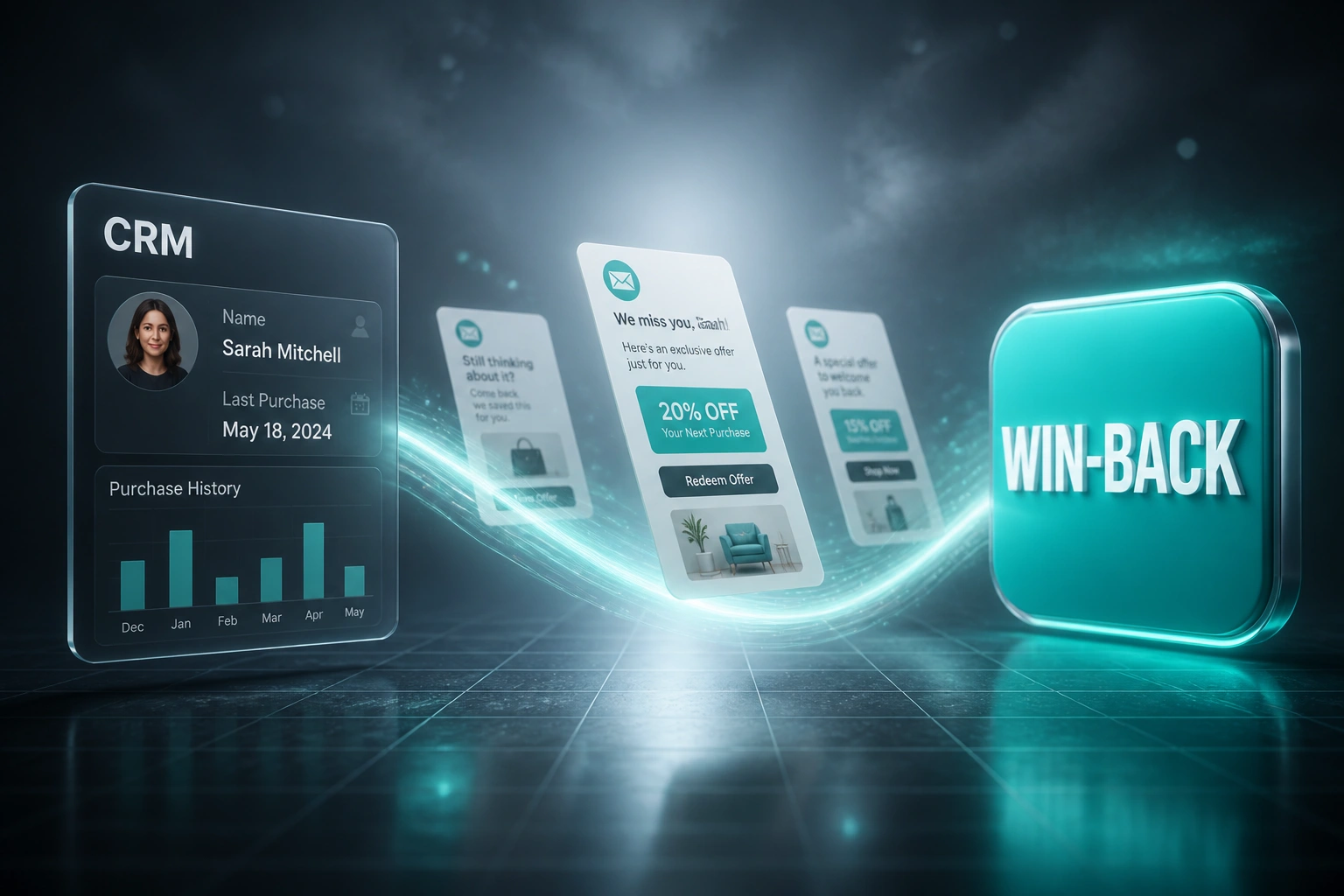
Lapsed segment syncs → personalised offer deploys → channels fire on schedule → revenue returns to CRM.
CRM Flags Lapsed Buyers
Purchase recency and value thresholds sync into campaign-ready segments
Offers & Timing Deploy
Personalised messaging and offer ladders go out in the optimal send window
Channels Re-Engage
Email, WhatsApp, and SMS coordinate so non-openers get the next best touch
Revenue Syncs Back
Orders and reactivation status write back to CRM for ROI reporting
Everything You Need to Re-Engage Lapsed Customers
CRM-Synced Lapsed Segments
Pull recency, order value, and product history from your CRM or store so every win-back campaign speaks to the right cohort.
Multi-Channel Campaign Orchestration
Coordinate email, WhatsApp, and SMS with shared journey state, frequency caps, and collision prevention across channels.
Offer Escalation Ladders
Start with personalised reminders, then escalate to free shipping or modest discounts only for engaged non-converters.
Optimal Send Timing Windows
Trigger at 1.5–2× your repurchase cycle, not a blunt 90-day rule, so you catch buyers before brand recall fades.
Personalised Messaging at Scale
Product recommendations, last-purchase context, and channel preference drive the copy, not a single batch template.
Reactivation ROI Dashboards
Track reactivation rate, revenue recovered, cost per returnee, and CAC comparison so marketing can defend the budget.
Platforms We've Wired for Win-Back Campaigns
From R780 CAC to R95 Per Returnee
How a Cape Town ecommerce brand recovered R2.4M from its lapsed list in 90 days with multi-channel win-back campaigns.
The Batch Blast Approach
- 18,000 lapsed buyers sat idle while Meta and Google CAC climbed
- Marketing sent one quarterly email with a flat 20% off to the whole list
- No CRM split by recency, AOV, or WhatsApp consent
- About 3% reactivation, mostly discount chasers with weak second orders
- Finance could not compare cost per returnee to true CAC
The Multi-Channel Win-Back
- CRM segments by 60 / 120 / 180-day lapse and predicted order value
- Offer ladder: reminder first, then free shipping, then 10–15% for engagers
- Email plus WhatsApp for consented buyers, SMS only for email non-openers
- ~16% programme reactivation across the lapsed list in 90 days
- Dashboard showed R95 cost per returnee versus R780 blended CAC
Before vs After Win-Back Campaign Design
How It Works
From first conversation to live win-back campaigns in 3–5 weeks.
Audit Your Lapsed List
We map how many buyers are dormant, by how long, and what they are worth if they return.
Design the Campaign
Segments, offer ladder, channel mix, and send windows sized to your repurchase cycle.
Build & Test
We wire CRM sync, creative, and multi-channel journeys, then test against a holdout cohort.
Launch & Optimise
Go live with monitoring on reactivation rate, revenue recovered, and cost per returnee.
Frequently Asked Questions
What is a win-back campaign for lapsed customers?
A win-back campaign is a multi-channel marketing programme that re-engages buyers who have stopped purchasing. It uses CRM-synced segments, personalised messaging, timed offers, and channels like email, WhatsApp, and SMS to bring them back profitably, rather than replacing them with expensive new acquisition.
How is this different from a dormant-account reactivation sequence?
Win-back campaigns are marketing-led: offers, creative, and send timing across channels for people who already bought once. Dormant-account reactivation sequences focus on product or login inactivity with value segmentation and incentive ladders inside the product. We build both, but this engagement is campaign-and-offer led.
When should we start a win-back campaign after the last purchase?
Trigger at roughly 1.5–2× your average repurchase interval. Consumables often start at 60–90 days; apparel at 120–180 days. Klaviyo benchmark data shows sends at 30–45 days after last purchase can convert about 2.3× better than sends at 90 days or later when that window fits your cycle.
Do we need a discount to re-engage lapsed customers?
Not always. Omnisend data shows a first win-back email without a discount can still convert around 1.2% of recipients. Best practice is to lead with personalised value, then escalate to free shipping or a 10–15% offer only for engaged non-converters. Deep discounts above 20% rarely justify the margin hit.
Which channels work best for win-back in South Africa?
Email remains the scalable base layer, but multi-channel sequences lift reactivation by roughly 47% versus email alone. In South Africa, WhatsApp reaches about 94–96% of internet users with open rates near 98%, so pairing email with WhatsApp and selective SMS is usually the highest-ROI mix for lapsed buyers.
How much does a multi-channel win-back campaign build cost?
Scoped campaign builds typically range from R25,000 to R60,000 depending on CRM complexity, channel count, and offer logic. Against a cost per returnee near R95 versus several hundred rand in CAC, most clients with a meaningful lapsed list see payback within one to two campaign cycles.
Stop Paying Full CAC for Customers You Already Won
If your lapsed list is growing while acquisition costs climb, you are funding the most expensive way to replace revenue you could recover with a proper win-back campaign.
Tell us how large your lapsed list is, which CRM and channels you run, and what a returning order is worth. We will show you how multi-channel win-back would work for your catalogue.