Abandoned Cart Recovery Automation: Recapture Lost Sales
South African online stores lose most carts before payment. Manual follow-ups arrive too late, SMS never fires, and you keep buying ads to replace shoppers who already had items in checkout.
We build the recovery sequences that bring them back.
Sound Familiar?
These are the exact issues ecommerce founders and marketing leads bring us:
- Over 70% of carts leave without a purchase, and nobody follows up until the next morning
- Marketing spends hours copying cart links into one-off emails while the shopper has already moved on
- SMS and WhatsApp reminders never fire because cart data never reaches your messaging tools
- Recovered orders are not logged back into the CRM, so sales and support have no history
- You keep buying Facebook ads to replace shoppers you already had in checkout
Manual recovery typically takes 6–48 hours, while emails sent within the first hour convert at roughly double the rate of next-day sends. Paid acquisition costs keep rising, but a recovery SMS in South Africa still costs cents, not rands per click.
What Cart Abandonment Recovery Actually Does
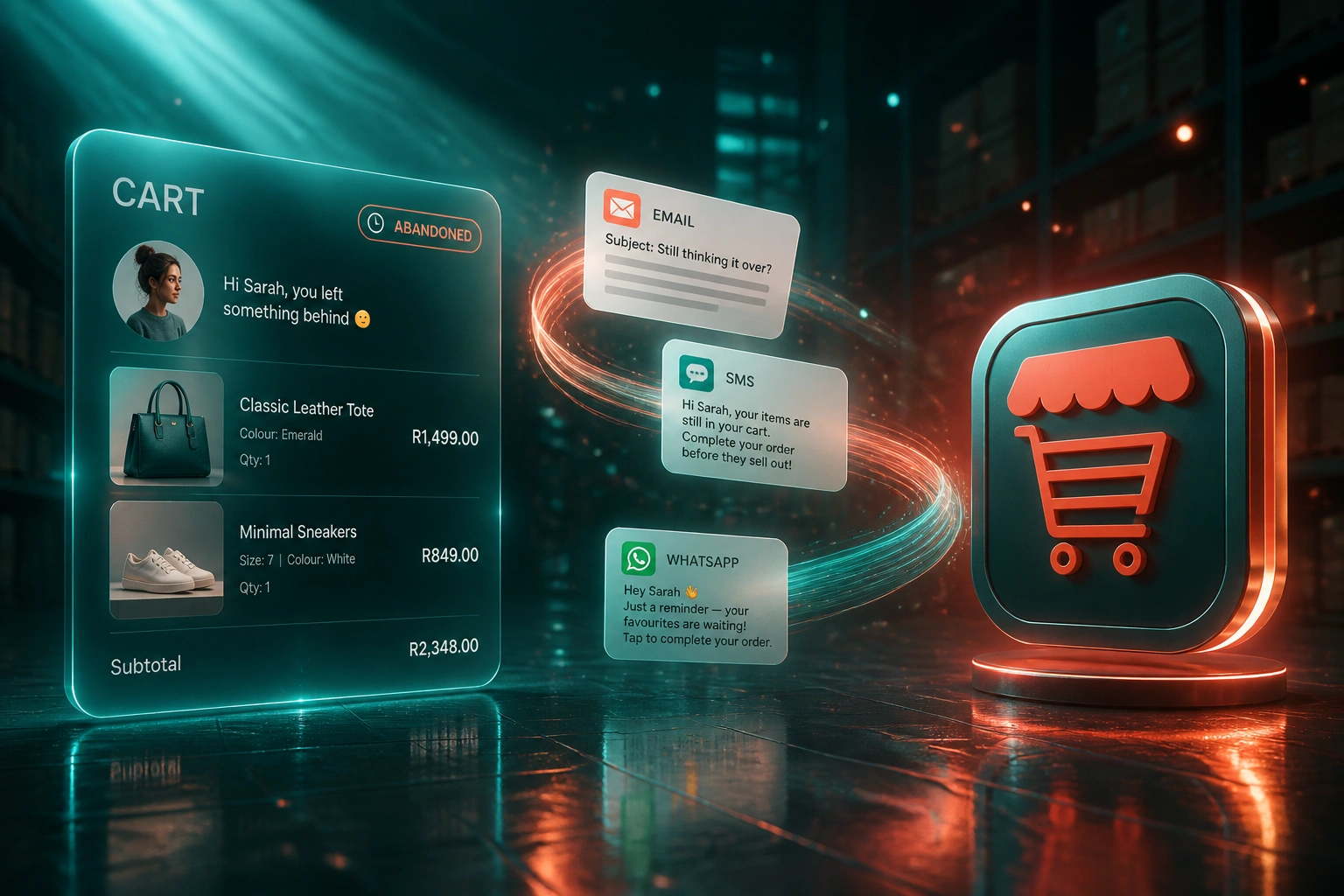
Cart drops → sequence fires → payment link opens → order writes back. No one copying cart URLs by hand.
Cart Abandoned
Shopper leaves checkout on Shopify, WooCommerce, or your custom cart
Sequence Starts
Email, SMS, or WhatsApp fires with cart items and a checkout link
CRM and Gateway Sync
Profile, consent, and payment status stay aligned across tools
Revenue Recovered
Completed orders attribute to the sequence step that closed them
Everything You Need for Reliable Cart Recovery
Timed Recovery Sequences
Cart abandoned → email within 45 minutes, SMS at the right pause, WhatsApp when consent allows. Three touches beat one every time.
Cart and Profile Sync
Line items, totals, and customer details sync into your CRM or ESP so every message is personalised and POPIA-aware.
One-Click Payment Links
Each follow-up carries a deep link back to the exact cart and your PayFast, Ozow, Stripe, or Yoco checkout.
Consent and Suppression
Purchasers drop out instantly. Opt-outs and quiet hours are respected so you recover revenue without burning the list.
Multi-Channel Routing
Email for detail, SMS for urgency, WhatsApp for conversation. Channel order follows what the shopper actually opens.
Revenue Attribution
Recovered orders write back to the CRM with source, sequence step, and value, so you can see payback in Rand, not guesses.
Platforms We've Wired for Cart Recovery
From R38K to R92K Recovered Each Month
How a Cape Town Shopify lifestyle brand stopped leaving carts cold and cut follow-up from eight hours a week to one.
The Manual Process
- Marketing assistant exported abandoners the next morning and emailed one by one
- Eight hours a week copying cart links, with no SMS or WhatsApp
- First touch often 18–30 hours late, when intent had already cooled
- Recovered about R38,000 a month from carts that still answered
- CRM never saw the recovery attempt, so support had no context
The Automated Process
- Cart drop triggers email within 45 minutes, SMS at 24 hours, WhatsApp where consented
- Marketing reviews suppressions and offers for about one hour a week
- Payment links reopen the exact PayFast checkout with items intact
- Recovered revenue lifted to about R92,000 a month
- Every recovered order writes back to HubSpot with sequence step and value
Before vs After Cart Recovery Automation
How It Works
From first conversation to live cart recovery in 2–4 weeks.
Tell Us Your Store
Platform, payment gateway, ESP or CRM, and how you handle consent today.
Free Scoping Call
30-minute call to map abandonment volume, average cart value, and the sequence that fits your brand.
Build & Test
We wire cart events to messaging, test with real abandoners, and tune timing before go-live.
Go Live & Monitor
Switch off manual chasing. Dashboards and alerts show recovery rate, revenue, and suppression health.
Frequently Asked Questions
How long does abandoned cart recovery automation take to set up?
A standard Shopify or WooCommerce recovery flow takes 2–4 weeks from scoping to go-live. Stores that already use Klaviyo or Omnisend can often go live faster. Custom carts and multi-channel WhatsApp setups typically take 4–6 weeks.
Which platforms can you connect for cart recovery?
We have built recovery flows for Shopify, WooCommerce, custom carts, and Takealot seller workflows, syncing into Klaviyo, HubSpot, Omnisend, and CRM tools. If your store can emit a cart event and your messaging tool has an API, we can connect it.
Will this disrupt our current marketing workflows?
No. We design sequences to sit alongside your existing campaigns. Your team keeps the same tools. Automation handles the timed follow-ups, and we run parallel testing before switching off manual chasing.
How do you handle POPIA and messaging consent?
Recovery only runs where you have a lawful basis: transactional cart reminders for identified shoppers, and marketing SMS or WhatsApp only where consent is recorded. Opt-outs and purchase suppressions apply immediately across channels.
Is SMS cheaper than buying more ads to replace lost carts?
In South Africa, bulk SMS typically costs R0.20 to R0.35 per message. Meta traffic clicks often run R5 to R25. A recovery SMS that reopens a cart you already paid to acquire is almost always cheaper than replacing that shopper with a new click.
How much does cart recovery automation cost?
Simple one-way email recovery syncs start from around R15,000. Multi-channel setups with CRM write-back, SMS, and WhatsApp typically range from R25,000 to R60,000. Most stores with 20+ recoverable carts a day see ROI within 4–8 weeks from recovered revenue alone.
Stop Leaving Abandoned Carts Cold
If your store is still chasing abandoners by hand, or not at all, you are funding paid ads to replace shoppers who already chose your products.
Tell us which platform you run, which payment gateway and ESP you use, and how many carts drop each week. We will show you exactly how a recovery sequence would work for your store.