Agentic AI Workflows: Autonomous Multi-Step Business Process Automation
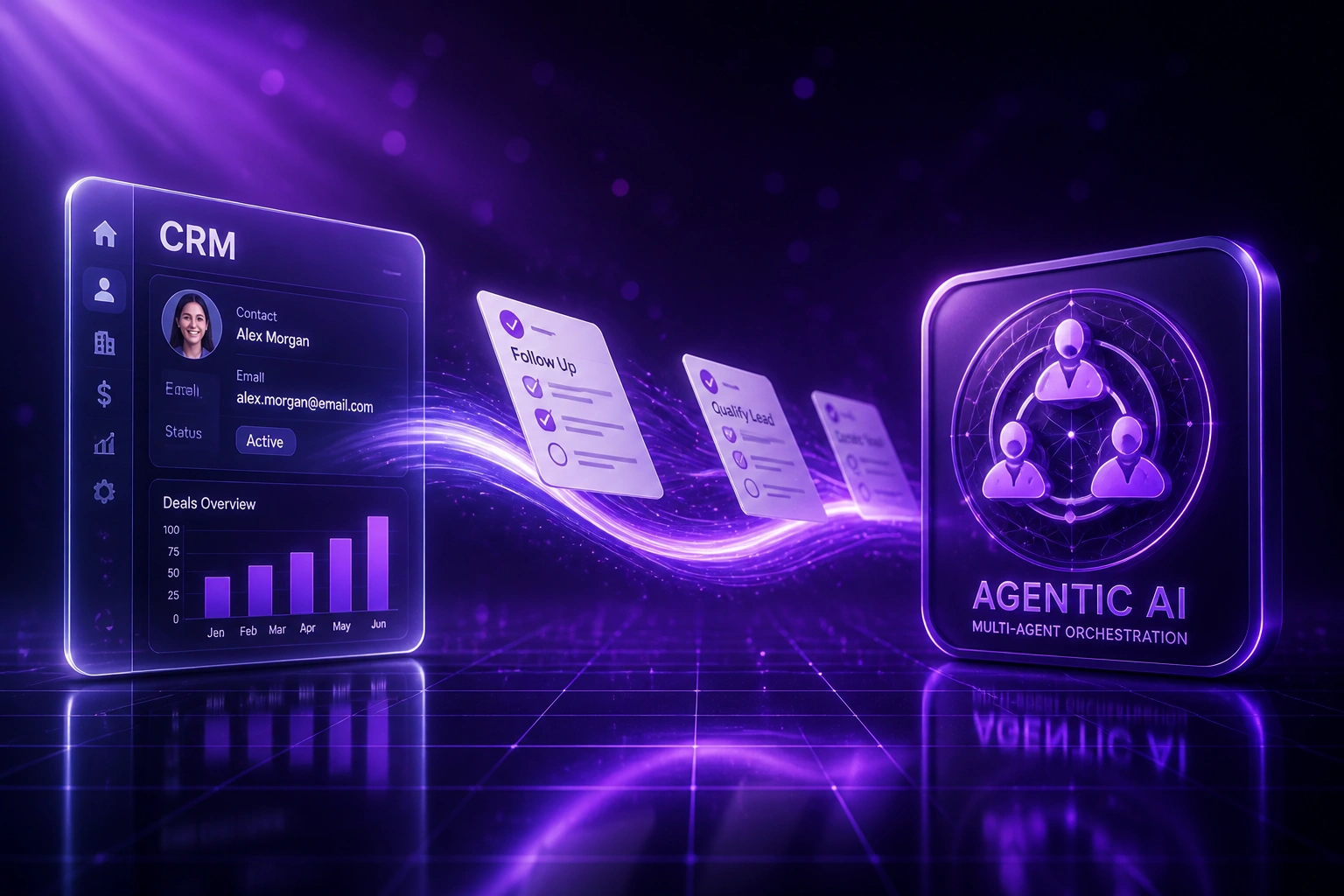
Your COO is drowning in handoffs. Sales closes in the CRM, ops rebuilds the project, finance retypes the invoice, and someone still has to chase the welcome email. Brittle Zapier-style chains crack the moment the process branches.
We build AI agents that plan, act, and escalate across your systems so multi-step work finishes without a human at every step.
Sound Familiar?
These are the exact issues our clients faced before agentic workflow orchestration:
- Won deals sit for days while ops re-keys the same client into project, finance, and email tools
- Zapier-style chains break on branching logic, so someone still babysits every exception
- Finance, sales, and delivery each wait on the others before the next step can start
- Nobody owns the end-to-end process, so delays hide between handoffs instead of on a dashboard
- Month-end becomes a reconciliation scramble because systems never stayed in sync during the month
Gartner predicts over 40% of agentic AI projects will be cancelled by the end of 2027, largely because of unclear value, rising costs, and "agent washing" that rebrands chatbots and RPA as autonomous agents. Buying a washed tool is the expensive path. A scoped multi-step workflow with measurable cycle-time cuts is the reliable one.
What Agentic AI Workflow Automation Actually Does
Trigger fires → agent plans the path → systems update → humans only see exceptions.
Business Event Fires
Deal won, invoice overdue, renewal due, or onboarding form submitted in your CRM
Agent Plans & Acts
Checks policy, chooses the branch, and coordinates CRM, finance, ops, and email steps
Systems Stay in Sync
Project created, invoice drafted, stakeholders notified, statuses written back
Escalate or Complete
Edge cases land with a human; clean runs finish without another handoff queue
Everything You Need for Autonomous Process Orchestration
Autonomous Multi-Step Agents
AI agents plan and execute full business processes across CRM, finance, ops, and email, not just a single task when a human prompts them.
Decision Points Built In
Agents choose the next action from live data: which invoice terms, which owner, which follow-up path, then continue without a meeting.
Cross-System Coordination
One orchestration layer updates HubSpot, Xero, project tools, and inbox together, so no department becomes the human API.
Escalate Only When Needed
Confidence thresholds and policy rules pause the agent for human approval on edge cases. Everything else runs through.
Audit Trail & Guardrails
Every agent step is logged with reasons, so COOs can see what ran, why it branched, and who approved exceptions.
Beyond Brittle Zap Chains
Replace fragile linear automations with stateful agentic AI workflows that handle branching, retries, and recovery without a tangle of Zaps.
Platforms We Orchestrate Across
From 14 Hours/Week of Handoffs to 2.5
How a mid-size South African professional services firm cut multi-system process time from days to hours with agentic AI workflows.
The Manual Handoff Chain
- Ops copied won deals from HubSpot into the project tool by hand
- Finance rebuilt client details and line items in Xero days later
- Welcome and kickoff emails waited on whoever remembered
- Average 3–5 business days from deal close to client live and invoiced
- A brittle Make/Zapier tangle failed whenever a deal branched oddly
The Agentic Process
- Deal won triggers an agent that plans project setup, invoice draft, and communications
- CRM, Xero, and ops tools update in one coordinated run
- Policy exceptions escalate with a context pack; clean deals finish alone
- Same-day client kickoff and draft invoice, every ordinary deal
- Ops reviews a queue of exceptions instead of ferrying every step
Before vs After Agentic Orchestration
How It Works
From first conversation to live autonomous workflows in 3–6 weeks for a focused process.
Map the Process
Which handoffs hurt most: deal-to-delivery, invoice-to-cash, onboarding, renewals. We document triggers, decisions, and systems.
Free Scoping Call
30-minute call to design the agent flow, escalation rules, and which steps stay human versus autonomous.
Build & Test
We build the multi-agent orchestration, run it in parallel with your current process, and tune confidence thresholds on real cases.
Go Live & Monitor
Agents take the routine path. Dashboards track cycle time, exception rate, and hours recovered so ROI stays visible.
Frequently Asked Questions
How is agentic AI different from Zapier or Make?
Zapier and Make excel at fixed if-this-then-that chains. They struggle when a process needs judgment, multi-path branching, or state across days. Agentic AI workflows plan the next step from live context, coordinate across systems, and escalate only when policy or confidence requires a human. We often keep simple Zaps where they fit, and reserve agents for the multi-step work that keeps breaking.
Will agents replace our ops and finance team?
No. Agents remove the ferrying of data between CRM, finance, ops, and email. Your team keeps ownership of exceptions, client relationships, and judgment calls. The goal is fewer late nights chasing handoffs, not fewer skilled people.
How long does an agentic workflow project take?
A focused multi-step process (for example deal-won to project setup, welcome sequence, and draft invoice) typically takes 3–6 weeks from scoping to go-live. Broader portfolios covering renewals, collections, and onboarding usually land in 6–10 weeks, with the first process live earlier.
What happens when the agent is unsure?
We set confidence and policy guardrails during design. Low-confidence decisions, high-value invoices, or unusual contract terms pause in an escalation queue with the context pack your team needs. The rest of the pipeline keeps moving.
Which systems can agentic workflows connect?
We have orchestrated agents across HubSpot, Pipedrive, Salesforce, Xero, Sage, Slack, Microsoft 365, project tools, and custom internal systems. If your stack has an API or a reliable export path, we can include it in the workflow.
How much does agentic AI workflow orchestration cost?
Focused multi-agent builds for one end-to-end process typically start from around R45,000. Cross-department orchestration with several decision branches and escalation paths usually sits in the R60,000–R120,000 range. Firms recovering 10+ hours a week of coordination often see payback inside one to two quarters.
Stop Paying the Handoff Tax Between Your Systems
If your team is still the integration layer between CRM, finance, ops, and email, you are funding a problem agentic AI workflows already solve.
Tell us which multi-step process burns the most hours, which systems it touches, and where Zaps keep breaking. We will show you how autonomous agents would plan, act, and escalate for your business.