AI Bank Reconciliation: Intelligent Transaction Matching for SA Businesses
Month-end still burns days because FNB, Absa, and Nedbank EFTs rarely carry clean invoice references. Split payments and partial remittances stall cash application while AR ageing pretends those invoices are still open.
We build AI matching that recovers most of that reconciliation time and applies cash the day it clears.
Sound Familiar?
These are the exact issues our clients faced before AI transaction matching:
- Month-end bank reconciliation eats 20–50 hours because EFT references never match invoice numbers cleanly
- Split payments and partial remittances sit in suspense while AR ageing still shows those invoices as open
- Xero and Sage bank rules auto-match only about 60–67% of lines; the rest is hand matching every close
- Finance chases already-paid invoices because cash application lags 1–3 days behind the bank feed
- Staff shortages leave junior bookkeepers stuck on transaction matching instead of SARS-ready exception work
Half of finance teams still take six or more business days to close, and cash reconciliation is the number-one time sink. With SARS and audit readiness on the calendar, delayed cash application and unmatched bank lines are no longer a quiet back-office problem.
What AI Bank Matching Actually Does
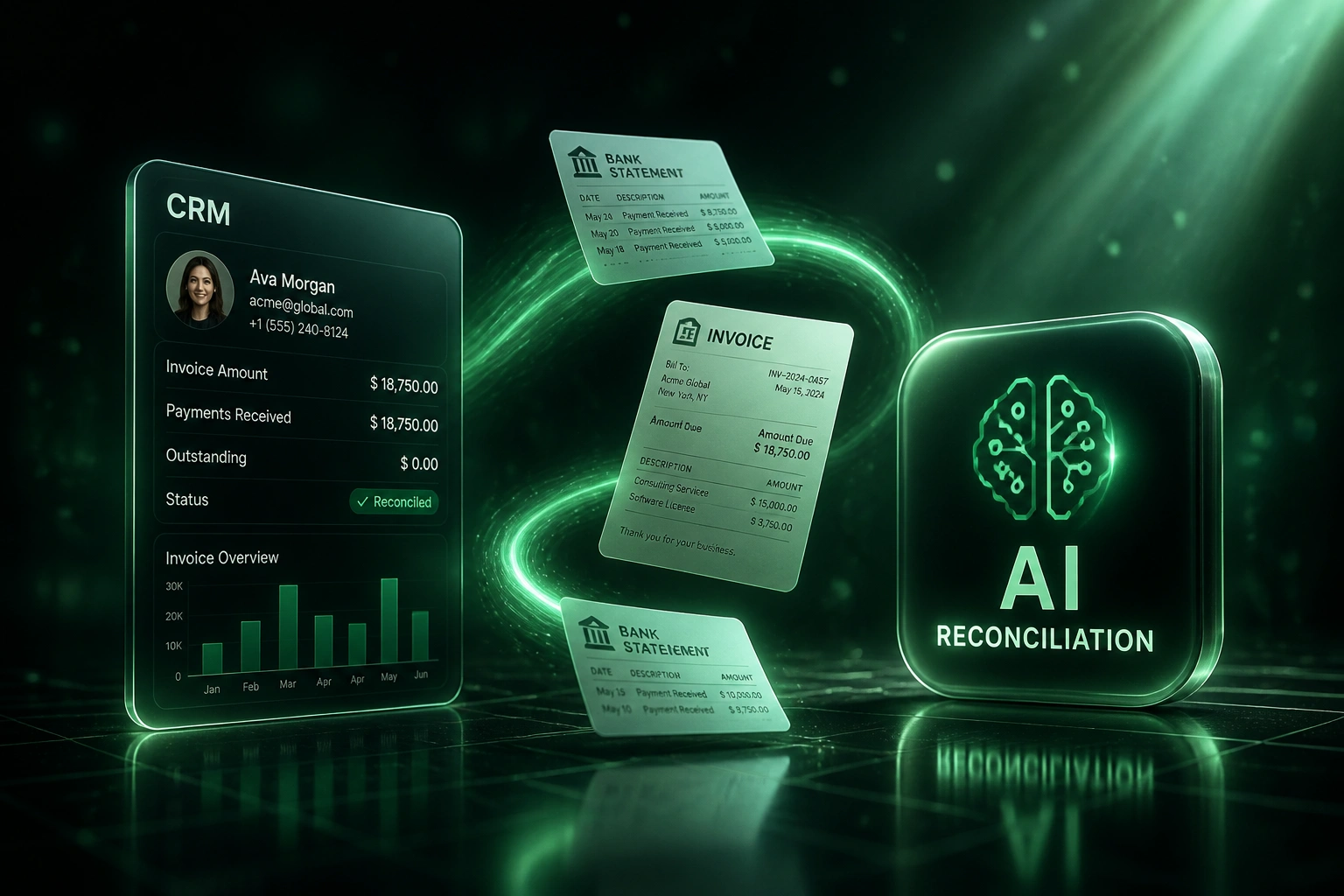
Bank feed lands → AI matches invoices → exceptions queued → cash applied. Finance stops line-by-line comparing.
Bank Feed Arrives
FNB, Absa, Nedbank, Standard Bank, or Capitec lines import into Xero, Sage, or QuickBooks
AI Matches Transactions
Machine learning scores invoice, payer, amount, and reference patterns, including splits and partials
Exceptions Queued
High-confidence matches post; ambiguous lines pause with suggested invoices and reasons
Cash Applied Faster
AR ageing reflects cleared cash the same day; month-end accounts reconciliation shrinks to exceptions
Everything You Need for Reliable AI Reconciliation
Intelligent Transaction Matching
Machine learning matches bank lines to open invoices and payments using amount, date windows, payer history, and fuzzy EFT references, not just exact invoice numbers.
Split & Partial Remittances
One Absa deposit covering five invoices, or a Capitec short-pay against a balance, splits and applies automatically with a clear allocation trail.
SA Bank Feed Support
Works with FNB, Standard Bank, Absa, Nedbank, and Capitec feeds into Xero, Sage, or QuickBooks, including statement PDF and CSV paths where live feeds are patchy.
Exception Queues Only
High-confidence matches post straight through. Ambiguous lines pause with suggested matches so finance reviews the hard 10%, not every statement line.
Faster Cash Application
Payments leave suspense the same day they clear. AR ageing reflects cash already in the bank, so collectors stop chasing paid invoices.
Audit-Ready Match Trail
Every auto-match, override, and split allocation is logged with timestamps and users, ready for month-end, external audit, and SARS queries.
Banks and Ledgers We've Connected
From 28 Hours/Month to Under 4
How a Gauteng distributor cut bank matching time by roughly 85% and cleared unapplied cash days faster.
The Manual Process
- Two bookkeepers compared Absa and FNB feeds to Xero invoices line by line
- Customer EFTs used job numbers, trade names, or blank references
- Split remittances sat in suspense for 2–3 days before cash application
- Bank rules covered repeating suppliers; customer receipts stayed mostly manual
- Month-end close slipped whenever reconciliation backlog spilled into week two
The Automated Process
- AI matches clear most bank lines against open invoices within minutes of import
- Split and partial payments allocate automatically with an audit trail
- Finance reviews a short exception queue instead of every statement line
- Unapplied cash clears same day on high-confidence matches
- Month-end accounts reconciliation shrinks to genuine breaks and timing items
Before vs After AI Transaction Matching
How It Works
From first conversation to live AI matching in 3–5 weeks.
Tell Us Your Setup
Which banks and ledgers you use, how messy remittances arrive, and where month-end matching hurts most.
Free Scoping Call
30-minute call with your CFO or finance manager to map bank feed → AI match → exception queue → cash application.
Build & Test
We train on your historical reconciliations, run parallel against manual matching, and tune confidence thresholds until accuracy meets your bar.
Go Live & Monitor
Finance reviews exceptions only. Dashboards track auto-match rate, hours recovered, and unapplied cash ageing.
Frequently Asked Questions
How is AI bank reconciliation different from Xero or Sage bank rules?
Bank rules and native auto-rec excel at clean, repeating matches. Practitioner testing of Xero's auto-reconciliation typically clears about 60–67% of lines on suitable files, and Xero reports roughly 65% reconciled at 96% accuracy with JAX. AI matching targets the messy remainder: wrong EFT references, split deposits, partial remittances, and payer aliases that rules cannot express. Industry cash-application platforms aim for 90%+ straight-through match rates on that harder work.
Which South African banks and accounting tools do you support?
We connect FNB, Standard Bank, Absa, Nedbank, and Capitec feeds (and statement PDF/CSV extracts where needed) into Xero, Sage Business Cloud, Sage Pastel, and QuickBooks. Multi-account and multi-entity setups are common for mid-market SA firms.
What happens when a payment cannot be matched automatically?
Low-confidence lines pause in an exception queue with the bank narrative, suggested invoices, confidence score, and reason. Clean matches never wait behind those exceptions. Your team confirms or corrects, and the model learns from the override.
Will this disrupt month-end or our auditors?
No. We run parallel for at least one full close so finance can compare AI matches to the manual workbook. Every decision is logged for audit. Your team keeps approving exceptions in the same ledger; automation removes the line-by-line matching grind.
How long does an AI reconciliation project take?
A focused build for one ledger and primary bank feeds typically takes 3–5 weeks from scoping to go-live. Multi-entity groups, Pastel desktop paths, and heavy remittance-email capture usually sit closer to 5–7 weeks.
How much does AI bank reconciliation cost?
Focused AI matching into a single Xero or Sage entity typically starts from around R35,000. Multi-bank, multi-entity builds with remittance capture and custom exception workflows usually sit in the R45,000–R80,000 range. Teams spending 20+ hours a month on cash reconciliation often recover the build within 2–4 months at South African bookkeeper rates of R400–R900 per hour.
Stop Burning Month-End on Bank Matching
If your finance team is still matching EFT lines to invoices by hand, you're spending senior hours on a problem machine learning already solves well.
Tell us which banks and ledgers you run, how remittances arrive, and where the backlog hurts most. We'll show you exactly how AI bank reconciliation would work for your close.