AI BEE Verification: Automate B-BBEE Scorecard Data Collection
Compliance officers, CFOs, and BEE managers at mid-market SA companies still chase supplier certificates, then retype scorecard inputs from payroll and procurement into agency templates. Gaps appear weeks before the SANAS visit, when fixing preferential procurement or Skills Development evidence is a fire drill.
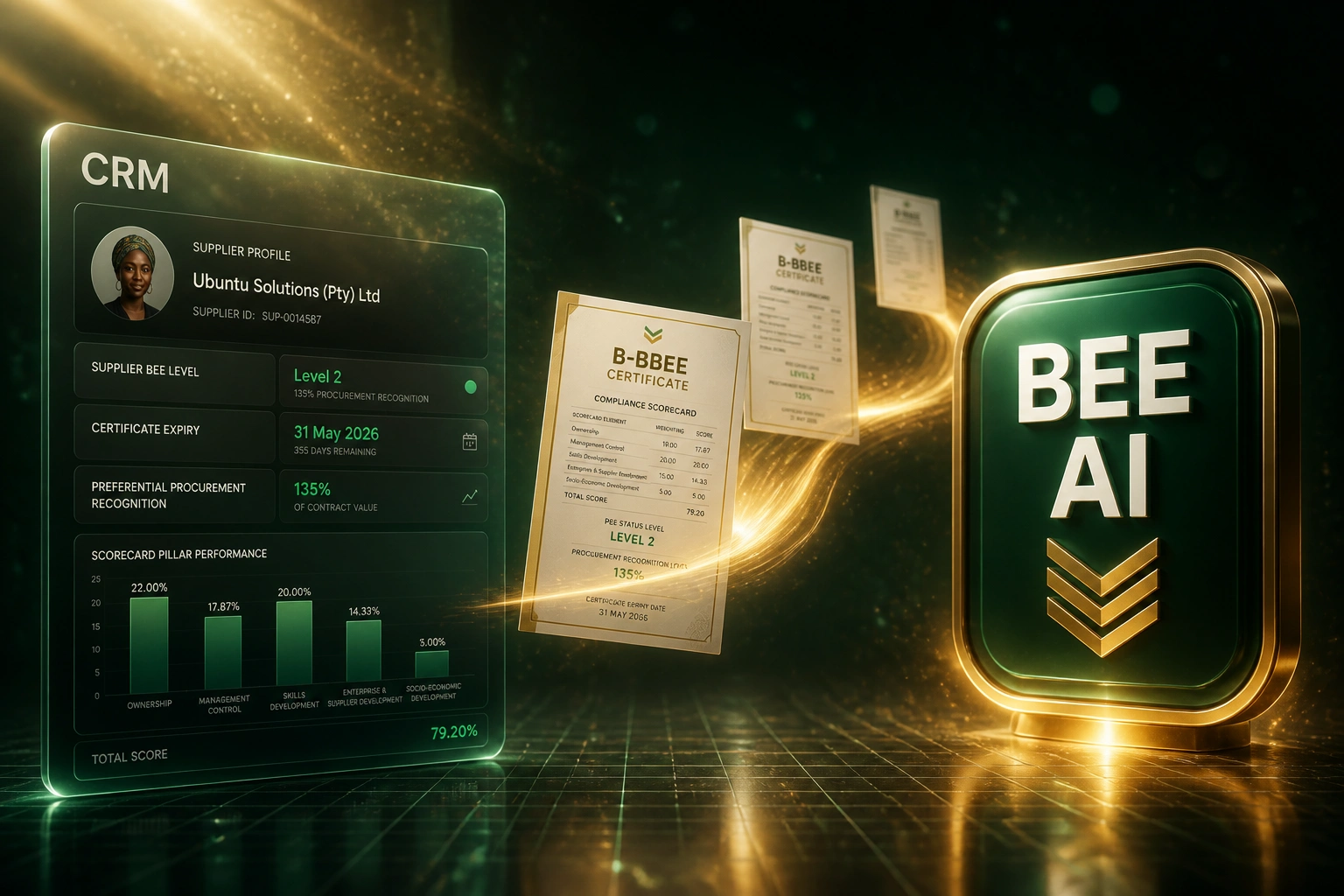
We build B-BBEE AI that extracts certificate fields and maps them to scorecard pillars before verification season starts.
Sound Familiar?
These are the exact issues our clients faced before B-BBEE scorecard automation:
- Compliance and procurement chase hundreds of supplier B-BBEE certificates and affidavits every verification cycle
- Scorecard inputs from payroll, ownership registers, and procurement ledgers are retyped into SANAS agency templates by hand
- Expired or missing supplier certificates default preferential procurement spend to zero recognition
- Gaps on Skills Development or ESD only surface weeks before the agency visit, when fixes are expensive
- A single priority-element miss triggers an automatic one-level downgrade, even when total points look fine
Missing a 40% sub-minimum on Ownership, Skills Development, or ESD drops you one B-BBEE level automatically. Falling from Level 4 to Level 5 cuts customer procurement recognition from 100% to 80%. For a supplier with R50 million of B-BBEE-conscious revenue, that single slip can cost customers R10 million in scorecard value annually.
What B-BBEE Scorecard AI Actually Does
Certificate arrives → fields extracted → pillar mapped → agency pack ready. No human retyping scorecard inputs every year.
Certificate Arrives
Supplier B-BBEE certificate or affidavit lands by email, portal upload, or scan
AI Extracts Fields
Level, recognition %, ownership, expiry, and empowering-supplier status become structured data
Pillars Update
Preferential procurement and related scorecard elements refresh against your supplier ledger
Agency-Ready
Evidence pack exports cleanly so verification is review, not a certificate scavenger hunt
SA Compliance Automation Built for BEE Verification
Supplier Certificate Extraction
AI reads SANAS-style B-BBEE certificates and EME/QSE affidavits. Level, recognition %, ownership %, expiry, and empowering-supplier status land as structured fields.
Scorecard Pillar Mapping
Extracted fields map to Ownership, Management Control, Skills Development, ESD (including preferential procurement), and Socio-Economic Development so your working scorecard stays live.
Procurement Ledger Link
Certificate status ties to supplier spend from your ERP or AP ledger so preferential procurement points rest on verified credentials, not a last-minute spreadsheet scramble.
Expiry & Gap Alerts
Certificates and affidavits are valid for 12 months. Expiry windows and missing evidence flag early so recognition gaps do not appear at verification.
Confidence Review Queue
High-confidence fields post straight through. Ambiguous scans sit in a short queue with the source highlight so BEE managers confirm a handful of cells, not every certificate.
Agency-Ready Evidence Pack
Supplier ledger, certificate file references, and pillar totals export in the shape SANAS-accredited agencies expect, cutting evidence queries and cycle time.
Systems We've Connected for B-BBEE Scorecard AI
From Six Weeks of Certificate Chasing to Nine Days
How a Midrand industrial manufacturer cleared 180 supplier certificates and defended Level 4 without a verification-season scramble.
The Manual Process
- BEE coordinator emailed suppliers for certificates and affidavits for weeks
- About 15–20 minutes per supplier: open PDF, type level, recognition %, expiry into spreadsheets
- Expired credentials and missing affidavits only surfaced when the agency raised queries
- Payroll skills spend and procurement totals retyped into agency templates under deadline pressure
- Preferential procurement points at risk whenever evidence could not be linked to invoices
The Automated Process
- Certificates upload → BEE AI extracts fields in seconds
- Coordinator reviews low-confidence fields only, then posts to the supplier master
- Expiry and missing-evidence alerts run year-round, not only before the agency visit
- Working scorecard shows preferential procurement and ESD exposure in near real time
- Agency evidence pack exports with ledger links, cutting follow-up queries sharply
Before vs After B-BBEE Scorecard Automation
How It Works
From first conversation to live scorecard automation in 3–5 weeks.
Tell Us Your Setup
How many suppliers you measure, which ERP or procurement system holds spend, and where verification-season backlog hurts most.
Free Scoping Call
30-minute call to map certificate fields, scorecard pillars, preferential procurement rules, and the review queue your BEE team will use.
Build & Test
We train on your real certificate mix, wire ledger write-back, and run parallel against manual capture until accuracy meets your bar.
Go Live & Monitor
Switch off blanket retyping. Monitoring tracks straight-through rate, expiry risk, and hours recovered ahead of the next verification.
Frequently Asked Questions
How is B-BBEE scorecard AI different from generic OCR?
Generic OCR copies characters. B-BBEE AI is trained on South African certificate and affidavit layouts: contributor level, procurement recognition percentage, black ownership, empowering-supplier status, issue and expiry dates, and the five scorecard elements. Extraction maps into your working scorecard and supplier master, with validation rules that match how SANAS-accredited agencies read evidence.
Which scorecard elements and systems can you connect?
We commonly extract certificate fields that feed Ownership, Management Control, Skills Development, Enterprise and Supplier Development (preferential procurement, supplier development, enterprise development), and Socio-Economic Development. Spend and supplier masters usually sit in Sage, Xero, SAP, Syspro, Microsoft Dynamics, Excel or SharePoint packs, or custom procurement systems. If the destination has an API or import path, we write structured BEE fields into it.
Will this disrupt our verification agency relationship?
No. Your SANAS-accredited agency still verifies. We prepare cleaner evidence packs so queries drop and cycle time shortens. Agencies bill on time spent; structured certificates and linked invoices typically mean fewer follow-ups and a faster certificate issue.
What happens if a supplier certificate is missing or expired?
Certificates and affidavits are valid for 12 months from issue. Spend with suppliers lacking valid evidence for the measured period generally attracts zero preferential procurement recognition. The system flags missing or expired credentials early so procurement can chase renewals before verification, not during it.
How does this help defend our B-BBEE level?
Ownership, Skills Development, and ESD are priority elements with 40% sub-minimums. Missing any one triggers an automatic one-level downgrade. Preferential procurement alone carries 25 of ESD's 40 points. Continuous certificate capture and pillar mapping surface gaps while you can still act, instead of discovering them weeks before the agency visit.
How much does B-BBEE scorecard automation cost?
A focused supplier-certificate pipeline into one procurement or scorecard workspace typically starts from around R40,000. Multi-source packs covering payroll skills evidence, ownership registers, preferential procurement ledgers, confidence queues, and agency export usually sit in the R55,000–R110,000 range. Mid-market firms that burn six-figure admin on verification prep often recover the build within one verification cycle against staff time and level-risk exposure.
Stop Treating Verification Season Like a Fire Drill
If your compliance team is still chasing supplier certificates and retyping scorecard data every year, you are spending money on a problem that B-BBEE AI already solves.
Tell us how many suppliers you measure, which systems hold procurement and payroll evidence, and where the backlog hurts most. We will show you exactly how scorecard automation would work for your next SANAS verification.