AI Contract Review: Automated Clause Analysis and Risk Identification
Your commercial team is stuck waiting on legal. Manual clause review is slow and inconsistent, so liability caps, indemnity, termination rights, and missing POPIA terms get spotted late, or not at all.
We build the AI that pre-screens every clause against your playbook so deals close faster without raising legal risk.
Sound Familiar?
These are the exact issues our clients faced before AI clause review:
- Commercial directors wait days for legal sign-off while counsel re-reads liability, indemnity, and termination clauses by hand
- Each reviewer flags different risks, so the same MSA comes back with inconsistent redlines week to week
- Missing POPIA operator language and data-processing terms slip through until a vendor assessment or regulator question forces a scramble
- Playbooks exist as PDFs and slide decks, but nobody has time to check every non-standard clause against approved fallbacks
- Deals stall in "legal review" with no clause-level risk summary the commercial team can act on
Section 21 of POPIA requires a written operator agreement whenever a vendor processes personal information on your behalf. The Information Regulator has already issued enforcement notices for missing contracts, and administrative fines can reach R10 million. Clause gaps are a commercial and regulatory risk.
What AI Clause Analysis Actually Does
Agreement arrives → clauses classified → risk scored against your playbook → counsel clears exceptions only.
Agreement Lands
MSA, NDA, or vendor paper from email, SharePoint, or DocuSign enters the review queue
Clauses Classified
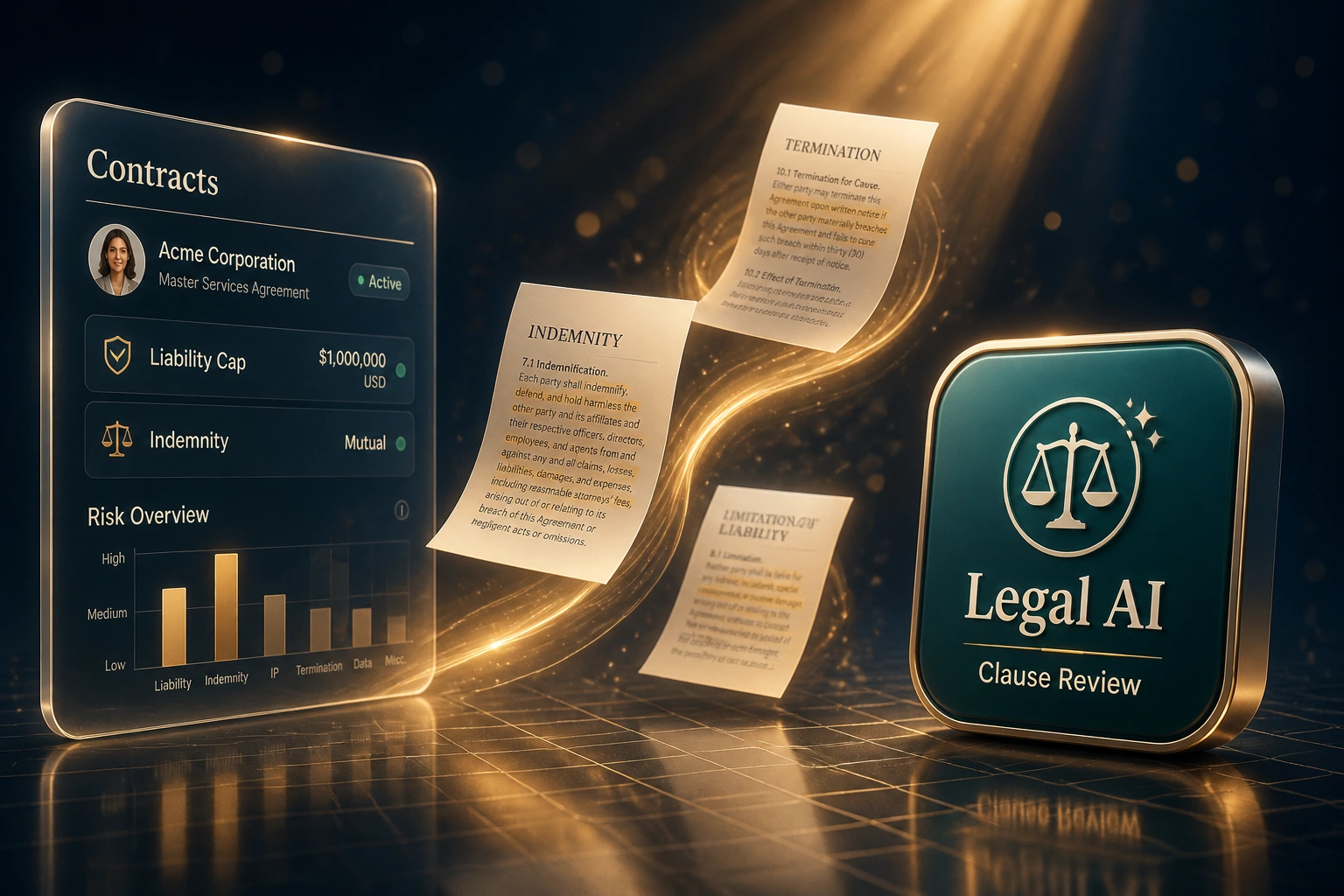
Liability, indemnity, termination, renewal, and data-processing language pulled into structured fields
Risk Scored
Each clause compared to your playbook; non-standard and missing POPIA terms flagged with severity
Counsel Clears
Exceptions reviewed in minutes; commercial gets a clear path to sign-off without the backlog
Everything You Need for Reliable Contract Risk Screening
Liability Cap Screening
AI compares every liability cap, carve-out, and consequential-damage waiver against your approved floors and ceilings before counsel opens the file.
Indemnity Risk Flags
One-sided indemnities, uncapped IP claims, and mutual vs unilateral wording are scored and highlighted so high-risk indemnity never hides in the middle of the pack.
Termination & Renewal Checks
Notice windows, auto-renewals, convenience termination, and survival clauses are extracted and checked against your commercial playbook in seconds.
POPIA & DPA Gap Detection
Missing operator agreements, weak security schedules, and absent section 21 language are flagged so vendor contracts do not leave you exposed under POPIA.
Non-Standard Language Alerts
Every clause is compared to your standard templates and fallback positions. Deviations land in a ranked list, not a 40-page redline dump.
Counsel Exception Packs
On-playbook agreements clear with a short summary. Risky paper arrives with clause citations, severity, and suggested fallbacks so lawyers decide, not hunt.
Intake Sources and Systems We've Connected
From 4 Hours to 25 Minutes per Agreement
How a 60-person SA software company cut legal wait time and stopped liability and POPIA gaps delaying commercial close.
The Manual Process
- GC and legal ops re-read every MSA for liability caps, indemnity, termination, and data terms
- First-pass clause review averaged 4 hours, with different reviewers flagging different risks
- Vendor paper often lacked POPIA operator language until a security questionnaire forced a rewrite
- Average 11 business days from receipt to commercial sign-off on customer MSAs
- Sales and commercial directors chased legal weekly with no clause-level status they could share
The Automated Process
- Agreements from email, SharePoint, and DocuSign enter the queue the moment they arrive
- AI classifies liability, indemnity, termination, and POPIA clauses and scores them against the playbook
- Counsel opens an exception pack and spends about 25 minutes on flagged clauses only
- On-playbook paper clears same day; high-risk deviations arrive with suggested fallbacks
- Commercial sees risk severity and review status without chasing counsel for a verbal update
Before vs After AI Clause Review
How It Works
From first conversation to live clause screening in 3–5 weeks.
Tell Us Your Setup
Which agreement types stall deals most, where paper arrives, and which liability, indemnity, termination, and POPIA rules matter.
Free Scoping Call
30-minute call to map intake → clause extraction → playbook scoring → counsel exceptions, and set severity thresholds.
Build & Test
We encode your clause playbook, wire intake sources, and run parallel on live MSAs and vendor paper until accuracy matches your bar.
Go Live & Monitor
Counsel reviews flagged clauses only. Monitoring tracks review hours, deviation rates, cycle time, and commercial wait time.
Frequently Asked Questions
How is AI clause review different from broader contract analysis?
Broader analysis summarises a whole agreement. Clause review zeroes in on the risk language that actually blocks sign-off: liability caps, indemnity, termination, renewal, and missing POPIA or data-processing terms. We score each clause against your playbook so counsel sees exceptions first, and commercial teams stop waiting on full-document re-reads.
How accurate is the clause extraction and risk flagging?
Independent benchmarks such as the LawGeex study found AI issue-spotting around 94% accuracy versus about 85% for lawyers on timed NDA review. Domain-adapted models routinely report clause-extraction F1 scores near 0.90. We start from your templates and historical redlines, raise confidence thresholds over the first months, and keep humans on low-confidence and high-severity exceptions.
How long does an AI clause review project take?
A focused build for one intake path and one clause playbook typically takes 3–5 weeks from scoping to go-live. Simpler NDAs and order forms can be live in about two weeks. Multi-entity playbooks, DocuSign plus SharePoint intake, and CRM status write-back usually sit closer to 5–7 weeks.
What happens when the model is unsure about a clause?
Low-confidence extractions, unfamiliar counterparty paper, and high-severity deviations pause the agreement, show the suggested reading with confidence, and ask counsel or commercial ops to confirm. Clear, on-playbook contracts never wait behind those exceptions.
Will this replace our lawyers or increase legal risk?
No. Your GC and counsel keep the final call on risk. Automation removes the hours spent hunting liability, indemnity, and POPIA gaps so lawyers spend time on judgment and negotiation. We run parallel testing before switching off the manual first pass.
How much does AI clause review cost?
Focused builds for one intake channel and a single clause playbook typically start from around R35,000. Multi-source intake, CRM write-back, and multi-entity playbooks usually sit in the R45,000–R75,000 range. Teams reviewing 80+ agreements a year often recover the build cost within 2–3 months from staff time alone.
Stop Waiting Weeks on Manual Clause Review
If commercial deals are stuck behind inconsistent, full-document re-reads, you are paying for a bottleneck that clause-level AI already solves.
Tell us which agreements stall most, which liability and POPIA rules matter, and where paper arrives today. We will show you exactly how automated clause analysis would work for your legal and commercial teams.