AI Customer Health Score: See At-Risk and Expansion Accounts Early
Guessing which customers are happy and which are at risk is unreliable. While CSMs manage by spreadsheet, silent churn and missed expansion compound. AI health scoring from product usage, support load, and engagement gives customer success and CEOs a continuous, actionable view of every account.
We build the living health signal so your team acts before risk crystallises.
Sound Familiar?
These are the exact issues our clients faced before AI health scoring:
- CSMs rate account health from gut feel and last week's QBR notes, not live product usage
- Support heat, login decline, and stalled engagement sit in three tools nobody joins weekly
- Spreadsheet health scores go stale within days while silent churn and missed expansion build
- At-risk accounts surface only when a renewal conversation turns cold or a champion goes quiet
- Expansion-ready accounts stay buried under the same green traffic light as merely "fine" ones
A 5% cut in churn can lift profits by 25–95% (Bain), yet most CS teams still spot risk only ~11 days before cancellation. The 52-day gap versus automated scoring is the difference between an 18% save rate and roughly 44%. Competitors with living account health AI will keep the revenue your spreadsheets miss.
What AI Health Scoring Actually Does
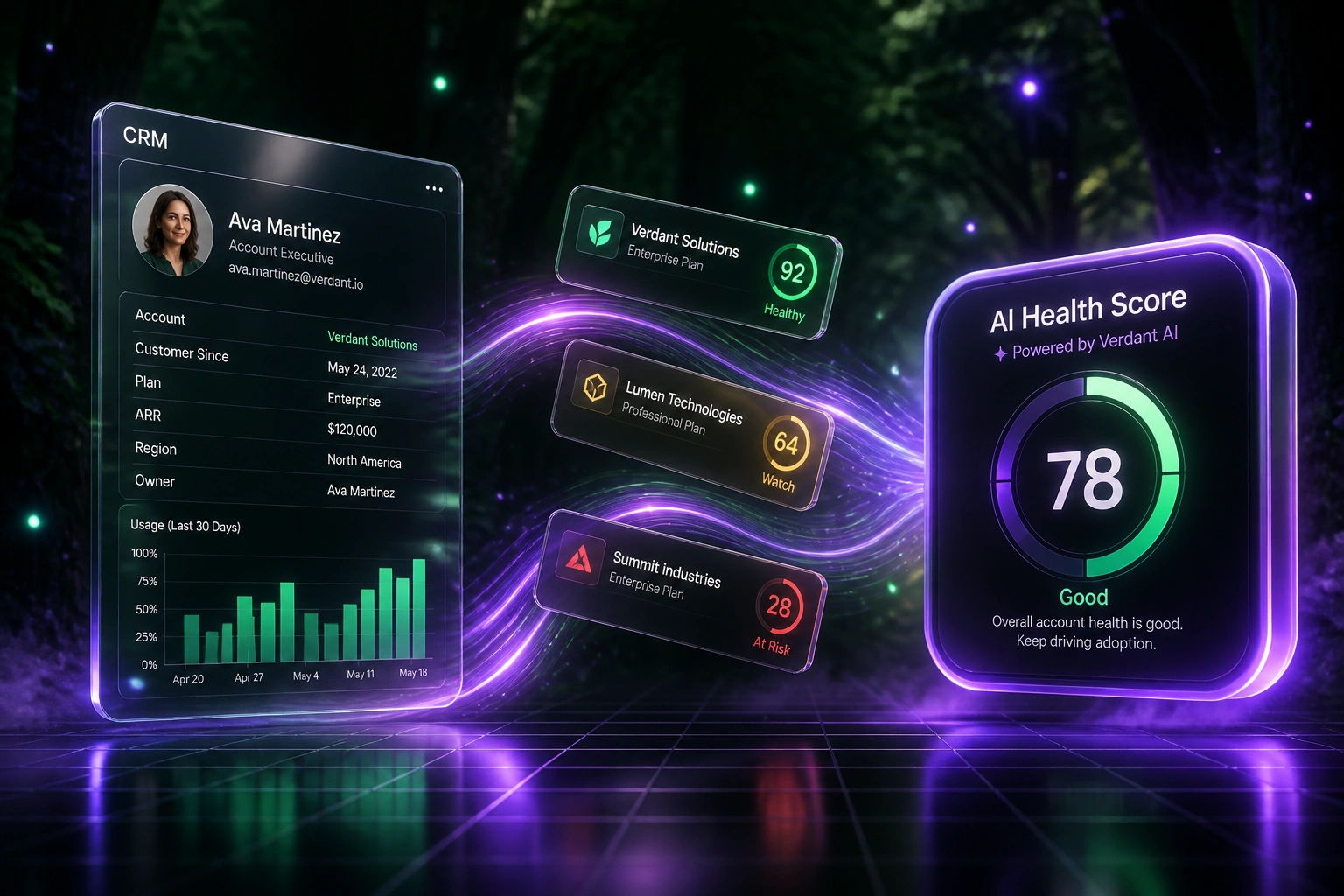
Usage, support, and engagement → continuous customer health score → CRM bands → CS acts on risk and expansion.
Signals Refresh Daily
Product usage, tickets, engagement, and CRM activity update for every live account
Model Scores Account Health
AI rolls signals into a 0–100 customer health score with explainable drivers
Score Writes Back to CRM
Band, score, and delta update. Slack or task alerts fire on sharp declines
CS Triages the Portfolio
Save red accounts early; push green accounts into expansion and advocacy plays
Everything You Need for Reliable Account Health AI
Multi-Signal Health Models
We score every account from product usage, support load, engagement cadence, and CRM activity so AI health scoring reflects how the relationship is really going, not a static traffic light.
Live Account Health Fields
Each CRM record carries a continuous 0–100 customer health score with red, amber, and green bands. CS directors open Monday with a living portfolio view, not a lagging exit list.
Usage, Support & Engagement Inputs
Seat utilisation, feature adoption, ticket volume and severity, NPS or CSAT, email replies, and meeting attendance feed one score so account health AI catches slow declines early.
Expansion & Save Playbooks
Score drops trigger save outreach; rising healthy bands surface expansion and QBR opportunities. Tasks write back to the CRM so the score drives action, not another ignored dashboard.
CRM-Native Score Write-Back
Health scores land in HubSpot, Salesforce, Pipedrive, or Dynamics. Views, Slack alerts, and CS dashboards filter on band and delta without leaving the CRM.
Calibrated Weighting Over Time
We audit score predictions against renewals and expansions every quarter and re-weight signals so account health AI stays accurate as your product and ICP change.
CRMs We've Wired for Customer Health Scores
From 14 Hours of Spreadsheet Scoring to a Living Portfolio
How a mid-market SaaS CS team replaced gut-feel account health with AI scores and lifted NRR by 6 points in a year.
The Spreadsheet Health Ritual
- Each CSM spent ~14 hours a week pulling usage, tickets, and CRM notes into Excel
- Manual assessment spotted risk about 11 days before cancellation
- Save rate on at-risk accounts sat near 18% because outreach started too late
- Portfolio capped around 52 accounts per CSM before quality collapsed
- Expansion candidates and at-risk logos shared the same vague "amber" label
The Living Health Score Week
- Every account carries a live AI customer health score in Salesforce
- Risk surfaces ~63 days earlier, giving CS time to intervene and expand
- Save rate rose to ~44% with playbooks triggered on score drops
- Data prep fell under 90 minutes a week; CSM caseloads scaled toward 95
- Monday standup runs red declines and green expansion bands, not gut feel
Before vs After AI Health Scoring
How It Works
From first conversation to live customer health scores in 3–6 weeks.
Tell Us Your Setup
Which CRM, what usage and support data you have, and how CS currently judges account health.
Free Scoping Call
30-minute call with your CEO or CS lead to define signal weights, bands, and playbook triggers.
Build & Test
We wire the scoring model, write scores into the CRM, and shadow live accounts for a calibration week.
Go Live & Monitor
CS works from the living health list. Dashboards track NRR movement, save rates, and CSM hours recovered.
Frequently Asked Questions
How is an AI customer health score different from churn prediction?
Churn prediction is the binary early-warning alert: who is likely to leave. An AI customer health score is the continuous living signal for every account, built from usage, support, and engagement, so CS and account managers see at-risk and expansion-ready accounts before churn risk crystallises. Health scoring is the daily compass; churn prediction is the red alert.
What signals go into AI health scoring?
Typical models combine product usage and seat utilisation, support ticket volume and severity, engagement (meetings, email replies, QBR attendance), and CRM commercial signals. We start with four to six leading indicators you already collect, then refine weights against your renewal and expansion history.
Will this replace our existing CRM health fields?
It upgrades them. Most CRM health fields are manual or rule-based traffic lights that CSMs stop trusting. We write a calibrated score and band into the same CRM so existing views and workflows keep working, with explainable top drivers so the team can act.
How much CSM time does this free up?
Manual health scoring commonly consumes 12–15 hours per week per CSM gathering data across tools. Automated scoring typically cuts that to under 90 minutes of review, so capacity can scale from roughly 50–75 accounts toward 150+ without proportional headcount (Gainsight / Datagrid benchmarks).
How long does an AI customer health score project take?
Most builds take 3–6 weeks from scoping to go-live: signal audit, model design, CRM write-back, playbook wiring, and a parallel calibration week. Cleaner HubSpot or Salesforce books with clear usage and ticket history can be live in about two weeks.
How much does AI customer health scoring cost?
Custom health models with CRM write-back and CS playbooks typically range from R40,000 to R85,000 depending on data sources and platforms. Teams with meaningful ARR at risk usually recover the project cost within 2–4 months from retained revenue, expansion lifts, and CSM hours alone.
Give CS a Living Health Score, Not a Spreadsheet
If your team still rates accounts by gut feel while usage, support, and engagement live in separate tools, you are funding silent churn and missing expansion that a continuous score would surface weeks earlier.
Tell us which CRM you run, what product and support data you have, and where CS currently loses the plot on account health. We will show you how AI health scoring would rank your book of business.