AI Deal Win Prediction: Stop Trusting Optimistic Forecasts
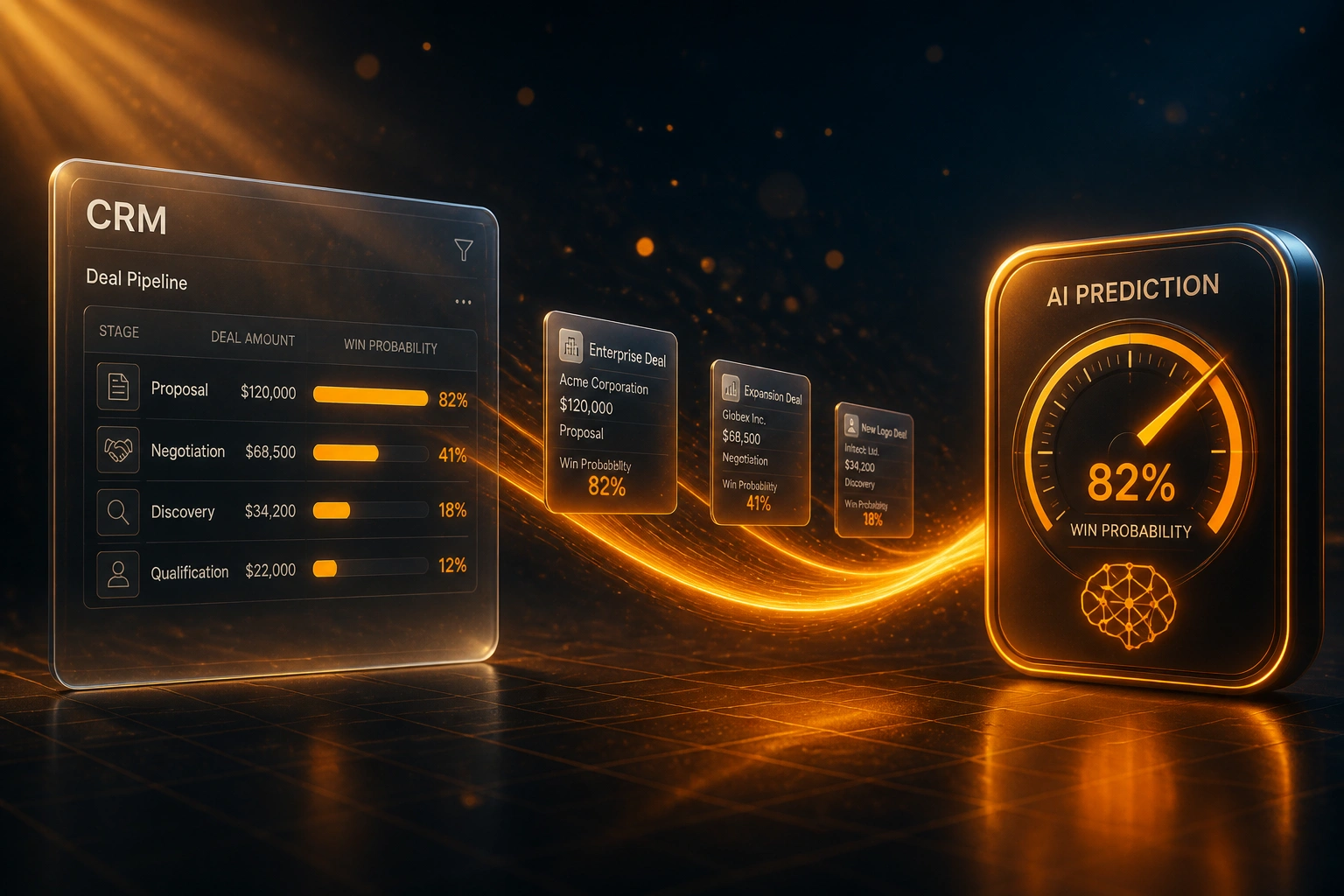
Every Monday your forecast call sounds confident. By Friday the number has slipped. Reps are optimistic about every deal, but sales forecasting AI sees patterns humans miss: win probability from deal attributes, stage velocity, and activity signals, so the commit stops lying.
We build the deal prediction model that scores open pipeline, not gut feel.
Sound Familiar?
These are the exact issues our clients faced before deal prediction:
- Monday forecast calls rely on optimistic commits that miss by 15–25% every quarter
- Reps mark deals at 70% when history shows closer to 40%, and nobody challenges it
- Twenty to forty percent of the open pipeline is dead weight nobody has closed-lost
- Sales directors over-invest SE time and exec sponsorship in deals that never close
- Stage probabilities stay stuck at CRM defaults instead of your closed-won patterns
Xactly's 2024 benchmark found only 20% of sales orgs forecast within 5% of actuals, and 43% miss by 10% or more. Four in five leaders missed at least one quarterly forecast last year. Gut-feel probability is the common thread.
What Deal Prediction Actually Does
Open deal → scored win probability → forecast uses the model → reps stop chasing zombies.
Deal Moves in CRM
Opportunity advances stages, logs activity, or slips its close date in HubSpot, Salesforce, or your CRM
Model Scores Win Probability
AI compares the deal to closed-won history: attributes, stage velocity, and activity signals
Score Writes Back to CRM
Win probability field updates on the opportunity. Forecast views and alerts refresh automatically
Forecast Stops Lying
Monday commits use model scores. Low-probability deals get re-qualified or closed-lost
Everything You Need for Reliable Win Probability AI
Closed-Won Model Training
We train on 12–24 months of your won and lost deals so win probability reflects real patterns: stage velocity, activity signals, and deal attributes, not gut feel.
Live Win Probability Scores
Every open opportunity gets an AI win probability inside the CRM. Forecast calls use model scores, not optimistic stage defaults or rep commit theatre.
Activity & Stage Signals
Email cadence, meeting frequency, stakeholder count, days-in-stage, and close-date slips feed the model so stalled deals surface before the quarter ends.
CRM-Native Probability Fields
Scores write back to HubSpot, Salesforce, Pipedrive, or Dynamics. Pipeline views, weighted forecasts, and board packs filter on predicted win rate.
Risk Alerts & Deal Hygiene
Deals that drift below your threshold trigger alerts. Reps and managers get a clear push to re-qualify or close-lost instead of nursing zombies.
Continuous Retraining
New closed-won and closed-lost outcomes retrain the model on a schedule. Deal prediction stays accurate as your ICP, cycle length, and market shift.
CRMs We've Wired for Deal Prediction
From 22% Miss to 9% Miss
How an 8-person B2B sales team replaced optimistic Monday commits with AI win probability and stopped over-investing in deals that would never close.
The Optimistic Forecast
- CRO ran Monday forecast from rep commits and CRM stage defaults
- Quarterly miss averaged 22%, with board packs rewritten mid-quarter
- Roughly one in three open deals had gone quiet for 30+ days
- Reps spent about 7 hours a week nursing zombie opportunities
- SE and exec time poured into late-stage deals that historically lost
The Modelled Forecast
- Every open deal carries a live AI win probability in HubSpot
- Monday commits use model bands; overrides require a written reason
- Deals below threshold auto-flag for re-qualify or close-lost
- Zombie-deal hours dropped from ~7 to under 1 per rep per week
- SE and exec sponsorship reserved for high-probability late stage
Before vs After Win Probability AI
How It Works
From first conversation to live win probability in 3–6 weeks.
Tell Us Your Setup
Which CRM, how many closed deals you have, and where forecast calls go wrong every Monday.
Free Scoping Call
30-minute call with your sales director or CRO to define accuracy targets, data readiness, and risk bands.
Build & Test
We train the win-probability model on your history, write scores into the CRM, and shadow the live forecast for a week.
Go Live & Monitor
Switch forecast calls to model scores. Dashboards track accuracy lift and hours pulled off zombie deals.
Frequently Asked Questions
How is AI deal win prediction different from CRM stage percentages?
CRM stages apply fixed probabilities (Proposal equals 60%, Negotiation equals 80%) regardless of the deal. AI deal prediction scores each opportunity from closed-won history: activity signals, stage velocity, stakeholder count, and deal attributes. Rep optimism and default weights stop driving the forecast.
How is this different from AI lead scoring?
Lead scoring ranks inbound MQLs at the top of the funnel. Deal win prediction scores open opportunities already in the pipeline: mid and late funnel forecasting so you know which deals will close and which to walk away from. Same CRM, different decision.
How much closed-won data do we need for sales forecasting AI?
We usually start with 12–24 months of closed-won and closed-lost history and consistent stage definitions. Below that threshold we ship a hybrid: historical win rates by stage and segment for coverage, ML where the data is dense, then retrain as volume grows.
Will reps trust the scores on forecast calls?
Adoption fails when scores feel arbitrary. We ship explainability (top contributing signals), calibrate bands against real win rates, and run a shadow week so the CRO can compare model commits to rep commits before go-live.
How long does an AI deal prediction project take?
Most builds take 3–6 weeks from scoping to go-live: data audit, model training, CRM field mapping, forecast dashboard wiring, and a parallel shadow week. Cleaner Salesforce or HubSpot datasets with clear stage hygiene can be live in about two weeks.
How much does AI deal win prediction cost?
Custom win-probability models and CRM write-back typically range from R40,000 to R85,000 depending on data cleanup and platforms. Most teams of 5+ reps recover the project cost within 2–4 months from redirected selling time and fewer false commits alone.
Stop Betting the Quarter on Optimistic Commits
If your Monday forecast call still runs on gut feel and stage defaults, you are planning headcount and cash on a number that already knows how to lie.
Tell us which CRM you run, how many closed deals you have, and where the forecast usually breaks. We will show you how AI deal win prediction would score your open pipeline.