AI Document Summarisation: Key Findings in Minutes, Not Hours
Your ops and executive leads spend evenings grinding through reports, whitepapers, and board packs before meetings. By the time the room starts, half the pack is still unread and decisions stall.
We build AI summary flows that extract key findings and recommendations in seconds, with human review still in the loop.
Sound Familiar?
These are the exact issues our clients faced before AI document summarisation:
- Leadership packs land late, and nobody has four hours free to read 200 pages before the meeting
- Key findings and recommendations sit buried in whitepapers while the team skims the first twenty pages
- Meeting notes from last month never surface the open actions until someone asks in the room
- Prep time eats evenings: ops and exec leads re-read the same report the night before every board
- Decisions get deferred because half the pack went unread and nobody trusts a skim
Board packs keep growing while prep windows shrink. Board Intelligence finds 24% of packs now exceed 200 pages, and 55% of directors receive materials less than five working days before the meeting. Text summarisation is how teams keep decisions on the agenda instead of the unread pile.
What AI Document Summarisation Actually Does
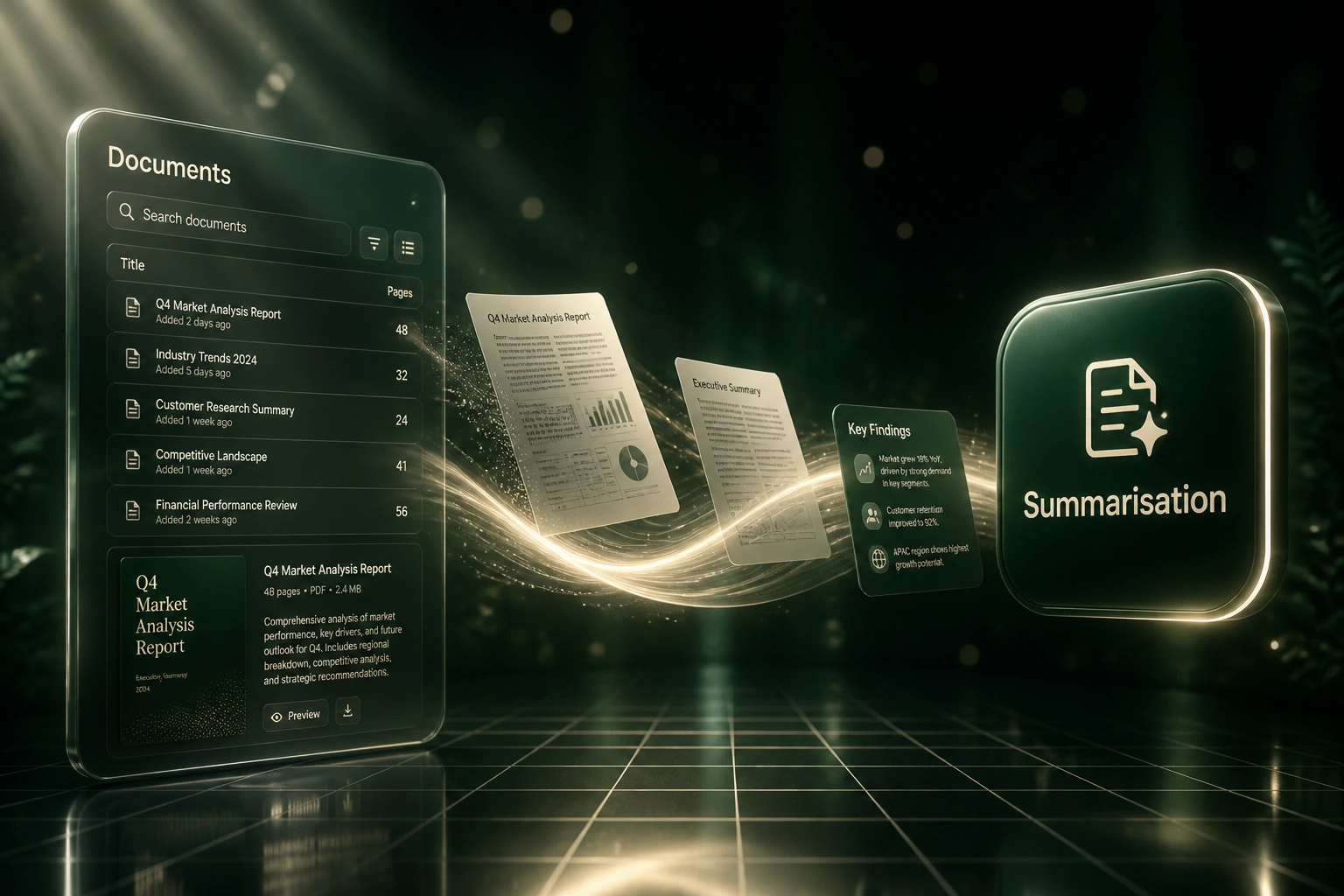
Pack lands → AI summary generated → findings and actions extracted → digest delivered. Prep in minutes, not hours.
Document Arrives
A report, whitepaper, board pack, or meeting-note set lands in SharePoint, Drive, or your library
AI Summary Built
Document summarisation AI extracts key findings, risks, and recommendations
Actions Listed
Open decisions, owners, and follow-ups become a checklist your team can work
Digest Delivered
Brief lands in Slack, Teams, or email so humans review before the meeting
Everything You Need for Reliable Document Digests
Key Findings Extraction
Long reports, whitepapers, and board packs compress into a clear AI summary: findings, risks, and recommendations in seconds.
Action Item Capture
Open decisions, owners, and follow-ups from meeting notes and packs are listed so prep ends with a checklist, not a bookmark.
Human Review Loop
Every summary links back to source pages so leads verify before acting. AI briefs; humans decide.
SharePoint & Drive Ingest
Summaries run when a new pack lands in SharePoint, Google Drive, or your document library, without a manual upload step.
Role-Aware Briefs
Ops, finance, and commercial leads get the same pack summarised for their lens: risks, numbers, or recommendations first.
Meeting-Ready Digests
One-page digests drop into Slack, Teams, or email so the room starts on decisions, not page-turning.
Document Stores We've Connected for Summaries
From 4 Hours to 25 Minutes
How a six-person ops leadership team cut meeting prep on long reports and board packs, recovered 890 hours a year, and kept every decision under human review.
The Manual Process
- Ops and exec leads read 150–220 page packs the night before leadership meetings
- Four hours average to extract findings, risks, and open actions by hand
- Meeting notes from prior weeks sat unread until someone raised them in the room
- Whitepapers and vendor reports were skimmed, so recommendations arrived half-baked
- Decisions slipped a week when the pack landed less than five days out
The Summarised Process
- Pack lands in SharePoint → AI summary with key findings and recommendations
- Twenty-five minutes to review the digest and spot-check source pages
- Action items from meeting notes surface automatically before the next agenda
- Role-aware briefs mean finance and ops read the same pack for their lens
- Humans still approve every recommendation; AI never decides alone
Before vs After Text Summarisation
How It Works
From first conversation to live document digests in 2–4 weeks.
Tell Us Your Setup
Where packs live, who reads them before meetings, and which document types burn the most hours.
Free Scoping Call
30-minute call to map ingest sources, summary formats, review rules, and where digests should land.
Build & Test
We wire summarisation to your libraries, then parallel-test digests against packs your team already knows.
Go Live & Monitor
AI summaries become the default prep path. Monitoring keeps faithfulness, latency, and delivery healthy.
Frequently Asked Questions
How long does AI document summarisation take to set up?
A standard setup for one document library and one digest format takes 2–4 weeks from scoping to go-live. Single-folder pilots can be live within two weeks. Multi-source packs with role-aware briefs and Slack or Teams delivery typically take 4–6 weeks.
Which document types and stores do you support?
We build AI document summarisation for PDFs, Word files, and exported packs from SharePoint, Google Drive, OneDrive, Dropbox, Notion, and Confluence. If your library exposes files via API or webhook, we can connect it.
Will our team still open the full report?
Yes, when they need to. Summaries are the briefing layer: key findings, recommendations, and action items with links back to source pages. People open the full document only when a claim needs checking, which is how human review stays in the loop.
How is this different from AI email summarisation or contract analysis?
Email digests handle threads. Contract analysis scores clauses and playbook risk. AI document summarisation is for general business packs: reports, whitepapers, board materials, and meeting notes turned into findings and recommendations for meeting prep.
How accurate are the summaries?
We tune prompts and review loops on your real packs during parallel testing. Digests cite source excerpts so humans can verify before deciding. Teams treat summaries as the briefing layer, then open the original when a detail matters. Faithfulness remains a known challenge for any LLM summariser, which is why we design for human review rather than unattended decisions.
How much does AI document summarisation cost?
Single-library digests start from around R15,000. Multi-source packs with role-aware briefs, action extraction, and Slack or Teams delivery typically range from R25,000 to R60,000. Teams recovering a few hours a week of meeting prep usually see ROI within 2–3 months.
Stop Burning Evenings on Long Reports
If your ops and executive team is still reading every page before meetings, you are spending money on a problem that document summarisation AI already solves.
Tell us where your packs live, which meetings burn the most prep hours, and what a good digest looks like for your leads. We'll show you exactly how AI document summarisation would work for your business.