AI Employee Engagement: Predict Disengagement and Retention Risk
Attrition burns cash long before the exit interview. Most CHROs and People Ops leads still wait on annual surveys while behavioural signals are already fading. Workforce AI scores retention risk from activity patterns so managers intervene weeks before resignations land.
We build the engagement model that ranks who needs support, not last year's survey heat map.
Sound Familiar?
These are the exact issues our clients faced before engagement prediction:
- Annual engagement surveys arrive months after disengagement has already set in
- Managers only learn someone is leaving when the resignation email lands
- HR spends hours on exit interviews that cannot reverse a decision already made
- Retention risk lives in gut feel, not a ranked list People Ops can act on weekly
- HRIS, calendar, collaboration, and leave signals sit in separate tools with no retention model
89% of South African employers say unfilled critical-skills vacancies hurt operations (Xpatweb 2025). Replacing a mid-level professional on R450k–R750k can cost R450k–R1.1M when recruitment, ramp, and lost productivity are included. Waiting for the annual survey is waiting for cash to walk out the door.
What Engagement Prediction Actually Does
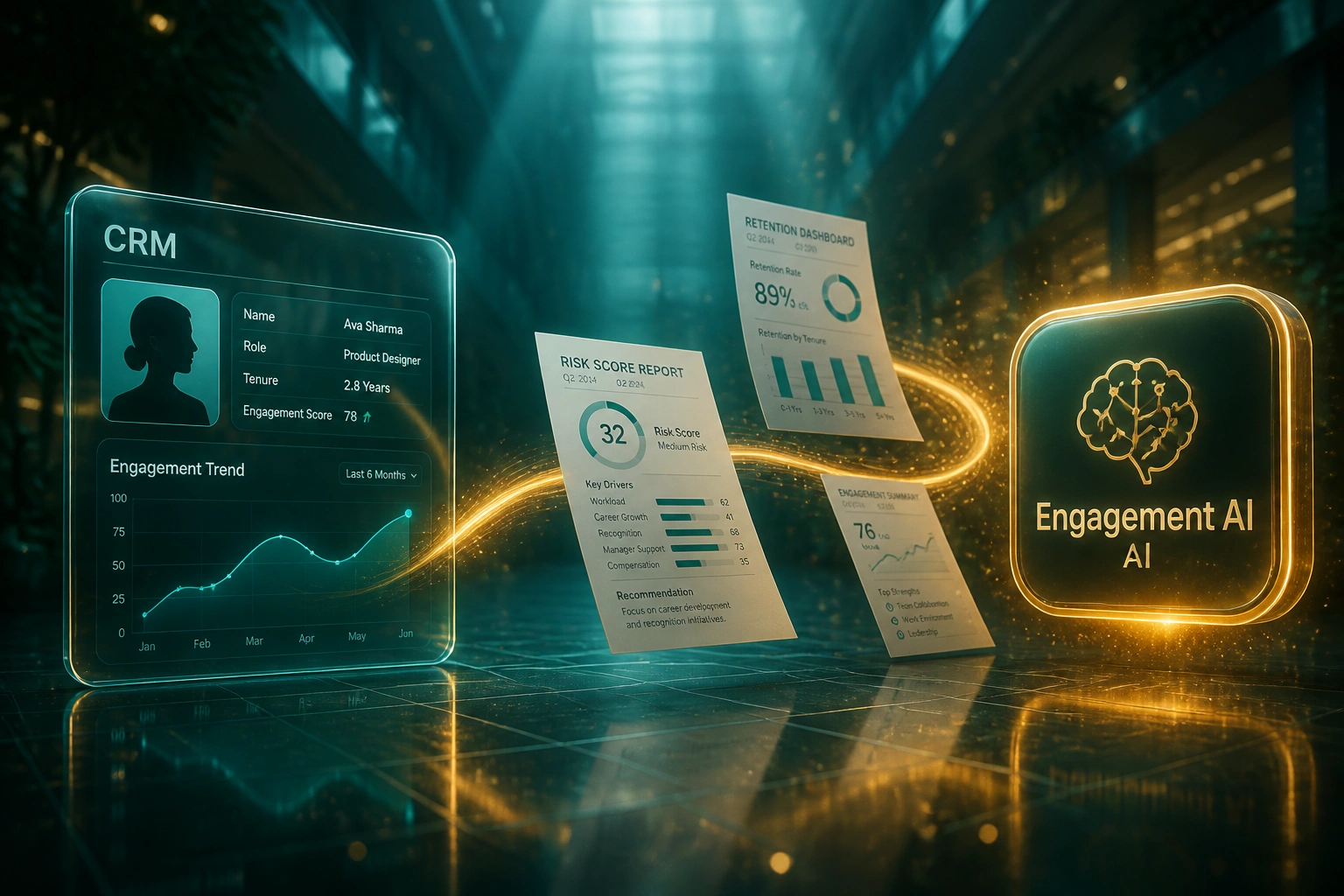
Activity signals → risk score → at-risk list → manager intervention before resignation.
Signals Update Weekly
HRIS tenure, leave, calendar load, collaboration patterns, and recognition events refresh for every employee
Model Scores Retention Risk
AI compares each person to historical leavers: collaboration drop-off, leave spikes, and recognition gaps
Score Writes Back to HRIS
Risk field and at-risk views update. Manager alerts fire for high bands with explainable drivers
Managers Run Stay Playbooks
Supportive interventions start weeks earlier, while the person is still open to staying
Everything You Need for Reliable Workforce AI
Behavioural Signal Models
We train on content-free activity patterns: calendar load, collaboration drop-off, leave spikes, recognition gaps, and tenure bands so retention prediction reflects how people work, not a once-a-year survey score.
At-Risk Employee Lists
Every employee gets a live retention risk score inside the HRIS or manager dashboard. People Ops opens Monday with a ranked attrition list instead of last quarter's engagement pack.
HRIS + Activity Signals
HRIS tenure and role data, calendar load, collaboration patterns, leave, and recognition events feed the model so workforce AI catches quiet disengagement weeks earlier.
Manager Intervention Playbooks
High-risk bands trigger supportive actions: stay conversations, workload reviews, career-path check-ins, recognition prompts, and tasks written back to the manager's queue.
HRIS-Native Risk Fields
Scores write back to BambooHR, Workday, Sage People, SuccessFactors, or your people platform. Views, dashboards, and alerts filter on predicted attrition risk automatically.
Continuous Retraining
Stayed and left outcomes retrain the model on a schedule. Attrition modelling stays accurate as your org structure, hybrid patterns, and role mix change.
HRIS Platforms We've Wired for Retention Prediction
From 14% Regrettable Attrition to 8%
How a mid-market People Ops team replaced lagging engagement surveys with AI risk scores and started supporting at-risk employees six weeks earlier.
The Lagging Survey Cycle
- CHRO saw engagement only after the annual survey closed and the board pack landed
- Managers spotted flight risk about 1–2 weeks before a resignation, if at all
- Successful stay interventions sat at ~22% because outreach started too late
- HR spent ~5 hours a week on reactive exit interviews and replacement admin
- Mid-level exits on R450k–R750k salaries burned R450k–R1.1M each in replacement cost
The Predictive Retention Week
- Every employee carries a live retention risk score in the HRIS
- At-risk list gives ~6 weeks of lead time before typical resignations
- Stay success rose to 58% with playbooks triggered within 48 hours
- Reactive exit-admin load dropped by ~4 hours per week for People Ops
- Monday People Ops standup runs the ranked attrition list, not last year's survey
Before vs After Retention Prediction
How It Works
From first conversation to live retention scores in 3–6 weeks.
Tell Us Your Setup
Which HRIS, what activity and leave data you have, and where attrition currently surprises People Ops.
Free Scoping Call
30-minute call with your CHRO or People Ops lead to define risk bands, intervention playbooks, and POPIA-safe data use.
Build & Test
We train the engagement model on your history, write scores into the HRIS, and shadow live cohorts for a week.
Go Live & Monitor
Switch manager workflows to the at-risk list. Dashboards track intervention rates, lead time, and regrettable attrition avoided.
Frequently Asked Questions
How is AI employee engagement prediction different from an annual survey?
Annual surveys are lagging snapshots. Engagement often starts falling up to nine months before a resignation (Workday Peakon). AI employee engagement prediction scores retention risk from ongoing HRIS and activity patterns so managers get weeks of early warning, not a board pack after the damage is done.
Is this employee surveillance?
No. We design for supportive intervention, not surveillance. Models use aggregated, content-free signals (load, collaboration patterns, leave, recognition gaps) with clear purpose limitation under POPIA. Scores guide stay conversations and career support; they are not performance weapons or secret monitoring of message content.
What data do we need for retention prediction?
We usually start with 12–24 months of voluntary exits and tenure, plus HRIS role and manager history, leave, and available collaboration or calendar load signals. Thin activity data still works with HRIS and recognition events; we expand features as your people stack matures and retrain as volume grows.
Will managers trust and act on the risk scores?
Adoption fails when scores feel arbitrary. We ship explainability (top contributing drivers), calibrate bands against real attrition rates, and wire intervention playbooks so an alert becomes a stay conversation task, not another dashboard to ignore. A shadow week lets People Ops compare model flags to lived experience before go-live.
How long does an AI engagement prediction project take?
Most builds take 3–6 weeks from scoping to go-live: data audit, model training, HRIS field mapping, playbook wiring, and a parallel shadow week. Cleaner BambooHR or Workday datasets with clear resignation history can be live in about two weeks.
How much does AI employee engagement prediction cost?
Custom retention models with HRIS write-back and manager playbooks typically range from R45,000 to R95,000 depending on data sources and platforms. Most teams with mid-level professionals at R450k–R750k recover the project cost within 2–4 months from a handful of prevented regrettable exits alone.
Stop Learning About Attrition from Exit Interviews
If People Ops only hears about disengagement after the resignation lands, you are paying replacement cost for a problem that predictive HR analytics can surface weeks earlier.
Tell us which HRIS you run, what activity and leave data you already have, and where regrettable attrition hurts most. We will show you exactly how engagement prediction would work for your workforce, with POPIA-aware design from day one.