AI Lead Scoring for CRM: Predict Who Will Close
Your reps chase every MQL the same way while high-intent deals go cold. Manual and gut-feel scoring is inconsistent and biased. Predictive lead scoring analyses historical conversion patterns and ranks leads objectively so sales time goes to the highest-probability opportunities first.
We build the ML lead ranking that writes scores into your CRM.
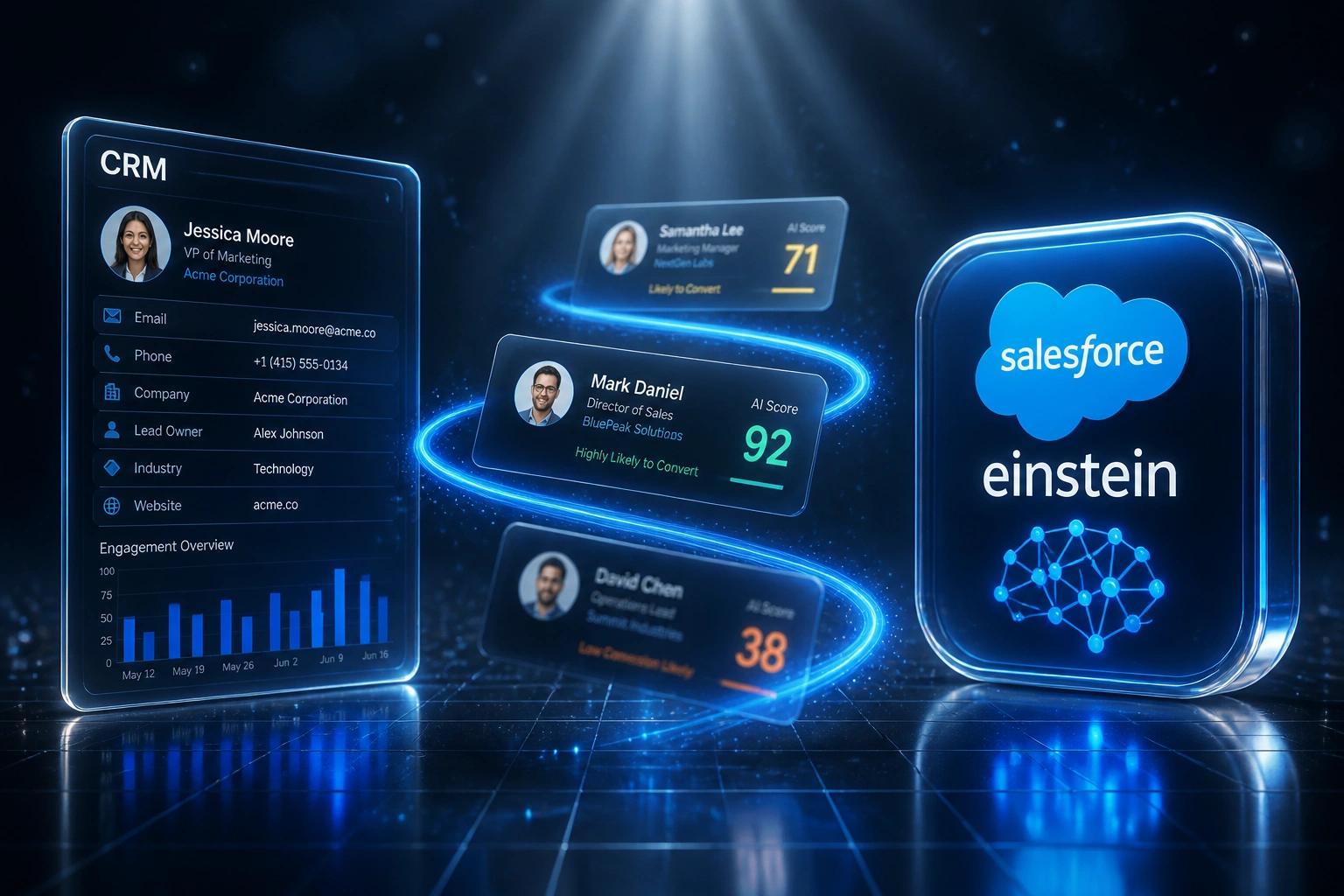
Sound Familiar?
These are the exact issues sales leads and CROs brought to us before predictive scoring:
- Reps chase every MQL equally while high-intent deals go cold in the queue
- Manual scores reflect gut feel and politics, not closed-won conversion patterns
- Sales spends most of the week on leads that were never going to close
- Rule-based points models reward title and form fills, not buying behaviour
- Marketing and sales argue over lead quality with no objective ML ranking
Cost per lead keeps rising while sales capacity stays flat. Sixty-one percent of B2B marketers still send every lead to sales with no scoring. Native Einstein and HubSpot predictive seats often cost R2,700+ per user per month, and still fail when historical data is thin or dirty. Rising CPL makes every wasted call more expensive.
What Predictive AI Lead Scoring Actually Does
Closed-won history trains the model → new leads get ranked → high scores route first. No FIFO queue.
History Analysed
ML learns which firmographic and behavioural patterns predicted closed-won deals
Lead Scored in CRM
Every new MQL gets a predictive score and top contributing signals written back
High Scores Routed
Top-band leads hit AE queues first; mid and low bands stay in nurture
Outcomes Retrain
Won and lost deals refresh the model so ML lead ranking stays accurate
Everything You Need for Predictive Lead Scoring
Predictive Model Training
We train on 12–24 months of your closed-won and closed-lost CRM history so the score reflects who actually converts, not who looks important on paper.
Objective AI Lead Ranking
Every new lead gets a predictive score inside the CRM. High-probability opportunities surface first; low-score contacts park in nurture.
Signal Explainability
Reps see why a lead scored high: firmographics, engagement paths, and conversion lookalikes, so they trust the queue instead of ignoring it.
CRM-Native Score Fields
Scores write back to HubSpot, Salesforce, Pipedrive, or Dynamics properties. Views, lists, and forecasts filter on probability, not arrival time.
Priority Routing & Alerts
Top-band leads assign to the right AE within minutes, with Slack or email alerts so high-intent deals never sit overnight.
Continuous Retraining
Won and lost outcomes retrain the model on a schedule. Predictive lead scoring stays accurate as your ICP and market shift.
CRMs We've Built Predictive Scoring On
From 11% MQL-to-SQL to 49%
How a mid-market B2B team stopped treating every MQL equally and let predictive AI lead scoring decide who sales called first.
The Manual Queue
- Marketing passed ~180 MQLs a month into a FIFO sales queue
- Rule-based points rewarded title and downloads, not conversion likelihood
- Reps spent roughly 70% of outreach time on leads that never qualified
- MQL-to-SQL sat at 11% while high-intent deals went cold overnight
- Sales and marketing argued weekly over whose leads were "good"
The Predictive Process
- ML model trained on 24 months of closed-won and closed-lost CRM data
- Every new lead scored in Salesforce within minutes of creation
- Top-band leads routed to senior AEs; mid-band stayed in nurture
- Reps saw score rationale so they trusted the ranking, not their inbox order
- Unqualified chase time dropped sharply; conversion lifted in 90 days
Before vs After Predictive Lead Scoring
How It Works
From first conversation to live predictive scores in 3–6 weeks.
Tell Us Your Setup
Which CRM, how many closed deals you have, and where reps waste time on unqualified MQLs.
Free Scoping Call
30-minute call with your sales lead or CRO to define success metrics, data readiness, and score bands.
Build & Test
We train the ML model on your history, write scores into the CRM, and shadow-rank the live queue for a week.
Go Live & Monitor
Switch routing to predictive bands. Dashboards track conversion lift and hours recovered per rep.
Frequently Asked Questions
How is AI lead scoring different from rule-based points models?
Rule-based models assign fixed points for title, company size, and form fills. Predictive AI lead scoring analyses historical conversion patterns with machine learning, then ranks who is most likely to close. Manual and gut-feel scoring stays inconsistent and biased; ML ranking is objective and improves as outcomes accumulate.
How much closed-won data do we need for predictive lead scoring?
Salesforce Einstein typically needs around 1,000 qualified leads and 120 closed opportunities. We usually start with 12–24 months of CRM history. Below that threshold we can ship a hybrid model: rules for coverage, ML where the data is dense, then retrain as volume grows.
Can you work with Salesforce Einstein or HubSpot predictive scoring?
Yes. On Salesforce we configure Einstein Lead Scoring (Enterprise+) or layer a custom model when native limits or data quality block accuracy. On HubSpot, predictive scoring sits on Enterprise; we also build custom ML ranking that writes into CRM properties when native tools are too expensive or too opaque for your CRO.
Will sales reps actually use the scores?
Adoption fails when scores feel arbitrary. We ship explainability (top contributing signals), calibrate bands against real win rates, and route only the top band into AE queues. Mid and low bands stay in nurture until behaviour lifts them.
How long does an AI lead scoring project take?
Most CRM predictive scoring builds take 3–6 weeks from scoping to go-live: data audit, model training, CRM field mapping, routing, and a parallel shadow week. Simpler score write-back on a clean Salesforce or HubSpot dataset can be live in about two weeks.
How much does AI lead scoring for CRM cost?
Custom predictive scoring and CRM routing typically ranges from R35,000 to R75,000 depending on data cleanup and platforms. Native Einstein or HubSpot Enterprise seats often run R2,700+ per user per month before implementation. Most teams of 5+ reps recover the project cost within 2–4 months from selling time alone.
Stop Paying Reps to Chase Low-Score Leads
If your sales team still works MQLs in arrival order, you are burning capacity on a problem predictive AI lead scoring already solves.
Tell us which CRM you run, how many closed deals you have, and where high-intent opportunities go cold. Our AI development team will show you how ML lead ranking would score and route your pipeline.