AI Product Description Generation: Unique SEO Copy from Your Catalogue
You are drowning in empty or duplicated product pages. Writing unique descriptions for hundreds of SKUs by hand is too slow, freelancers are too expensive, and manufacturer copy will not win you organic traffic.
We build the product content AI pipeline that turns attributes into SEO-optimised descriptions at catalogue scale.
Sound Familiar?
These are the exact issues our ecommerce clients faced before AI product descriptions:
- Hundreds of SKUs still show manufacturer copy, one-line stubs, or empty description fields
- New products sit in draft for weeks while the team hand-writes SEO-optimised product content
- Freelancers charge R245–R820 per description, and the backlog never clears at catalogue scale
- Duplicate supplier text leaves Google picking someone else's page for the same product query
- Shopify Magic and one-off ChatGPT prompts cannot keep brand voice consistent across 500+ SKUs
Built-in Shopify Magic generates one product at a time, with no bulk pipeline, no PIM sync, and no lasting brand-voice memory. Once you pass a few hundred SKUs, per-product tools become the bottleneck, not the fix.
What the Product Content AI Pipeline Actually Does
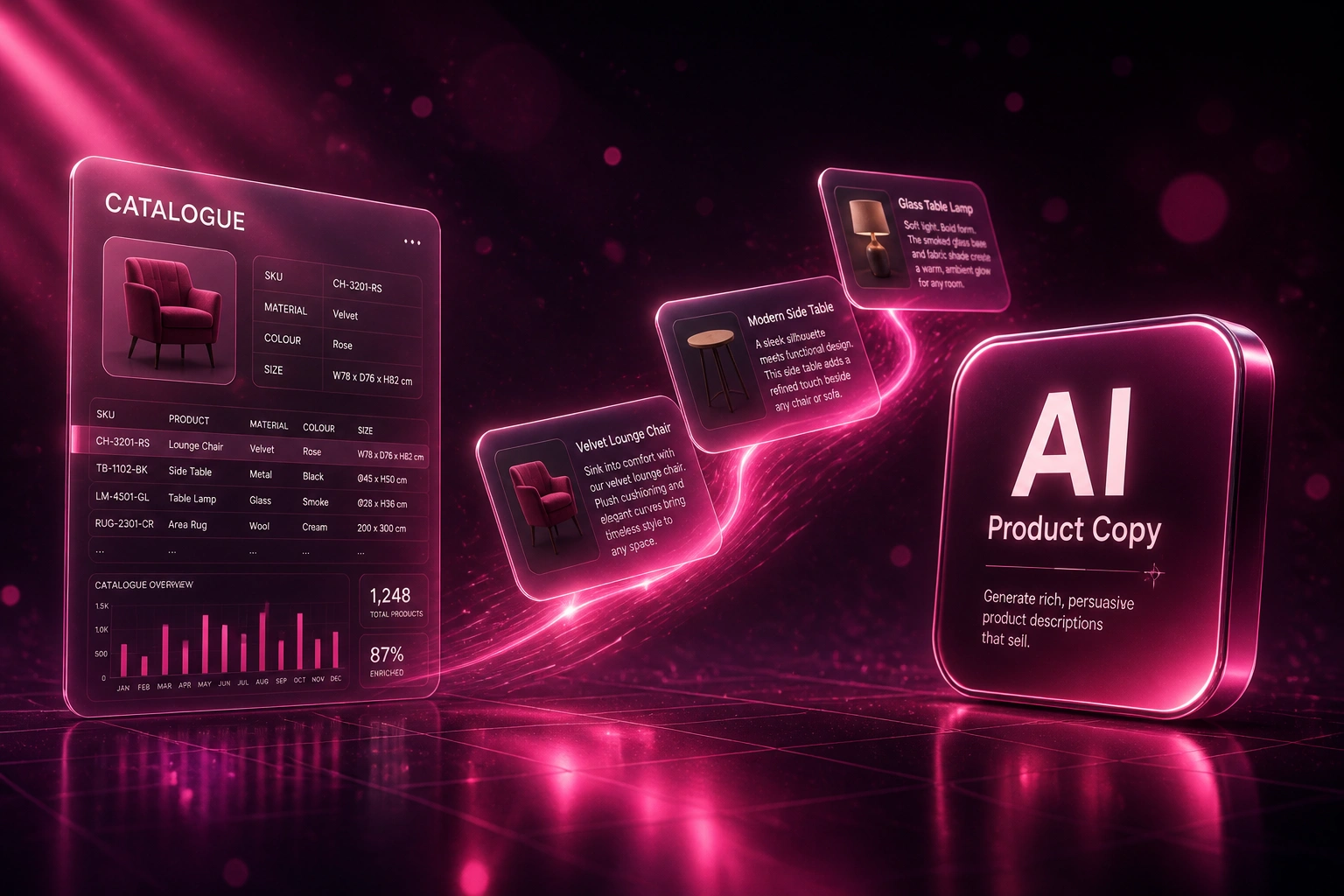
Attributes in → unique SEO copy out → editors approve → store or PIM updated. No hand-rewriting every SKU.
Attributes Arrive
SKU, materials, specs, and category fields pull from Shopify, WooCommerce, Magento, or your PIM
AI Writes the Draft
Brand-voice and SEO rules turn raw attributes into a unique product description and meta copy
Editor Approves
Merchandising reviews facts and tone in a few minutes instead of writing from a blank page
Catalogue Goes Live
Approved copy writes back to the product page so new SKUs launch with SEO-ready content
Everything You Need for Automated Product Copywriting
Attribute-to-Copy Pipeline
SKU, specs, materials, colours, and size fields from your PIM or store feed become unique, SEO-optimised product descriptions ready for review.
Brand Voice Guardrails
Approved samples and tone rules train the model so automated copywriting sounds like your catalogue, not generic ChatGPT filler.
Store & PIM Write-Back
Approved copy lands in Shopify, WooCommerce, Magento, or your PIM description and meta fields so new SKUs go live without retyping.
Bulk Catalogue Refresh
Thin or duplicated pages process in batches. Editors sample and approve instead of writing every line from scratch.
SEO Product Content
Titles, body copy, and meta descriptions target long-tail purchase queries so product content AI supports organic traffic, not just page fill.
Human Review Gate
Nothing auto-publishes by default. Marketing keeps the final say on facts, claims, and voice before copy hits the live catalogue.
Platforms We've Wired for Product Description Generation
From 12 Hours/Week to 3 Hours/Week
How a South African homeware retailer cleared 1,100 thin product pages, sped new SKUs to live, and stopped hiring more catalogue copywriters.
The Manual Process
- Marketing lead and freelancers rewrote descriptions from supplier PDFs and attribute sheets
- About 15–20 minutes per SKU, with a backlog of 1,100 thin or duplicated pages
- New seasonal products sat in draft for two to three weeks waiting on copy
- Freelance spend averaged R410 per description when capacity ran out
- Organic product pages competed on the same manufacturer wording as every other reseller
The Automated Process
- Shopify attributes and PIM fields feed the brand-voice model automatically
- Editors review AI drafts in roughly five minutes per product instead of writing from scratch
- 1,100 thin pages refreshed in nine days of part-time review
- New SKUs publish with unique, SEO-optimised descriptions the same day attributes are complete
- Organic product-page sessions rose 28% within four months of the refresh
Before vs After AI Product Descriptions
How It Works
From first conversation to live catalogue pipeline in 2–4 weeks.
Tell Us Your Setup
Which store or PIM you run, how attributes are stored today, and where product descriptions are stuck.
Free Scoping Call
30-minute call to map brand voice, SEO rules, attribute fields, and where drafts should land for approval.
Build & Test
We wire the attribute feed to the copy model, generate parallel drafts on real SKUs, and tune with your merchandising team.
Go Live & Monitor
Editors switch to review-and-publish. Monitoring keeps quality, uniqueness, and store write-back healthy as the catalogue grows.
Frequently Asked Questions
How is this different from Shopify Magic or pasting into ChatGPT?
Shopify Magic and ChatGPT are one-product-at-a-time tools with no memory of your catalogue rules. We build a WebFootprint pipeline: structured attributes in, brand-voice and SEO guardrails, human review, and write-back into Shopify, WooCommerce, Magento, or your PIM. AI product descriptions become a production system for catalogue scale, not a tab someone opens on Friday.
How long does an AI product description pipeline take to set up?
A standard attribute-to-store setup for one platform and a defined brand voice takes 2–4 weeks from scoping to go-live. Narrower single-store flows can be live in about two weeks. Multi-channel builds with PIM master copy plus Shopify and marketplace variants typically take 4–6 weeks.
Which ecommerce and PIM platforms do you support?
We have built product content AI flows into Shopify, WooCommerce, and Magento, with PIM systems such as Akeneo, Salsify, and inRiver, plus CSV or API feeds from custom catalogues. If your store or PIM has an API, we can connect it.
Will marketing still control what goes live?
Yes. The default is draft-and-review, not auto-publish. AI turns attributes into unique first drafts; merchandisers and catalogue leads check facts, tone, and SEO before anything replaces thin or manufacturer copy on the live product page.
Does automated product copywriting still help SEO?
Yes, when uniqueness and search intent are built in. Google does not issue a duplicate-content penalty for manufacturer text, but identical snippets across retailers give Google little reason to prefer your page. Unique, SEO-optimised descriptions from your attributes give each SKU a distinct chance to rank and convert.
How much does AI product description generation cost?
A single-store attribute-to-description pipeline starts from around R15,000. Full brand-voice modelling with bulk refresh, meta fields, and PIM or multi-store write-back typically ranges from R25,000 to R60,000. Teams clearing a multi-hundred-SKU backlog usually see ROI within 2–3 months against freelance rates of R245–R820 per description.
Stop Hiring More Copywriters for Empty Product Pages
If your catalogue is growing faster than your team can write unique, SEO-optimised descriptions, you are spending money on a problem that product content AI already solves at scale.
Tell us which store or PIM you use, how many SKUs need unique copy, and where descriptions stall today. We will show you exactly how attribute-to-description automation would work for your catalogue.