AI Product Recommendation Engine: Suggestions Customers Actually Buy
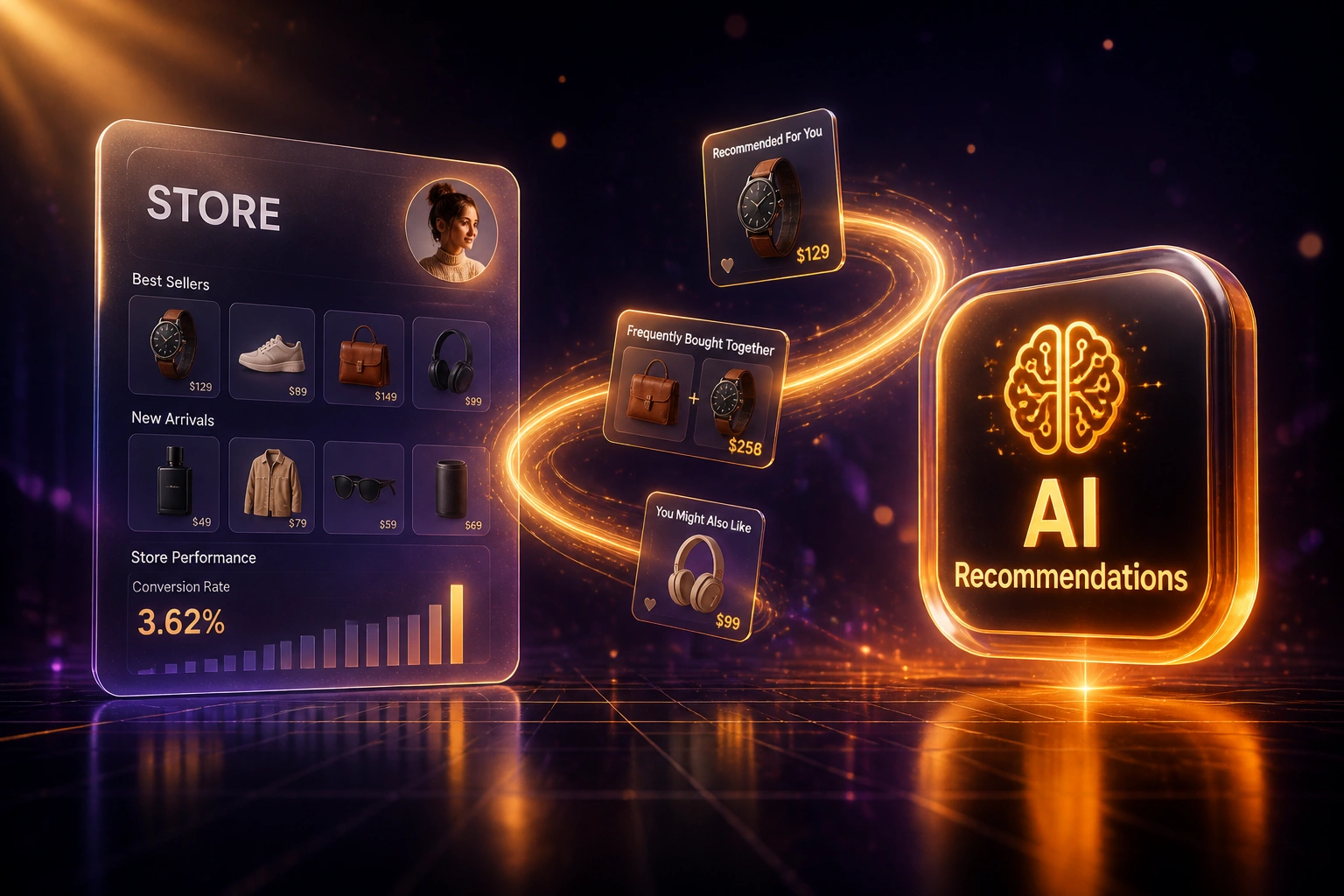
Generic "customers also bought" widgets and static merchandising leave money on the table. An AI recommendation engine trained on purchase patterns, browse behaviour, and inventory surfaces product suggestions that lift conversion rate and average order value.
We build the engine that turns catalogue noise into personalised revenue.
Sound Familiar?
These are the exact issues ecommerce directors faced before an AI recommendation engine:
- Homepage and PDP widgets still show the same "customers also bought" list to every shopper
- Merchandisers spend 20+ hours a week pinning, burying, and rebuilding category rules by hand
- Static related-product links go stale the moment inventory, seasonality, or bestsellers shift
- Average order value is flat because cart and PDP never surface the right cross-sell at the right moment
- You cannot attribute which product suggestions actually drive revenue, so budget stays stuck on ads
Shopify personalisation apps now scale with order volume, with full suites such as Rebuy Platform One from about R8,700 per month. As third-party cookies lose reliability, first-party browse and purchase data is the durable path to AI recommendations that still convert.
What the AI Recommendation Engine Actually Does
Shopper browses → model ranks → personalised product suggestions appear → basket and conversion climb.
Shopper Signals Arrive
Browse, add-to-cart, purchase history, and live inventory feed the model from your store
AI Ranks Products
The engine scores complementary and next-best items against margin and stock guardrails
Widgets Update Live
Homepage, PDP, cart, and email show personalised AI recommendations for that shopper
Revenue Is Attributed
You see conversion, AOV, and Rand driven by each recommendation placement
Everything You Need for Product Suggestions That Convert
Behaviour-Based Suggestions
Browse history, purchase patterns, and session intent feed an AI recommendation engine that personalises homepage, PDP, and cart widgets for each shopper.
Inventory-Aware Ranking
Suggestions respect live stock, margin rules, and exclusions so you never promote out-of-stock or low-margin SKUs into high-intent placements.
Cart & Bundle Upsells
Frequently-bought-together and cart-aware AI recommendations lift basket size with complementary products, not generic bestsellers.
Merchandising Guardrails
Your team still pins campaigns and brand rules. The engine works inside those guardrails instead of fighting them.
Multi-Placement Coverage
Homepage For You, PDP You May Also Like, cart add-ons, and post-purchase emails all run from one recommendation model trained on your catalogue.
Revenue Attribution
Dashboards show click-through, conversion, AOV lift, and Rand attributed to each AI recommendation block so ecommerce leadership can prove payback.
Platforms We've Wired for AI Recommendations
From Static Widgets to R2.1M Attributed Revenue
How a fashion retailer lifted AOV from R720 to R885 and cut manual merchandising from 22 hours a week to 7.
The Manual Process
- Merchandiser rebuilt "related products" rules across hundreds of SKUs every season
- 22 hours a week spent pinning, burying, and fixing stale category placements
- Every shopper saw the same generic product suggestions on PDP and cart
- AOV stuck at R720 with no clear attribution from cross-sell widgets
- Marketing kept buying ads to grow revenue the storefront failed to capture
The Automated Process
- AI recommendation engine ranks products from browse and purchase patterns in real time
- Homepage, PDP, and cart show inventory-aware personalised suggestions
- Merchandisers set guardrails once, then review exceptions instead of rebuilding lists
- AOV moved to R885, in line with the 15 to 24% lifts seen in AI recommendation benchmarks
- Dashboards attribute Rand to each placement so leadership can defend the investment
Before vs After AI Recommendations
How It Works
From first conversation to live AI recommendations in 3–6 weeks.
Tell Us Your Store
Platform, catalogue size, current widgets, and where conversion and AOV are leaking today.
Free Scoping Call
30-minute call to map placements, data sources, merchandising rules, and the lift targets that matter.
Build & Test
We train on your purchase and browse data, wire placements, and A/B test against static widgets before go-live.
Go Live & Monitor
Switch off stale rule lists. Monitoring tracks CTR, conversion, AOV, and recommendation-attributed revenue.
Frequently Asked Questions
How is an AI recommendation engine different from "customers also bought"?
Static "customers also bought" lists are the same for every visitor and only update when someone edits them. An AI recommendation engine analyses purchase patterns, browse behaviour, and inventory in real time so AI recommendations surface products each shopper is actually likely to buy.
Which storefronts and tools can you connect?
We have built recommendation placements for Shopify, WooCommerce, BigCommerce, custom and headless storefronts, and email tools such as Klaviyo and HubSpot. If your store can expose catalogue, order, and browse events, we can train and serve personalised AI recommendations against it.
Will this replace our merchandising team?
No. Merchandisers keep strategic control: campaign pins, brand exclusions, margin floors, and seasonal pushes. The engine removes the 20-hour-a-week grind of manually rebuilding related-product rules across thousands of SKUs.
How do you handle privacy and first-party data?
We train on first-party browse and purchase data you already own in the store and CRM, with POPIA-aware consent where marketing channels are involved. As third-party cookies lose reliability, that owned behavioural signal is what keeps personalised product suggestions working.
Is a custom engine better than a Shopify recommendation app?
Volume-priced apps such as Rebuy Platform One start around R8,700 per month and scale with orders. A custom AI recommendation engine is a one-time build (typically R40,000 to R90,000) tuned to your catalogue, margin rules, and SA inventory reality, without a fee that rises every time GMV grows.
How much does an AI product recommendation engine cost?
Focused PDP and cart placements start from around R40,000. Full homepage, PDP, cart, and email recommendation coverage with attribution dashboards typically ranges from R55,000 to R90,000. Stores recovering even a mid-single-digit AOV lift usually see payback within 2 to 4 months.
Stop Leaving Revenue on Generic Product Suggestions
If your storefront still shows the same related products to every shopper, you are paying for catalogue discovery that competitors have already automated.
Tell us your platform, catalogue size, and where conversion and AOV stall today. We will show you how an AI recommendation engine would work for your store, with payback in months rather than another SaaS fee that scales with every order.