AI Resume Screening: Automate Candidate Shortlisting for HR Teams
Your recruiters burn days reading CVs that do not match the role. Hiring managers wait for a shortlist while strong applicants go cold. Volume keeps rising, and six-second glances are not a hiring strategy.
We build hiring AI that screens against the job description, ranks fit, and hands managers a shortlist they can interview.
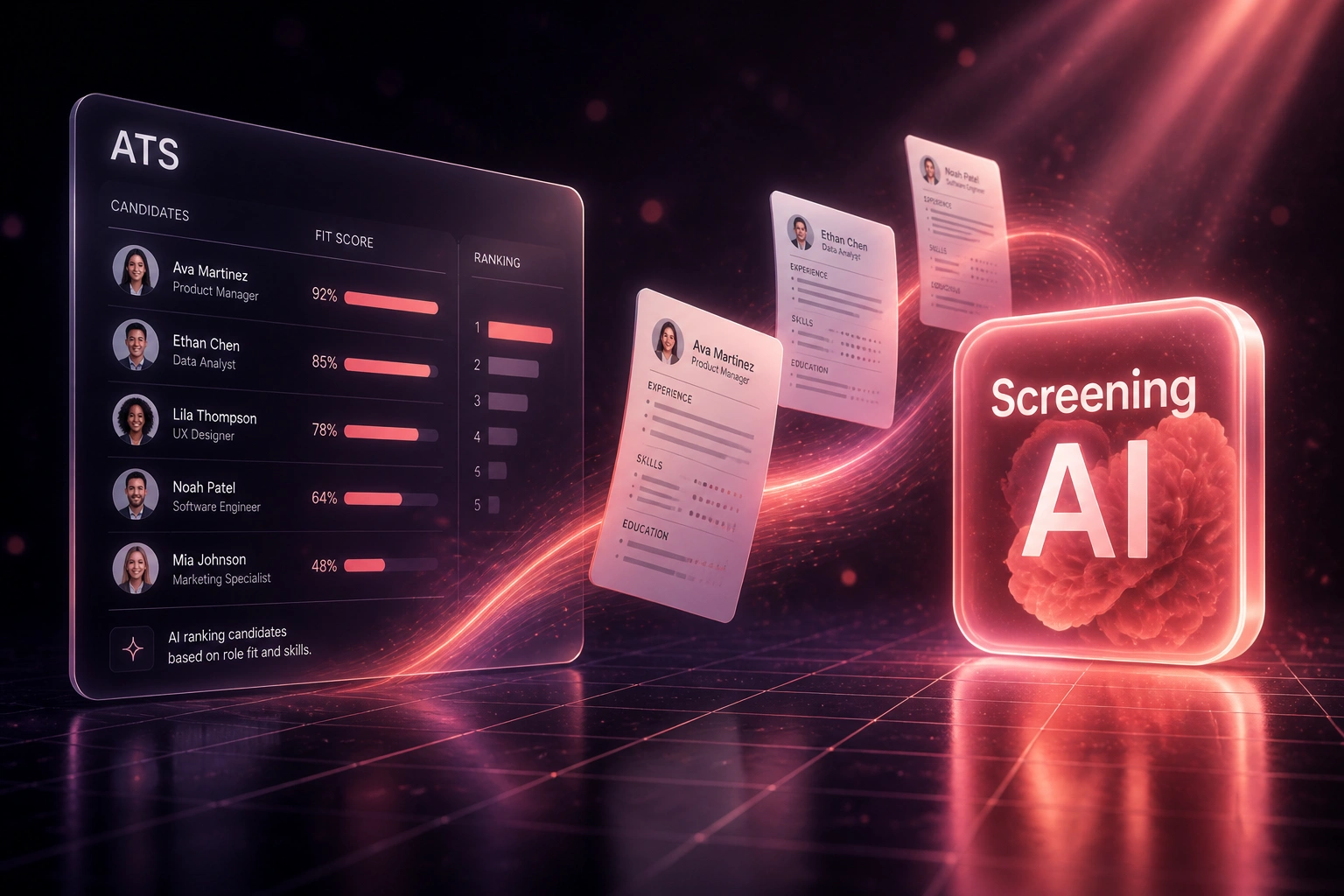
Sound Familiar?
These are the exact issues talent teams faced before AI candidate shortlisting:
- Recruiters burn days skimming CVs that never matched the job description
- Hiring managers get unsorted piles instead of a ranked shortlist they can trust
- Strong candidates go cold while application review sits in an eight-day queue
- Volume roles pull 180+ applications, so six-second glances replace real evaluation
- Fairness is hard to defend when every recruiter scores fit differently
Ashby's 2026 benchmarks put applications per hire above 300, roughly triple the 2021 baseline. Without AI recruitment screening against the JD, volume turns into missed talent and slower quality of hire.
What AI Resume Screening Actually Does
CV arrives → scored against the JD → ranked shortlist → hiring manager interviews faster.
Application Lands in ATS
Candidate applies through Greenhouse, Lever, Workday, or your careers portal
AI Screens Against the JD
Must-haves, skills, and experience bands scored consistently for every CV
Ranked Shortlist Ready
Recruiters review edge cases; hiring managers get fit-ranked candidates
Faster Interviews
Time-to-interview drops and quality of hire rises because weak fits never clog the diary
Everything You Need for Reliable HR Automation
JD Fit Scoring
Each CV is scored against the live job requirements: must-haves, nice-to-haves, experience bands, and skills. Fit is measured, not guessed.
Ranked Shortlists
Hiring managers receive a ranked candidate shortlist with clear fit reasons, so interview time goes to the strongest applicants first.
ATS & HRIS Write-Back
Scores, ranks, and disposition notes write back into Greenhouse, Lever, Workday, BambooHR, or your ATS so talent data stays in one system.
Fairness & Bias Controls
Names and other protected proxies can be masked before scoring. We log criteria, thresholds, and human overrides for auditability.
Recruiter Review Queue
Top-band candidates auto-advance, clear mismatches drop out, and the middle band waits for human review. Hiring AI assists; it does not replace judgment.
Volume Role Throughput
High-volume requisitions finish screening in hours instead of days, so time-to-interview drops without adding recruiter headcount.
ATS & HRIS Platforms We've Connected
From 9 Hours a Role to Under 2
How a Johannesburg talent team cut CV screening time, shortened time-to-interview by a week, and raised shortlist quality for hiring managers.
The Manual Process
- Two recruiters skimmed 150–250 CVs per open role by hand
- Nine hours of screening labour before a shortlist left the TA team
- Hiring managers received unsorted packs with no shared fit criteria
- Application-to-screen sat near a week while strong candidates went quiet
- Different recruiters ranked the same CV differently week to week
The Automated Process
- Every CV scored against the live job description inside the ATS
- Ranked shortlist ready the same day for hiring-manager review
- Recruiters spend under two hours reviewing edge cases and overrides
- Interview invites go out roughly a week earlier on volume roles
- Fairness logs show criteria, scores, and human decisions for audit
Before vs After AI Candidate Shortlisting
How It Works
From first conversation to live AI resume screening in 2–4 weeks.
Tell Us Your Setup
Which ATS or HRIS you run, how CVs arrive today, and where screening volume hurts most.
Free Scoping Call
30-minute call to map job-requirement scoring, shortlist rules, fairness controls, and hiring-manager handoff.
Build & Test
We calibrate on past hires, parallel-screen live requisitions, and tune until ranked shortlists beat your manual baseline.
Go Live & Monitor
Switch off manual pile-sorting. Monitoring tracks screen time, shortlist-to-interview conversion, and fairness metrics.
Frequently Asked Questions
How long does AI resume screening take to set up?
A standard ATS-connected CV screening and ranked shortlisting setup takes 2–4 weeks from scoping to go-live. A single high-volume role family can be live within two weeks. Multi-requisition coverage with fairness controls, human-review bands, and HRIS write-back typically takes 4–6 weeks.
Which ATS and HRIS platforms do you support?
We have built resume screening and candidate shortlisting into Greenhouse, Lever, Workday, BambooHR, SmartRecruiters, Bullhorn, and custom ATS or HRIS stacks. If applications land in a system with an API, we can score them against the job description and write ranks back.
Will hiring managers still make the final call?
Yes. AI recruitment screening ranks fit against the job requirements and prepares the shortlist. Recruiters and hiring managers still decide who interviews. The gain is that they start from a ranked, evidence-backed list instead of a raw CV pile.
How do you handle bias and fairness?
We design for skills-based matching against the JD, with optional masking of names and other protected proxies before scoring. Thresholds, criteria, and human overrides are logged so you can audit decisions. Fairness monitoring is part of go-live, not an afterthought.
How accurate is AI resume screening compared with manual review?
Vendor and research benchmarks commonly put AI evaluation consistency in the 85–95% range, versus roughly 60–70% inter-rater reliability when different humans score the same CVs. We parallel-test on your past and live requisitions and only go live when the ranked shortlist beats your current screening quality.
How much does AI candidate shortlisting cost?
A focused one-way screen into a single ATS starts from around R15,000. Full resume screening with ranked shortlists, fairness controls, and ATS or HRIS write-back typically ranges from R25,000 to R60,000. Teams recovering recruiter days each week usually see ROI within 2–3 months.
Stop Burning Recruiter Days on Mismatched CVs
If your talent team is still reading every application by hand, you are paying for a bottleneck that hiring AI already solves.
Tell us which ATS or HRIS you use, how many applications a typical role attracts, and where shortlisting stalls. We will show you how ranked candidate shortlisting would work for your hiring managers.