AI Tender Analysis: Extract Requirements from SA Government RFPs
Your bid managers drown in eighty-page eTenders packs while compulsory briefings, CIDB grades, and B-BBEE gates hide in the annexures. Miss one deadline or eligibility rule and the whole response is wasted.
We build the tender AI that extracts requirements, deadlines, and eligibility so BD only bids where you can win.
Sound Familiar?
These are the exact issues our clients faced before structured tender AI:
- Eighty-page eTenders packs sit unread while compulsory briefing dates slip past the bid calendar
- BD discovers the wrong CIDB grade or B-BBEE eligibility only after estimators have already priced the job
- Functionality criteria and returnable schedules are scattered across annexures, so go/no-go decisions take half a day
- Pricing schedules get completed in the wrong format, or late submissions are rejected without exception
- Win rate stays low because the team bids everywhere instead of only where capability and preference points can compete
Late submissions and skipped compulsory briefings are rejected without exception, while complex bid prep routinely costs R5,000–R50,000 per pack. A firm bidding 30 times a year at roughly R8,000 management cost each is already spending about R240,000 before win rate enters the picture. Preferential procurement and CIDB gates only raise the price of chasing the wrong work.
What Tender AI Document Extraction Actually Does
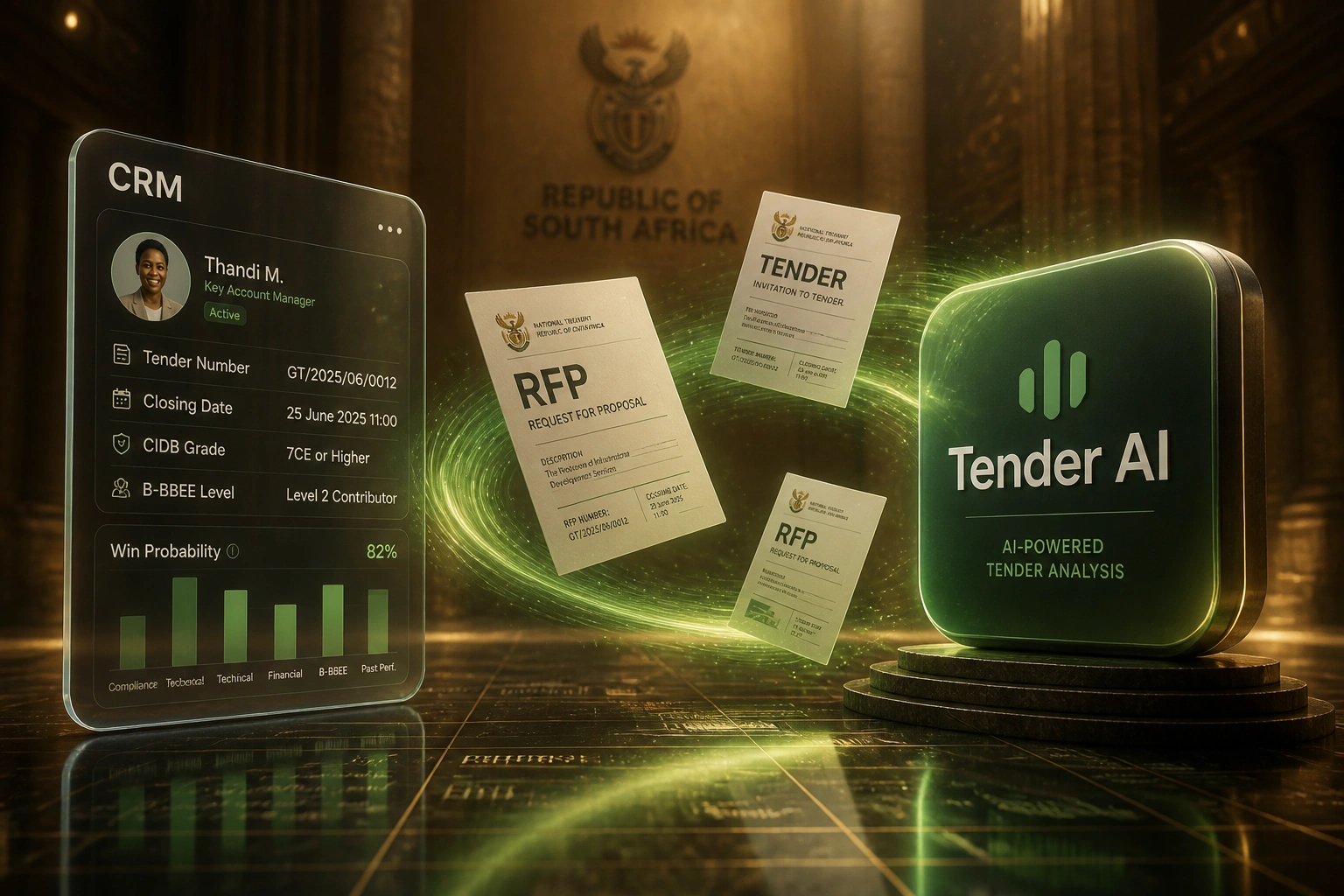
RFP lands → requirements extracted → eligibility matched → BD gets a go/no-go pack.
Tender Pack Arrives
eTenders download, email invitation, or SharePoint drop enters the analysis queue
Requirements Extracted
Deadlines, briefings, CIDB, B-BBEE, functionality criteria, and pricing schedules pulled into fields
Capability Matched
Eligibility and scope scored against your CIDB, B-BBEE, and CRM capability profile
Go / No-Go Ready
Bid manager reviews the pack in minutes and only commits estimators where you can compete
Everything You Need for Reliable Government Procurement Screening
Deadline & Briefing Capture
AI pulls closing dates, compulsory briefing times, clarification cut-offs, and submission methods into calendar and CRM fields before anyone misses a gate.
CIDB & B-BBEE Eligibility Gates
Required CIDB grades, B-BBEE contributor levels, CSD status, and other hard eligibility rules surface as structured checks matched against your company profile.
Functionality Criteria Mapping
Technical and functionality scoring criteria (often with a 60–70% threshold before price opens) become a checklist your bid writers answer point by point.
Pricing Schedule Extraction
BOQ lines, pricing instructions, and returnable schedule formats are extracted so estimators work from the tender's own structure, not a rewritten quote.
Capability Matching
Scope of work, key personnel requirements, and past-performance asks are scored against your CRM capability register so BD only pursues winnable SA tenders.
Human Go/No-Go Review
Low-confidence extractions and high-value RFPs pause for the bid manager. Clear eligibility mismatches never queue behind those exceptions.
Tender Sources and Systems We've Connected
From 6 Hours to 20 Minutes per Tender Pack
How a Gauteng mid-market contractor stopped wasting estimators on ineligible SA tenders and put briefing dates, CIDB gates, and functionality criteria into the CRM bid register.
The Manual Process
- Bid managers read full eTenders packs by hand before anyone could say go or no-go
- Screening averaged six hours per pack, with CIDB and B-BBEE rules often spotted too late
- Two compulsory briefings were missed in one quarter, voiding otherwise competitive responses
- Estimators priced jobs that failed the functionality threshold before price was opened
- Roughly R8,000 of management time burned on each losing or ineligible submission
The Automated Process
- New RFP packs from eTenders, email, and SharePoint enter analysis the moment they arrive
- AI extracts deadlines, briefings, CIDB, B-BBEE, functionality criteria, and pricing schedules
- Bid manager spends about 20 minutes confirming the go/no-go pack, with source pages cited
- Ineligible tenders are declined before estimators start, protecting bid recovery overhead
- Compulsory briefings and closing times land on the shared calendar automatically
Before vs After Tender AI Analysis
How It Works
From first conversation to live tender analysis in 3–5 weeks.
Tell Us Your Setup
Where tender packs land, your CIDB grades and B-BBEE level, and which CRM or bid register should hold extracted requirements.
Free Scoping Call
30-minute call to map intake → RFP analysis → eligibility match → bid-manager review → CRM write-back.
Build & Test
We encode your eligibility profile, wire document sources, and run parallel on live eTenders packs until extraction accuracy meets your bar.
Go Live & Monitor
BD reviews go/no-go packs only. Monitoring tracks briefing misses, hours recovered, and how often you skip ineligible tenders early.
Frequently Asked Questions
How is tender AI different from generic document OCR?
OCR pulls text off the page. Tender AI understands SA government RFP analysis: compulsory briefing dates, CIDB grades, B-BBEE preference gates, functionality thresholds, pricing schedules, and returnable SBD forms. The output is a structured go/no-go pack in your CRM, not another unread PDF.
Which South African tender sources can you connect?
We typically ingest packs from the National Treasury eTenders portal, email invitations, SharePoint or Drive drops, and CIDB-style construction invitations. If your team already downloads the full tender pack, we wire that intake path so document extraction starts the moment the file lands.
How long does an AI tender analysis project take?
A focused build for one intake path and your eligibility profile typically takes 3–5 weeks from scoping to go-live. Simpler deadline-and-eligibility extraction can be live in about two weeks. Multi-entity CIDB grades, CRM write-back, and capability matching usually sit closer to 5–7 weeks.
What happens when the model is unsure about a requirement?
Low-confidence fields, scanned annexures with poor OCR, and high-value eligibility gates pause for bid-manager confirmation, with the source page cited beside the suggested value. Clear closing dates and standard returnables write through without blocking the queue.
Will this replace our bid writers or estimators?
No. Your BD director still decides where to bid, and estimators still price the job. Automation removes the half-day hunt through eighty-page packs so the team spends time on winnable responses, not reading ineligible RFPs twice.
How much does AI tender document analysis cost?
Focused builds for one intake channel and a core eligibility schema typically start from around R35,000. Multi-source intake, CRM write-back, and capability matching usually sit in the R45,000–R75,000 range. Teams screening 20+ SA tenders a month often recover the build cost within 2–3 months from staff time and avoided wasted bid prep alone.
Stop Losing Tenders to Missed Gates
If compulsory briefings, CIDB grades, and B-BBEE rules still hide in eighty-page packs, you are paying for document extraction work that tender AI already solves.
Tell us where SA tenders arrive, which eligibility rules matter most, and which CRM or bid register should hold them. We will show you exactly how RFP analysis would work for your BD team.