AI Sentiment Analysis for CRM: Flag Unhappy Customers Before They Churn
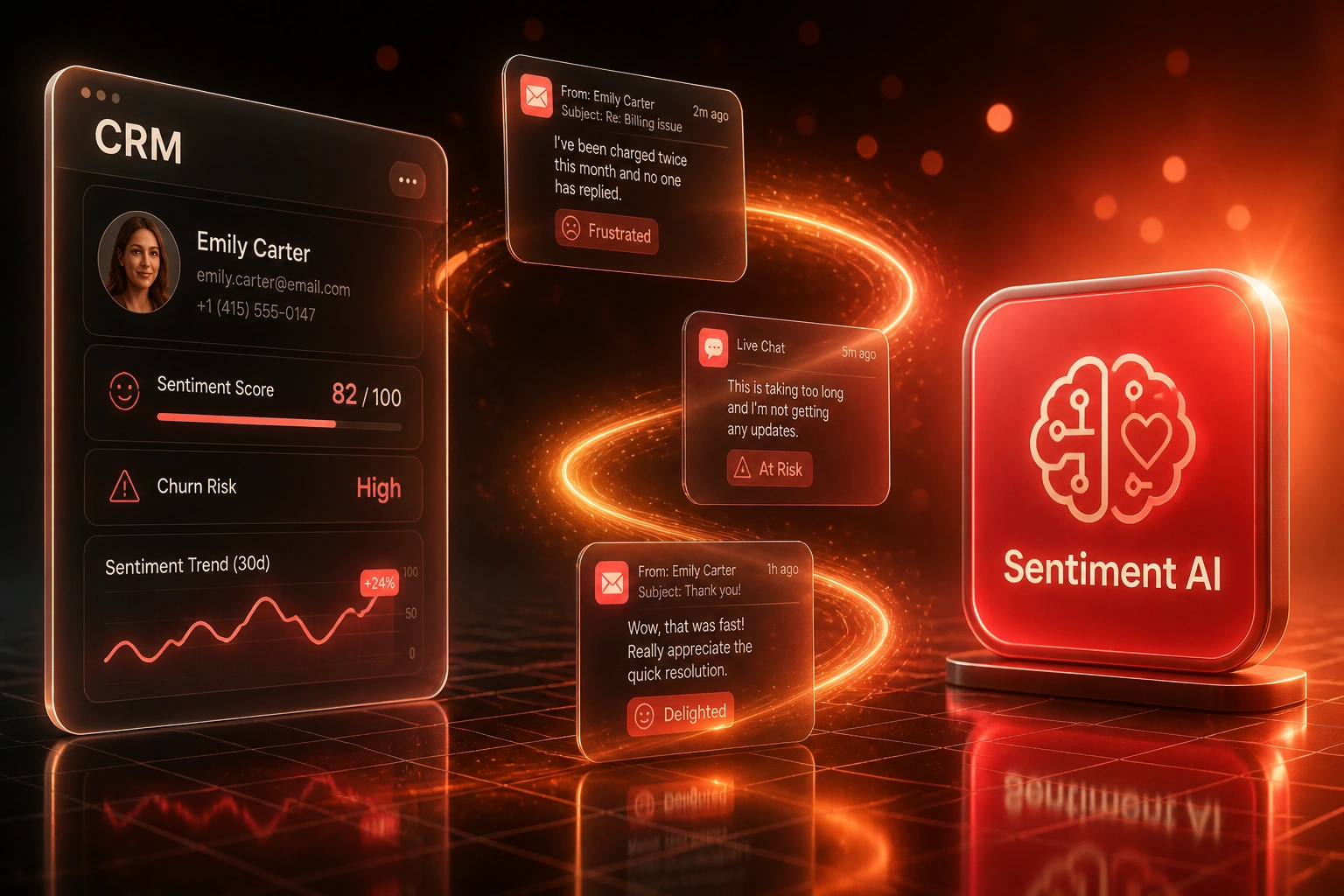
You only discover a customer is unhappy when they cancel. By then the save rate has collapsed. Customer sentiment AI on every email, call, and chat surfaces frustrated and at-risk accounts while you can still intervene.
We build the emotion detection layer that writes churn-risk flags into your CRM in real time.
Sound Familiar?
These are the exact issues our clients faced before customer sentiment AI hit the CRM:
- You only learn a customer is unhappy when they cancel or ghost renewal
- CSMs skim a fraction of emails, calls, and chat; the rest never get read
- Frustration builds across three tickets before anyone escalates the account
- Health scores lag: usage looks fine while the tone in every message is sour
- Sales and CS argue over who owns the save because the signal never hit the CRM
Average SaaS annual churn sits near 38%, while platforms now meter sentiment as a paid add-on. Zendesk Copilot is roughly R820 per agent per month to put sentiment into triggers and routing. Native ticket labels alone will not write churn-risk into your CRM or fire a save playbook.
What Sentiment Analysis Actually Does in Your CRM
Interaction lands → emotion scored → CRM updated → outreach triggered. No waiting for the cancel email.
Interaction Arrives
Email, chat, or call transcript hits your support or sales channel
Emotion Detection Runs
AI scores customer sentiment and labels Frustrated, Neutral, or Delighted
CRM Fields Update
Sentiment score, trend, and churn-risk flag write to the account record
Save Playbook Fires
CSM alert and proactive outreach task while the relationship is still recoverable
Everything You Need for Real-Time Emotion Detection
Multi-Channel Sentiment Scoring
AI scores every email, call transcript, and chat for customer sentiment so emotion detection is continuous, not a quarterly NPS sample.
CRM Field Write-Back
Sentiment scores, emotion labels, and churn-risk flags land on the contact and account record your team already opens every morning.
At-Risk Alerts
When tone slides from neutral to frustrated, the right CSM or AE gets a Slack or email alert while there is still time to intervene.
Proactive Outreach Triggers
Playbooks fire for high churn-risk accounts: check-in tasks, executive escalation, or a goodwill offer before the cancel button appears.
Trend and Trajectory Views
See whether sentiment is recovering or collapsing over 30 days, so a one-off bad day does not drown the real at-risk pattern.
Human Review Loops
Low-confidence scores queue for a quick human check. Your team stays in control; the AI does the reading volume humans cannot.
Platforms We've Wired for Sentiment Write-Back
From Cancel Surprises to 45-Day Early Warning
How a 35-person SaaS CS team cut monthly churn 33% after customer sentiment AI wrote at-risk flags into HubSpot.
The Manual Process
- CSMs skimmed tickets and forwarded threads when something felt off
- Average seven days of warning before a cancel, often less
- About 24% of flagged accounts were saved once someone noticed
- Fourteen hours a week spent hunting tone across email and chat
- 42% of unhappy customers never complained; they simply left
The Automated Process
- Every email, chat, and call scores into HubSpot within minutes
- Median 45 days of advance warning on at-risk accounts
- Save rate on flagged accounts climbed to about 61%
- Manual review dropped to a short daily exception queue
- Proactive check-ins fire while the relationship is still recoverable
Before vs After Sentiment Analysis in the CRM
How It Works
From first conversation to live sentiment write-back in 2–4 weeks.
Tell Us Your Setup
Which CRM and support channels, where unhappy customers hide today, and which accounts hurt most when they churn.
Free Scoping Call
30-minute call to map sentiment sources, score thresholds, alert owners, and where churn-risk flags should write back.
Build & Test
We wire emotion detection to your emails, calls, and chat, then parallel-test scores against accounts your CS team already knows.
Go Live & Monitor
At-risk alerts become the default early-warning path. Monitoring keeps accuracy, latency, and CRM write-back healthy.
Frequently Asked Questions
How long does AI sentiment analysis for CRM take to set up?
A standard build scoring email and chat into one CRM takes 2–4 weeks from scoping to go-live. Adding call transcripts and proactive outreach playbooks typically takes 4–6 weeks. We run parallel testing so your team trusts the scores before alerts go live.
Which channels and CRMs do you support?
We score Gmail, Outlook, Zendesk, Intercom, and call transcripts, then write customer sentiment AI fields into HubSpot, Salesforce, Pipedrive, Zoho CRM, Gainsight, and custom CRMs. If the channel exports text and the CRM has an API, we can connect them.
How is this different from NPS or CSAT surveys?
Surveys sample a fraction of customers, weeks after the moment that mattered. Sentiment analysis reads every interaction as it happens, so emotion detection flags frustration while the relationship is still recoverable, not after the cancel email lands.
Will our CSMs still own the relationship?
Yes. The AI does the reading volume humans cannot. Your team still decides the outreach, the offer, and the tone. Low-confidence scores can require human approval before any proactive message goes out.
How accurate is emotion detection on real emails and calls?
Modern LLM sentiment models reach roughly 0.91 F1 on clean text and 0.76–0.88 on noisy call transcripts. In field tests, AI spotted linguistic frustration markers at about 78% accuracy versus roughly 31% for unaided human review. We calibrate on your real threads during parallel testing.
How much does AI sentiment analysis for CRM cost?
Email and chat scoring into one CRM starts from around R15,000. Full multi-channel builds with churn-risk flags, alerts, and outreach triggers typically range from R25,000 to R60,000. Teams recovering even a handful of at-risk accounts usually see ROI within 2–3 months against the cost of replacing lost customers.
Stop Learning Customers Are Unhappy Only When They Cancel
If your CS or sales team still finds out too late, you are paying acquisition prices for a retention problem that emotion detection already solves.
Tell us which CRM and channels you use, how you spot at-risk accounts today, and what a saved renewal is worth. We will show you exactly how AI sentiment analysis would write into your CRM and fire proactive outreach.