AI Approval Workflows: Smart Routing Based on Content and Risk
Every purchase order, leave request, discount, and expense sits waiting for a human who rubber-stamps most of them. The safe ones should clear instantly. The risky ones should wake senior staff.
We build AI risk assessment that auto-approves low-risk items and escalates the rest.
Sound Familiar?
These are the exact issues our clients faced before intelligent approval routing:
- Purchase orders, leave requests, discounts, and expenses sit in queues while senior staff rubber-stamp most of them
- Approvers spend under eight minutes reading a request, yet the item waits days in an inbox before anyone opens it
- Hybrid and travel schedules bury email sign-offs; deputies are unclear and escalation is manual
- Low-risk routine items and high-risk exceptions share the same queue, so nothing moves until a director is free
- Audit asks who approved what and why, and the trail lives in scattered emails instead of an immutable log
Hybrid work turned desk-side sign-offs into inbox tag. Paper and corridor approvals never scaled; email and portal queues now stall POs for days while suppliers wait and early-payment discounts expire. Controllers still need SOX- and POPIA-ready evidence of who approved what.
What AI Approval Intelligence Actually Does
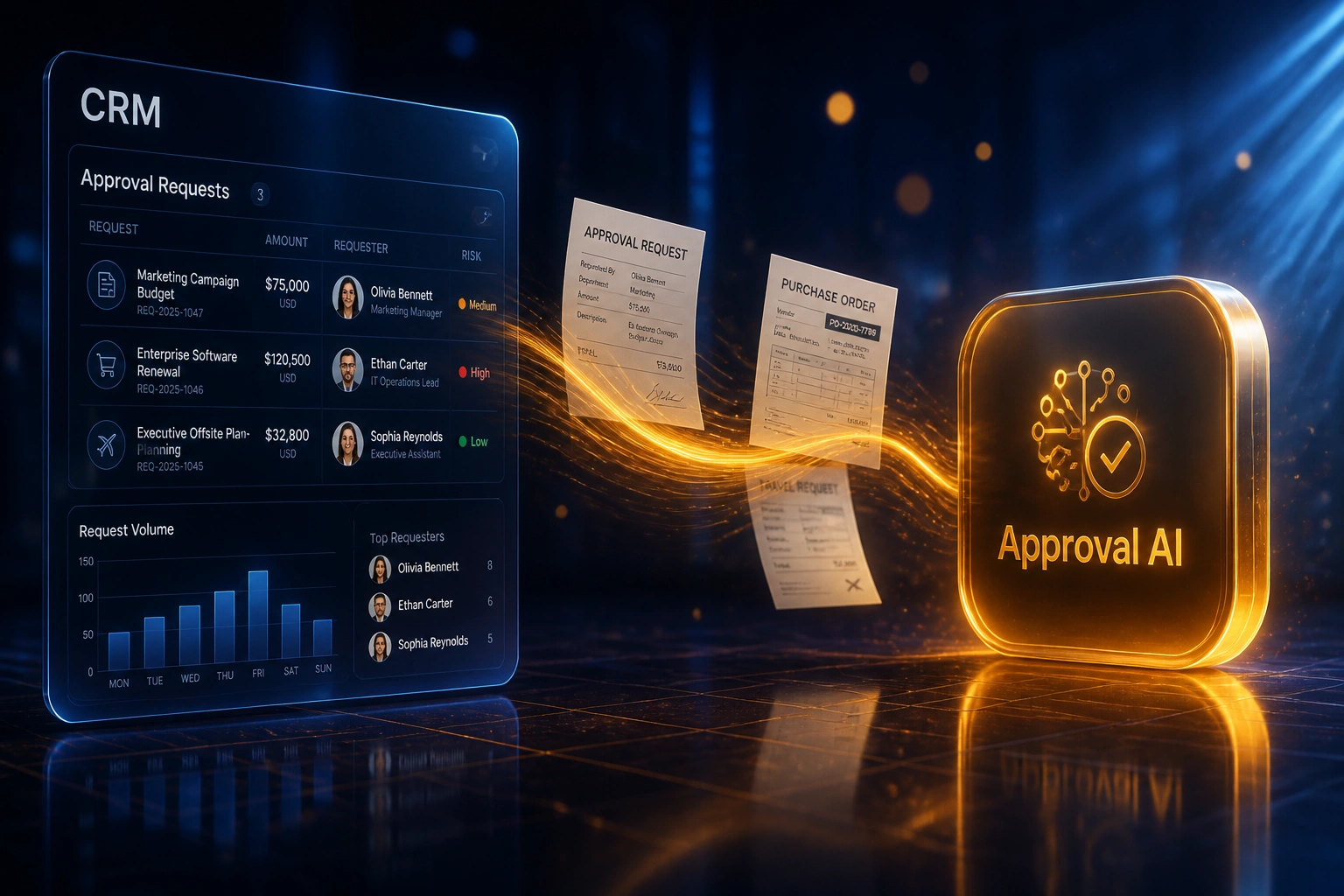
Request lands → risk scored → low-risk clears, high-risk escalates. Senior staff only see exceptions.
Request Submitted
PO, expense, leave, or discount enters CRM, ERP, or HRIS with full context attached
AI Risk Assessment
Amount, policy, vendor history, and content signals produce a risk score in seconds
Route or Auto-Approve
Low-risk clears with audit log; high-risk escalates to the named senior with rationale
Status Written Back
Source record updates, suppliers move, and finance keeps an immutable decision trail
Everything You Need for Process Automation That Still Controls Risk
AI Risk Assessment
Each request is scored on amount, policy fit, vendor history, requester pattern, and content signals before a human is involved.
Auto-Approval of Low Risk
Within-policy, low-value, familiar-vendor items clear instantly with a full audit trail. No waiting for a rubber stamp.
Intelligent Escalation
High-risk, out-of-policy, or unusual requests route only to the right senior approver with the risk rationale attached.
Content-Aware Routing
PO lines, expense categories, discount depth, and leave type drive the path. One intelligent workflow replaces flat sequential chains.
SLA Escalation & Deputies
Idle queues escalate on timers. Backup approvers fire automatically when primary signatories are offline or travelling.
Immutable Audit Trail
Every auto-approval, override, and escalation is logged with timestamp, score, and decision basis for finance and external audit.
Systems We've Wired for Intelligent Approvals
From Nine Days to Under Two
How a 90-person distributor stopped rubber-stamping routine POs and expenses, and put senior attention only on real exceptions.
The Manual Process
- Every PO and expense over R2,000 queued for two sequential manager sign-offs by email
- Average nine calendar days requisition-to-approval; touch time under ten minutes
- Finance estimated over 90% of items were approved unchanged (rubber-stamp theatre)
- Hybrid schedules buried requests; deputies were informal and untracked
- Early-payment discounts routinely missed because AP could not clear invoices in time
The Intelligent Process
- AI risk assessment scores every request on policy, vendor, amount, and content
- 78% of items auto-approve same day inside defined low-risk bands
- High-risk and anomalous requests escalate only to named senior approvers
- SLA timers and deputies stop hybrid-work stalls; status writes back to ERP and CRM
- Immutable audit log replaced email archaeology for internal and external review
Before vs After Intelligent Workflow
How It Works
From first conversation to live AI approvals in 3–5 weeks for a focused queue.
Map Your Approval Queues
Which request types bottleneck the business (POs, expenses, leave, discounts), who rubber-stamps them, and where the trail lives today.
Free Scoping Call
30-minute call to size volume, risk thresholds, systems of record, and payback against delayed approvals and missed early-payment discounts.
Build, Score & Parallel-Test
We wire risk scoring, auto-approval bands, and escalation paths, then run parallel against your current chain for a week to validate catch rate.
Go Live & Monitor
Low-risk items clear same day. High-risk wakes senior staff. Dashboards track cycle time, auto-approve rate, and override patterns.
Frequently Asked Questions
How is AI approval intelligence different from simple amount thresholds?
Fixed value bands help, but they still send every mid-range request to a human. AI risk assessment looks at content, vendor history, policy fit, requester patterns, and anomaly signals together. Routine items that would have been rubber-stamped clear automatically; only genuine exceptions reach senior staff.
Which request types can you score and route?
Typical builds cover purchase orders, expense claims, leave and absence requests, discount and quote approvals, and supplier onboarding gates. We start with the queue that burns the most calendar days, then extend the same risk model across related workflows.
Will auto-approval weaken our controls?
No. Auto-approval only applies inside policy bands you define, with a full audit trail of score, decision, and override. High-risk and out-of-policy items still require a named senior approver. Most clients find catch quality improves because humans stop drowning in routine yes-stamps.
Which systems do you connect?
Wherever requests already live: CRM (HubSpot, Salesforce, Pipedrive), accounting and ERP (Xero, Sage, SAP Business One), Microsoft 365, Slack or Teams for notifications, and custom HRIS or procurement tools with an API. Approvals write back to the source record so status is never siloed in email.
How long does an AI approval workflow project take?
A focused single-queue build (for example PO and expense risk scoring with auto-approval bands) is often live in 3–5 weeks. Multi-queue programmes covering procurement, HR, and commercial discounts with ERP and CRM write-back typically take 5–8 weeks including parallel testing.
How much does AI approval workflow intelligence cost?
Focused single-queue risk scoring and auto-approval typically starts from around R35,000. Multi-queue intelligent workflows with ERP, CRM, and audit logging usually fall between R55,000 and R110,000. Teams losing a week per PO to rubber-stamp chains often recover the engagement within one or two quarters from cycle-time and early-payment gains alone.
Stop Paying Latency to Rubber-Stamp Routine Approvals
If your COOs and controllers are still signing off items that would have been approved anyway, you are spending calendar days on a filter that catches almost nothing.
Tell us which approval queues bottleneck the business, which systems hold the requests, and what "faster with control" would unlock. We will show you exactly how AI risk assessment, auto-approval, and escalation would work for your process automation.