AI-Assisted Data Extraction: Using LLMs with Apify Scrapers
Your scrapers break every time a supplier portal redesigns. Ops still pastes messy HTML into spreadsheets because CSS selectors cannot reliably parse complex, unstructured pages. Pair Apify scraping with GPT or Claude for AI data extraction that classifies, extracts, and normalises fields with confidence scores and human review queues.
We build the LLM scraping Apify pipeline that recovers structured rows when selectors fail.
Sound Familiar?
These are the exact issues our clients faced before LLM-assisted extraction:
- CSS selectors break every time a supplier portal redesigns or A/B-tests a new layout
- Data and ops leads spend nights rewriting scrapers instead of shipping usable datasets
- Silent nulls slip into pricing and catalogue feeds when a class name moves, and nobody notices until Monday
- Teams still copy-paste from messy HTML into spreadsheets because intelligent data parsing feels too hard to operationalise
- Anti-bot changes and layout churn mean the same brittle scraper needs weekly attention across a growing site list
Actively maintained sites redesign every 2 to 4 months on average, while ScrapeOps-style industry estimates say 10 to 15% of crawlers need weekly fixes as DOMs, fingerprinting, and anti-bot rules shift. Apify now ships AI Web Scraper and GPT-backed Actors that extract by schema instead of brittle selectors. Waiting until the next portal redesign empties your pricing feed is the expensive option.
What LLM Scraping with Apify Actually Does
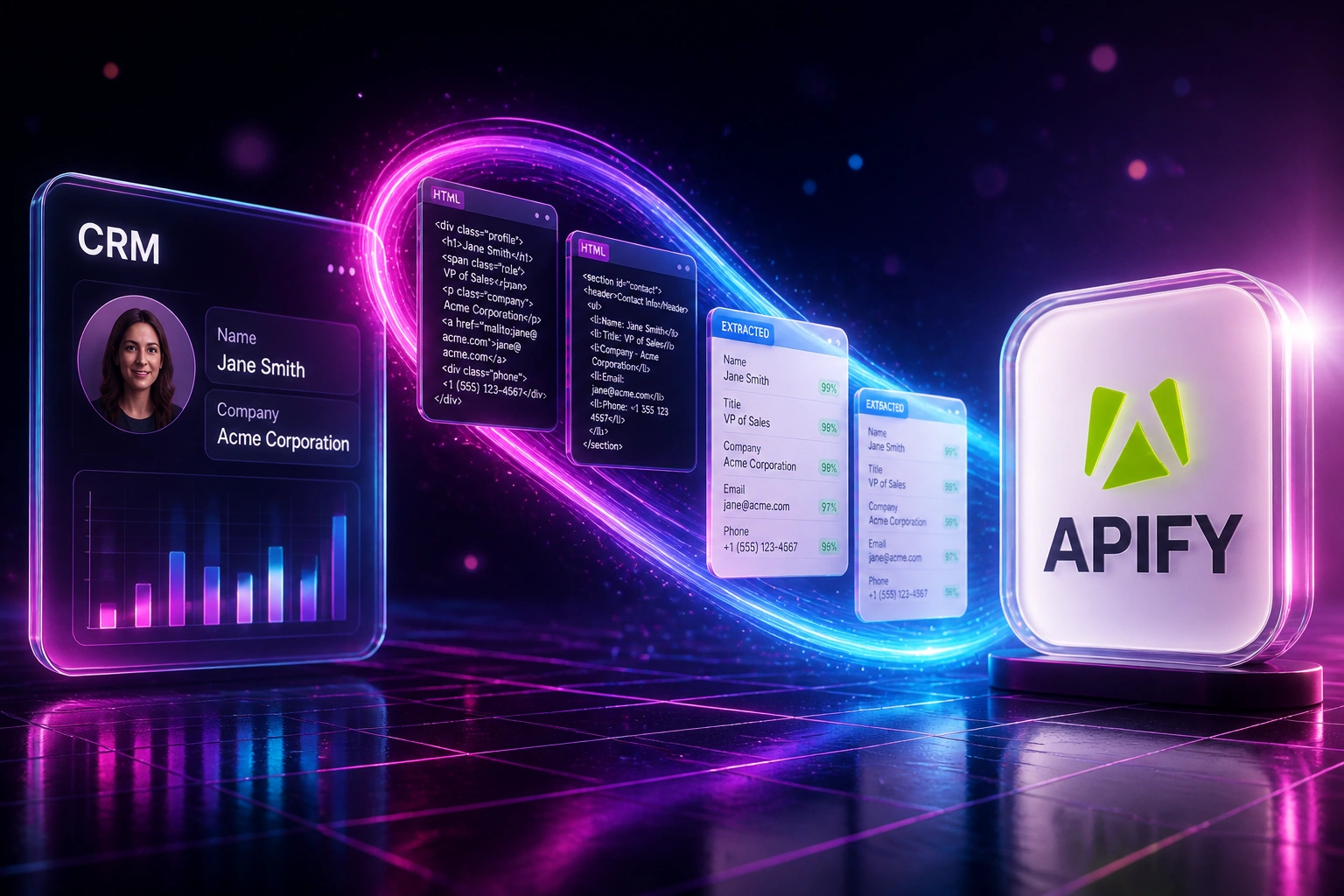
Page fetched → LLM extracts fields → confidence scored → CRM updated. No weekly CSS selector fire drills.
Apify Fetches the Page
Actors render the live portal or listing, with proxies when anti-bot rules kick in
GPT or Claude Extracts
The model reads cleaned content and returns schema fields: price, SKU, stock, contacts
Score & Review
High-confidence rows pass; low-confidence fields hit a human review queue
Normalised Delivery
Structured rows land in CRM, Sheets, or warehouse without Friday HTML archaeology
Everything You Need for Reliable AI Data Extraction
Apify Scrape + LLM Extract
Apify Actors fetch the live page. GPT or Claude then classifies, extracts, and normalises fields from complex unstructured HTML without depending on fragile CSS selectors.
Schema-Guided Field Mapping
You define the fields you need (SKU, price, stock, contact, status). The model returns structured JSON that matches your schema for intelligent data parsing at scale.
Confidence Scores
Every field carries a confidence score so high-certainty rows flow through, and ambiguous values surface for review instead of poisoning the CRM.
Human Review Queues
Low-confidence extractions land in an exception queue. Ops reviews edge cases in minutes, not by retyping entire portal catalogues.
Hybrid Selector Fallback
Stable pages keep cheap CSS selectors. When a selector returns null or drift alerts fire, LLM extraction recovers the row and keeps the feed alive.
CRM & Warehouse Delivery
Normalised rows sync into HubSpot, Sheets, BigQuery, or your warehouse on schedule, with monitoring when a site layout or anti-bot change shifts overnight.
Platforms We Pair for LLM-Assisted Extraction
From 6 Hours/Week Fixing Selectors to Under 1
How a Cape Town ecommerce ops team stopped rewriting CSS scrapers after every supplier portal redesign and recovered usable structured rows with GPT-assisted extraction.
The Brittle Selector Process
- Three supplier portals and two listing sites each had hand-maintained CSS selector sets
- About six hours a week spent diagnosing silent nulls and rewriting broken scrapers
- A mid-quarter portal redesign emptied price fields for four days before anyone noticed
- A/B layout variants still returned null on a material share of product pages
- Analysts fell back to copy-paste from messy HTML into spreadsheets during outages
The LLM-Assisted Process
- Apify Actors fetch pages; GPT extracts schema fields when selectors miss or drift
- Confidence scores route ambiguous fields to a short human review queue
- Accepted rows hold near the 98% accuracy band seen in layout-change benchmarks
- Stable pages still use cheap CSS selectors; LLMs cover the chaotic portals
- Layout breaks trigger alerts and LLM fallback instead of empty pricing dashboards
Before vs After LLM-Assisted Extraction
How It Works
From first conversation to live LLM-assisted extraction in 2–4 weeks.
Show Us the Break Points
Which portals redesign often, which CSS selectors keep failing, and which fields must land clean in the CRM.
Free Scoping Call
30-minute call to sample messy pages, choose GPT or Claude models, and design confidence thresholds plus review queues.
Build & Validate
We pilot Apify scraping with LLM-assisted extraction, compare rows to live pages, and tune schema plus confidence gates.
Go Live & Monitor
Scheduled runs keep structured rows current. Alerts and review queues catch layout churn without a full scraper rebuild.
Frequently Asked Questions
What is AI-assisted data extraction with Apify and LLMs?
Apify Actors scrape the page first. Then GPT or Claude (or Apify AI Actors) reads the cleaned content, classifies fields, and returns structured JSON matching your schema. It is intelligent data parsing for pages where CSS selectors keep breaking, with confidence scores and optional human review queues so ops only touches ambiguous rows.
How accurate is LLM extraction versus CSS selectors when layouts change?
McGill University researchers tested AI extraction across 3,000 pages on Amazon, Cars.com, and Upwork. AI methods held about 98.4% accuracy even when page structures changed, while CSS selectors degraded when layouts were modified. Selectors remain excellent on stable pages, but they fail silently when class names move. LLM extraction is the resilience layer for layout churn.
What does GPT or Claude cost per page for extraction?
An average cleaned web page is about 2,500 tokens (Anthropic). On GPT-4o-mini at USD 0.15 / USD 0.60 per million input / output tokens, a typical extract sits well under R0.10 per page at roughly R16.30 to the dollar. Independent resilience benchmarks put AI parsing around USD 0.15 to USD 0.50 per 1,000 pages (about R2.45 to R8.15 per 1,000). That is tiny next to hours of selector maintenance at R350 to R450 an hour.
Will this stop our scrapers breaking after every redesign?
It dramatically cuts the maintenance tax. Industry estimates put 10 to 15% of crawlers needing weekly attention as DOMs shift, and production CSS portfolios often see a 5 to 15% silent null rate as selectors drift. LLM-assisted extraction after the scrape recovers usable rows when the DOM moves, and confidence scoring plus review queues stop silent blanks from flowing into pricing and catalogue systems.
Do we replace all CSS selectors with GPT web scraping?
No. We use a hybrid. Stable, high-volume pages keep fast CSS selectors. LLM scraping with Apify handles complex unstructured pages, layout variants, and selector failures. That keeps token spend low while ending the weekly rewrite cycle on the sites that hurt most.
How much does Apify LLM-assisted data extraction cost to build?
Simple one-portal pilots with GPT or Claude extraction start from around R15,000. Multi-portal pipelines with confidence scoring, human review queues, hybrid selectors, and CRM delivery typically range from R25,000 to R60,000. Most data and ops desks reclaiming 4 to 8 hours a month of selector maintenance alone, plus avoiding silent data gaps, see payback within a few months.
Stop Paying Engineers to Rewrite Brittle Scrapers
If your data and ops leads still lose weeks to CSS selector breakage and Friday HTML copy-paste, you are paying for a problem Apify plus GPT or Claude already solves.
Tell us which portals redesign often, which fields must be structured, and where silent nulls hurt most. We will show you exactly how AI-assisted data extraction would work for your business.