Data Quality Validation: Ensuring Accuracy from Scraped Sources
You have been burned by bad scraped data: wrong prices in the CRM, missing fields after a quiet site redesign, and CSVs that look fine until someone makes a decision on them. Scraped data quality is the trust problem, not another pipeline plumbing job.
We build the Apify data validation layer that stops bad extracts before they reach CRM or warehouse.
Sound Familiar?
These are the exact issues our clients faced before a validation gate sat on Apify output:
- Apify runs still succeed after a site redesign, but prices, stock flags, or required fields come back empty or wrong
- Ops only discovers the break when a pricing board or CRM list looks off, days after bad rows already landed
- Analysts spend hours every week cleaning scraped CSVs: fixing nulls, re-mapping columns, and deleting duplicates by hand
- Schema drift between Actor output and CRM fields silently corrupts contact and product records
- Leadership no longer trusts competitor or catalogue data because one bad scrape poisoned the last campaign
Gartner finds 59% of organisations do not measure data quality at all, while mature scraping ops still see a steady 1–2% weekly job break rate when sites change. If bad Apify output can write straight into CRM or pricing, you are choosing to discover web data accuracy problems after the damage is done.
What Apify Data Validation Actually Does
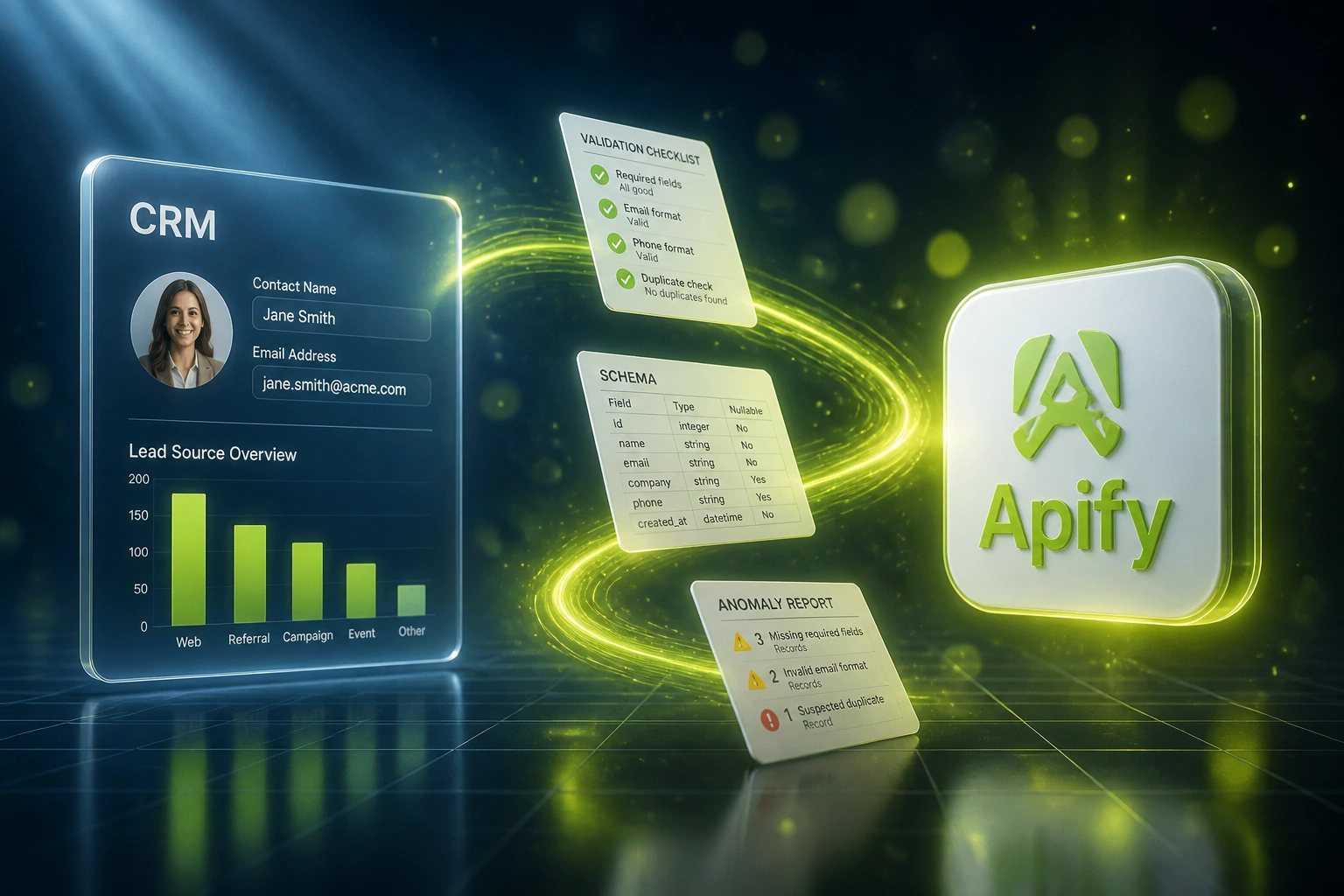
Actor finishes → schema and rules run → pass or quarantine → only trusted rows reach CRM and warehouse.
Apify Run Completes
Actor finishes and the dataset is ready. Nothing writes downstream yet.
Schema & Rule Checks
Required fields, types, duplicates, and formats are scored against your contract
Anomaly Scan
Row counts, null rates, and price outliers compared to the last healthy baseline
Pass or Quarantine
Clean batches load. Failed batches alert ops with a report, not a poisoned CRM
Everything You Need for Scraped Data Quality
Schema Validation
Every Apify dataset is checked against the field contract you agree: types, required columns, and unexpected new fields before anything reaches CRM or warehouse.
Required-Field Gates
Null spikes and missing prices, SKUs, emails, or URLs fail the batch. Completeness rules stop incomplete scrapes from looking like a successful load.
Anomaly Detection
Sudden row-count drops, wild price swings, and duplicate key surges raise alerts so silent scraper breakage cannot hide inside a green run status.
Quarantine & Pass Paths
Clean rows continue downstream. Suspect rows land in a review queue with a quality report, so ops decides once instead of cleaning every CSV from scratch.
Webhook Quality Hooks
When an Actor finishes, validation runs automatically. Pass or fail status can block CRM writes and warehouse loads until the batch meets your quality bar.
Audit Trail
Every checked batch leaves a pass/fail summary: which rules fired, how many rows failed, and when the last healthy scrape ran for each source.
Sources and Destinations We Gate
From 12 Hours/Week Cleaning to 2 Hours/Week Reviewing
How a 35-person ecommerce ops team stopped wrong competitor prices from landing in CRM and recovered trust in web data accuracy.
The Blind Load
- Apify Actors wrote competitor and catalogue extracts straight into CRM and sheets
- A retailer redesign emptied price fields for four days while runs still showed success
- Ops spent 12 hours a week cleaning scraped CSVs and re-mapping columns
- Sales quoted from poisoned price lists twice in one quarter
- Nobody owned scraper output testing, so every break became a Friday emergency
The Quality Gate
- Every finished Apify dataset hits schema, required-field, and anomaly rules first
- Failed batches quarantine with a report; CRM and warehouse stay clean
- Ops reviews exceptions for about two hours a week instead of rebuilding CSVs
- Site redesigns still break Actors, but bad rows no longer poison pricing
- Leadership trusts competitor and catalogue numbers again for weekly decisions
Before vs After Scraped Data Validation
How It Works
From first conversation to a live Apify quality gate in 2–4 weeks.
Tell Us Your Setup
Which Apify Actors you run, which fields must never be null, and where bad scrapes already hurt CRM or pricing.
Free Scoping Call
30-minute call to map validation rules, schema contracts, anomaly thresholds, and which destinations get a hard fail gate.
Build & Test
We wire schema checks and anomaly rules on real Actor output, quarantine bad batches, and prove the gate with your ops lead.
Go Live & Monitor
Switch off blind loads. Every scrape passes validation before CRM or warehouse writes, with alerts when a source drifts.
Frequently Asked Questions
What is data quality validation on Apify scraped sources?
It is a quality gate that runs after an Apify Actor finishes and before rows reach CRM, pricing tools, or a warehouse. We apply schema checks, required-field rules, duplicate detection, and anomaly thresholds so web data accuracy is proven before anyone trusts the extract.
How is this different from fixing the scraper itself?
Scrapers will keep breaking when sites redesign. The validation layer does not replace Actor maintenance. It catches silent failures early: empty prices, missing fields, schema drift, and row-count collapses, so bad data never lands downstream while your team schedules the Actor fix.
Which systems can sit behind the quality gate?
We commonly gate HubSpot, Pipedrive, Salesforce, custom CRMs, BigQuery, Snowflake, Redshift, and PostgreSQL. If a destination accepts API writes or staged loads, we can block or quarantine until the Apify dataset passes your rules.
What happens when a batch fails validation?
Failed batches stay out of production tables. Your team gets a clear report: which rules fired, sample bad rows, and whether the issue looks like a site redesign, a null spike, or a duplicate surge. Clean historical loads are left alone.
Will this slow down our scrapes?
Validation runs after the Actor finishes and typically adds minutes, not hours, for ordinary dataset sizes. The time you recover is the days of silent poison and the weekly CSV cleaning that bad scrapes create today.
How much does an Apify data validation layer cost?
Focused schema and required-field gates start from around R15,000. Full setups with anomaly detection, quarantine paths, webhook fail gates, and multi-Actor coverage typically range from R25,000 to R60,000. Teams spending 8+ hours a week cleaning scraped CSVs usually recover the project cost within 2–3 months from ops time alone.
Stop Letting Bad Scrapes Poison CRM and Pricing
If Apify output can still write unchecked into CRM or warehouse tables, you are paying for the next silent redesign with trust, cleanup hours, and bad decisions.
Tell us which Actors you run, which fields must never be empty, and where scrapes already hurt. We will show you how validation rules, schema checks, and anomaly detection would gate that flow for your team.