JSE Share Price and Announcement Monitoring: Financial Data with Apify
Portfolio managers, IR ops, and risk officers still chase SENS PDFs and delayed price screens while a full terminal licence sits out of budget. By the time the morning pack is built, the numbers are already stale.
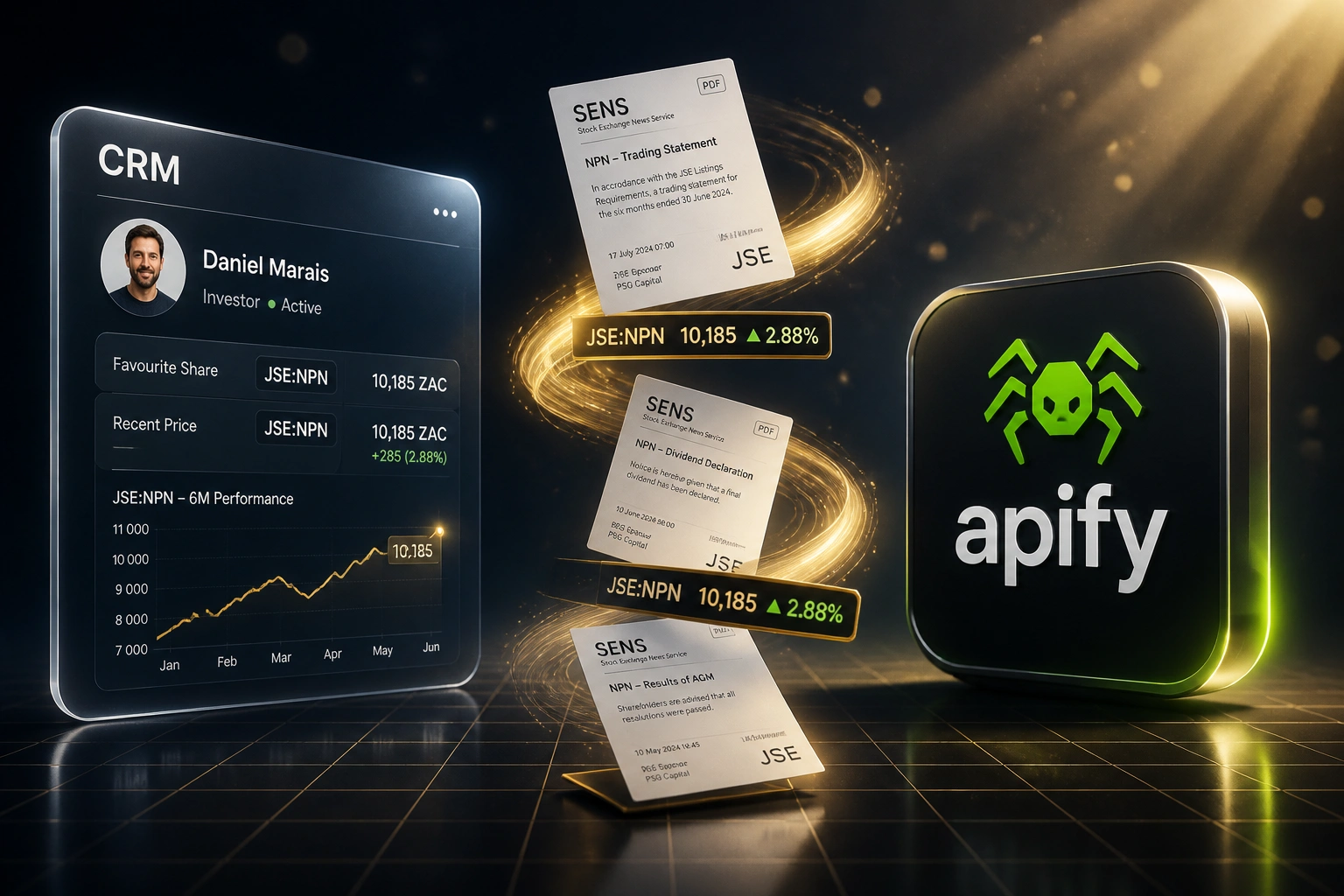
We build Apify scrapers that feed near-real-time JSE prices and SENS into your warehouse or dashboard.
Sound Familiar?
These are the exact issues portfolio, IR, and risk desks describe before automated JSE and SENS feeds:
- Portfolio and IR teams still open the JSE portal and chase SENS PDFs by hand every morning
- Share prices on free screens lag enough that morning briefings start on stale numbers
- Corporate actions (dividends, rights, cautionaries) get spotted late because someone missed an email or PDF
- Analysts spend hours copy-pasting tickers into spreadsheets instead of reading the market
- A full Bloomberg or LSEG seat is quoted in the hundreds of thousands of rand, so mid-market desks stay on manual watch
Terminal licences keep climbing while mid-market SA desks still need JSE share price scraping and a SENS announcement monitor. Bloomberg sits around R520,000 per seat per year; full LSEG Workspace packages often land near R360,000–R390,000. Paying that for every analyst who mainly watches SA prices and announcements is hard to justify, so teams stay on portals and PDFs until a miss hurts.
What JSE and SENS Monitoring with Apify Actually Does
Price or SENS updates → structured capture → warehouse or alert → analysts act. No human copy-pasting from portals.
Market Moves or SENS Drops
A JSE price updates or a listed company publishes a SENS announcement or corporate action
Apify Captures It
Scheduled Actors scrape prices and SENS pages, normalising ticker, headline, timestamp, and PDF link
Feed Hits Your Stack
Rows land in BigQuery, Snowflake, Postgres, or Power BI, with optional Slack or email alerts
Desk Works the Signal
Portfolio, IR, and risk teams read live dashboards instead of rebuilding morning packs by hand
Everything You Need for Reliable SA Stock Data Automation
JSE Share Price Scraping
Apify Actors pull listed share prices on a schedule so your warehouse and dashboards refresh without someone refreshing a portal.
SENS Announcement Monitor
New SENS headlines, issuers, and PDF links land as structured rows the moment they appear, ready for alerts and BI filters.
Corporate Action Capture
Dividends, rights issues, cautionaries, and trading statements are tagged so risk and IR ops stop relying on forwarded PDFs.
Analytics & Warehouse Feed
Clean JSON or CSV drops into BigQuery, Snowflake, Postgres, Power BI, or Looker so analysts work from one living dataset.
Watchlist Alerts
Price moves and SENS hits on your holdings fire Slack, Teams, or email alerts so the desk hears about them in minutes, not at lunch.
Run Health Monitoring
Failed scrapes and empty runs alert immediately. A quiet overnight break does not leave Monday's risk pack blind.
Sources and Destinations We Wire for SA Stock Data
From 12 Hours/Week to Under 1 Hour/Week
How a Cape Town asset manager stopped chasing SENS PDFs, fed JSE prices into Power BI, and skipped a R520k terminal seat.
The Manual Process
- Two junior analysts opened JSE screens and SENS portals every morning
- Roughly 12 hours a week spent downloading PDFs and pasting prices into Excel
- Corporate actions sometimes surfaced only when a broker emailed the desk
- Morning packs started on 15-minute-delayed free data and overnight SENS dumps
- A Bloomberg quote of about R520,000 per seat was declined as too rich for the team size
The Automated Process
- Apify Actors refresh watchlist prices and SENS hits on a minute-level cadence
- Structured rows land in BigQuery and Power BI before the open briefing
- Slack alerts fire on holdings when a SENS announcement or sharp move appears
- Analysts review exceptions instead of rebuilding the pack from portals
- No terminal seat purchased; data owned inside the firm's own stack
Before vs After JSE Share Price Scraping
How It Works
From first conversation to live JSE and SENS feed in 2–4 weeks.
Tell Us Your Watchlist
Tickers, sectors, corporate-action types, and which warehouse or dashboard should receive the feed.
Free Scoping Call
30-minute call to map refresh cadence, alert thresholds, and who must see price and SENS hits first.
Build & Test
We configure Apify scrapers, field mapping, and destination writes, then validate against live JSE and SENS data.
Go Live & Monitor
Switch off manual portal chasing. Monitoring keeps the feed reliable while your team works from the dashboard.
Frequently Asked Questions
Can Apify really deliver JSE share prices and SENS announcements into our analytics stack?
Yes. We build Apify Actors that scrape JSE share price screens and SENS announcement pages on a schedule, normalise ticker, price, headline, issuer, timestamp, and PDF link, then push structured rows into your warehouse, BI tool, or alert channel. It is financial data automation for SA desks, not a generic news crawl.
How does this compare with a Bloomberg or LSEG Workspace seat?
A single Bloomberg Terminal seat is about R520,000 per year at current rates (around US$31,980). Full LSEG Workspace packages often land around R360,000–R390,000 per seat. Those terminals are excellent for trading floors that need the full suite. Mid-market SA firms that mainly need JSE prices, a SENS announcement monitor, and corporate-action visibility into BI usually get a focused Apify pipeline for a fraction of one seat, with data they own.
How fresh is the data compared with delayed free screens?
The JSE requires delayed redistributed market data to be held back by at least 15 minutes. Free portals and end-of-day SENS products leave analysts briefing on lag. Our scrapers run on cadences measured in minutes during the trading day so near-real-time JSE prices and SENS hits reach your warehouse while the desk can still act.
Will this replace our custodian or terminal entirely?
No. Custodians, brokers, and terminal licences still matter for settlement, messaging, and deep analytics. What we solve is the expensive gap mid-market desks live with: chasing SENS PDFs and delayed price screens by hand because a full terminal seat is not justified for every analyst.
What about corporate actions we cannot afford to miss?
Industry research from The ValueExchange (cited by DTCC and others) found that 46% of corporate-event data is still processed manually, and 17% of US funds reported errors that cost them millions. Automating SENS capture into your analytics platform cuts the copy-paste step where misses and deadline slips start.
How much does JSE and SENS monitoring with Apify cost?
Focused JSE share price and SENS announcement monitors start from around R15,000. Watchlists with corporate-action tagging, warehouse write-back, Slack routing, and failure monitoring typically range from R25,000 to R60,000. Desks spending 8–12 hours a week on manual monitoring usually recover the project cost within 2–3 months from staff time alone, before counting a terminal seat they no longer need to buy.
Stop Chasing SENS PDFs and Delayed Price Screens
If your portfolio, IR, or risk team is still building morning packs from portals while a R520k terminal seat sits out of reach, you are paying for a problem that focused financial data automation already solves.
Tell us which JSE tickers you watch, where your analytics live, and how SENS awareness fails today. We will show you exactly how an Apify feed into your warehouse or dashboard would work for your desk.