Apify Webhooks to CRM: Automatic Lead Creation from Scraped Data
Scraped data sitting in Apify datasets until someone downloads a CSV is dead inventory. Your outbound team cannot call what is still trapped in Console, and every hour of delay burns the speed-to-lead advantage competitors are already using.
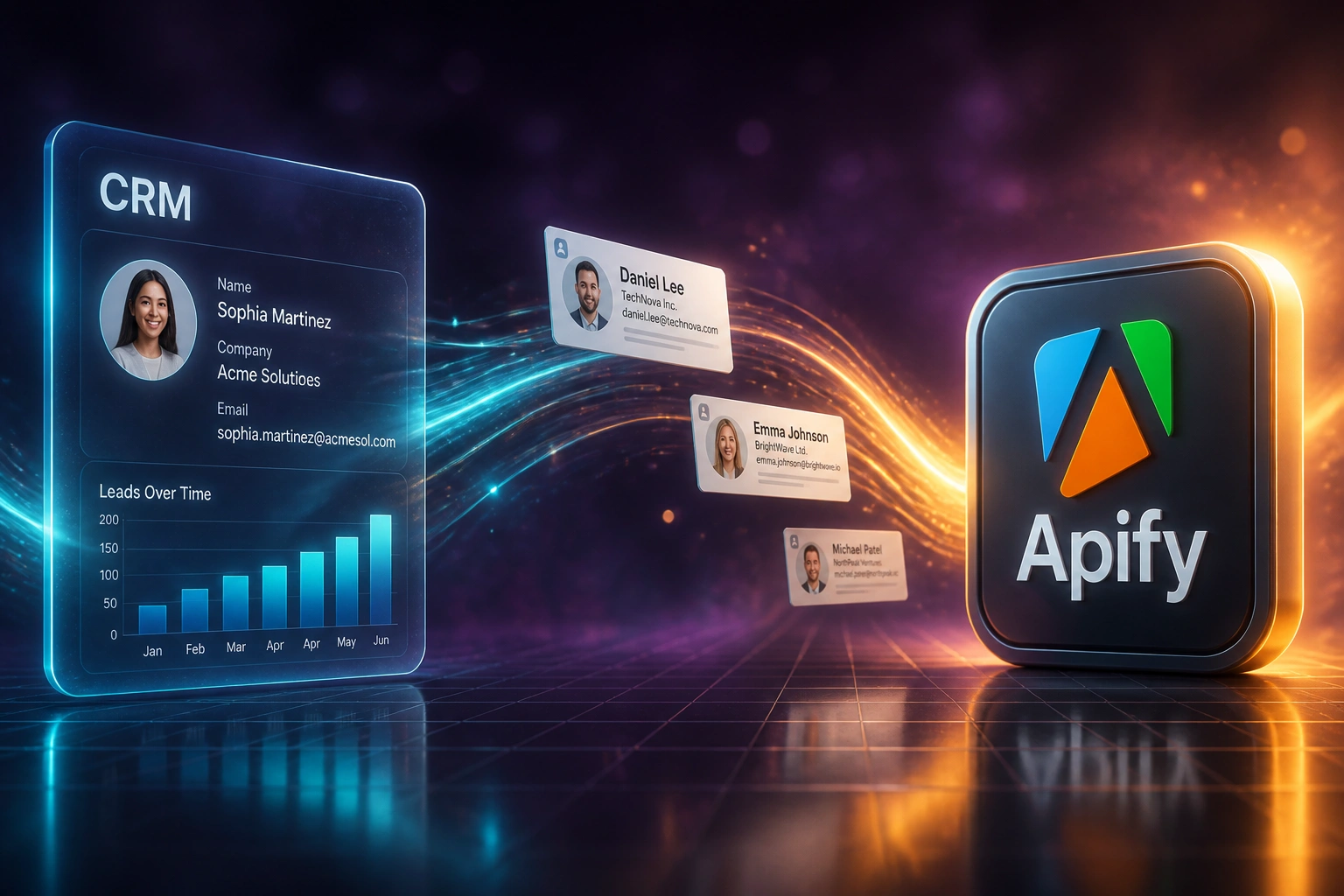
We wire Apify webhooks so each completed run creates live CRM leads the same hour.
Sound Familiar?
These are the exact issues our clients faced before Apify webhook CRM lead creation:
- Scraped Apify datasets sit until someone remembers to download a CSV
- Sales ops cleans columns, dedupes in Excel, then imports into the CRM by hand
- New leads wait a day or more before anyone can call, while competitors respond in minutes
- Bulk CSV imports after a big scrape hit CRM API rate limits and stall mid-upload
- Nobody trusts the list: half the team scrapes again, half works from last week's export
Close rates drop from 32% when you respond within 5 minutes to 12% after 24 hours. About 80% of that speed-to-lead advantage disappears within the first 30 minutes. Leaving a finished Apify run as a CSV to download later is handing that window to whoever calls first.
What the Webhook Lead Pipeline Actually Does
Actor finishes → webhook fires → CRM leads created → outbound starts. No human downloading a CSV between systems.
Apify Run Completes
Your Actor or task finishes with status SUCCEEDED and the dataset is ready
Webhook Fires
Apify POSTs the ACTOR.RUN.SUCCEEDED event to your secure endpoint within seconds
Leads Created in CRM
Dataset rows map into contacts, companies, or leads with dedupe and owner routing
Outbound Starts Same Hour
Sales sees fresh leads in the queue while competitors are still exporting spreadsheets
Everything You Need for a Reliable Webhook Lead Pipeline
Run-Complete Webhooks
When an Apify Actor finishes successfully, a webhook fires immediately. Lead creation starts the moment the run completes, not when someone opens Console.
Automatic CRM Lead Creation
New contacts, companies, or leads are created in HubSpot, Salesforce, Pipedrive, or your CRM from the finished dataset. Fresh scraped records become live pipeline the same hour.
Event-Driven, Not Polled
No scheduled API polling and no waiting for a batch job. Apify pushes ACTOR.RUN.SUCCEEDED events to your endpoint so the scraper-to-CRM automation stays event-driven.
Dedupe Before Create
Email, phone, and company matching stop the same prospect appearing three times after every scrape cycle. True new leads insert; matches update or skip.
Field Mapping & Routing
Dataset columns map to the CRM properties sales already filters on: title, company, source, location, and owner. Leads land in the right queue without a spreadsheet step.
Retry-Safe Delivery
Apify retries failed webhooks with exponential backoff for up to about 32 hours. We acknowledge quickly, process asynchronously, and dedupe on run ID so duplicates never double-create.
CRMs We've Wired to Apify Webhooks
From 5 Hours/Week to Under 1 Hour/Week
How a 12-person B2B sales-ops team stopped treating Apify datasets as Friday homework and got first-touch the same hour every scrape finished.
The Manual Process
- Ops downloaded Apify datasets as CSVs after each successful run
- 45–60 minutes per export: clean columns, fix phones, remove duplicates
- Bulk CRM imports stalled when HubSpot rate limits kicked in mid-upload
- Average 1–2 business days from scrape finish to first outbound call
- Sales constantly asked whether "today's scrape" was in the CRM yet
The Automated Process
- ACTOR.RUN.SUCCEEDED webhooks fire the moment each scrape completes
- Leads, contacts, and companies create in the CRM with field mapping and dedupe
- Creates are paced to stay inside CRM API limits instead of one giant import
- First-touch the same hour, while the list is still warm
- Ops reviews exceptions only: failed runs, ambiguous matches, quarantine rows
Before vs After Apify Webhook Lead Creation
How It Works
From first conversation to live webhook lead creation in 2–4 weeks.
Tell Us Your Setup
Which Actors you run, which CRM should receive new leads, and where the CSV download ritual hurts most.
Free Scoping Call
30-minute call to map webhook events, field mapping, dedupe rules, and routing into sales queues.
Build & Test
We wire Actor run → webhook → CRM lead creation, run parallel against a CSV week, and validate create rates with your team.
Go Live & Monitor
Switch off manual imports. Alerts catch failed runs or webhook retries so dead inventory never silently piles up again.
Frequently Asked Questions
What is an Apify webhook CRM lead pipeline?
It is an event-driven integration where Apify fires a webhook when an Actor run succeeds, your receiver fetches the finished dataset, and new leads, contacts, or companies are created in HubSpot, Salesforce, Pipedrive, or your CRM automatically. Sales and marketing work from live records the same hour, instead of waiting for a CSV export.
How is this different from Apify API sync or CRM enrichment?
API sync often polls on a schedule. Enrichment updates fields on contacts you already have. This page is about automatic lead creation: webhooks that fire when a scrape completes and create new CRM records from scraped data. It is a scraper-to-CRM automation for net-new pipeline, not a polish job on existing stubs.
Which CRMs can receive leads from Apify webhooks?
We have built webhook lead pipelines into HubSpot, Salesforce, Pipedrive, Zoho CRM, Monday.com, Freshsales, and custom CRMs with an API. If your CRM accepts contacts, companies, or leads via API, we can map Apify dataset fields into it.
Will bulk scrapes hit CRM API rate limits?
Bulk CSV imports after a large Apify run often burst into HubSpot's private-app limit of about 100 requests per 10 seconds and stall mid-upload. A webhook pipeline paces creates as the run finishes, retries safely, and avoids the "download everything then flood the API" pattern that burns quota.
What if a webhook fails or arrives twice?
Apify retries non-2xx responses with exponential backoff for up to about 32 hours across roughly 11 attempts. Our receivers acknowledge quickly, process asynchronously, and dedupe on Actor run ID so the same finished scrape never creates duplicate leads.
How much does an Apify webhook to CRM lead pipeline cost?
Simple one-way webhook → CRM lead creation starts from around R15,000. Pipelines with custom dedupe, multi-Actor webhooks, and routing logic typically range from R25,000 to R60,000. Teams spending 4+ hours a week on CSV import usually recover the project cost within 2–3 months from ops time alone, before counting faster first-touch conversion.
Stop Leaving Scraped Leads as Dead Inventory
If finished Apify runs still wait for a CSV download before they become CRM leads, you are paying for scrapes your outbound team cannot use in time.
Tell us which Actors you run, which CRM should receive new leads, and where the export ritual slows you down. We will show you exactly how Apify webhook CRM automatic lead creation would work for your sales and marketing ops stack.