Shift Swaps: Let Employees Trade Shifts Within Rules You Define
If you are the middleman for every WhatsApp shift trade, you already know the cost: evenings spent checking skills and hours, informal swaps that never reach the roster, and no-shows when a deal falls through. Ops and HR managers feel it as constant interruption, not roster flexibility.
We build the schedule trading system that lets staff swap peer-to-peer inside your guardrails.
Sound Familiar?
These are the exact issues our clients faced before automated shift swaps:
- Every shift trade lands in your WhatsApp: you check skills, hours, and who is already covering, then reply when you can
- Staff agree a swap that never reaches you, so one person shows up and the other does not
- A trade quietly breaches daily rest or weekly overtime caps, and you only see it when payroll or a complaint lands
- You approve swaps late because you were on the floor, so coverage gaps sit open through the peak
- Roster flexibility exists on paper, but employees still leave because trading a shift feels like begging a manager
Informal roster changes and undocumented shift swaps are a standing BCEA risk in South Africa. Without a written trail of who worked which hours and who approved the trade, rest-period and overtime disputes become expensive guesswork when a complaint arrives.
What Automated Shift Swap Management Actually Does
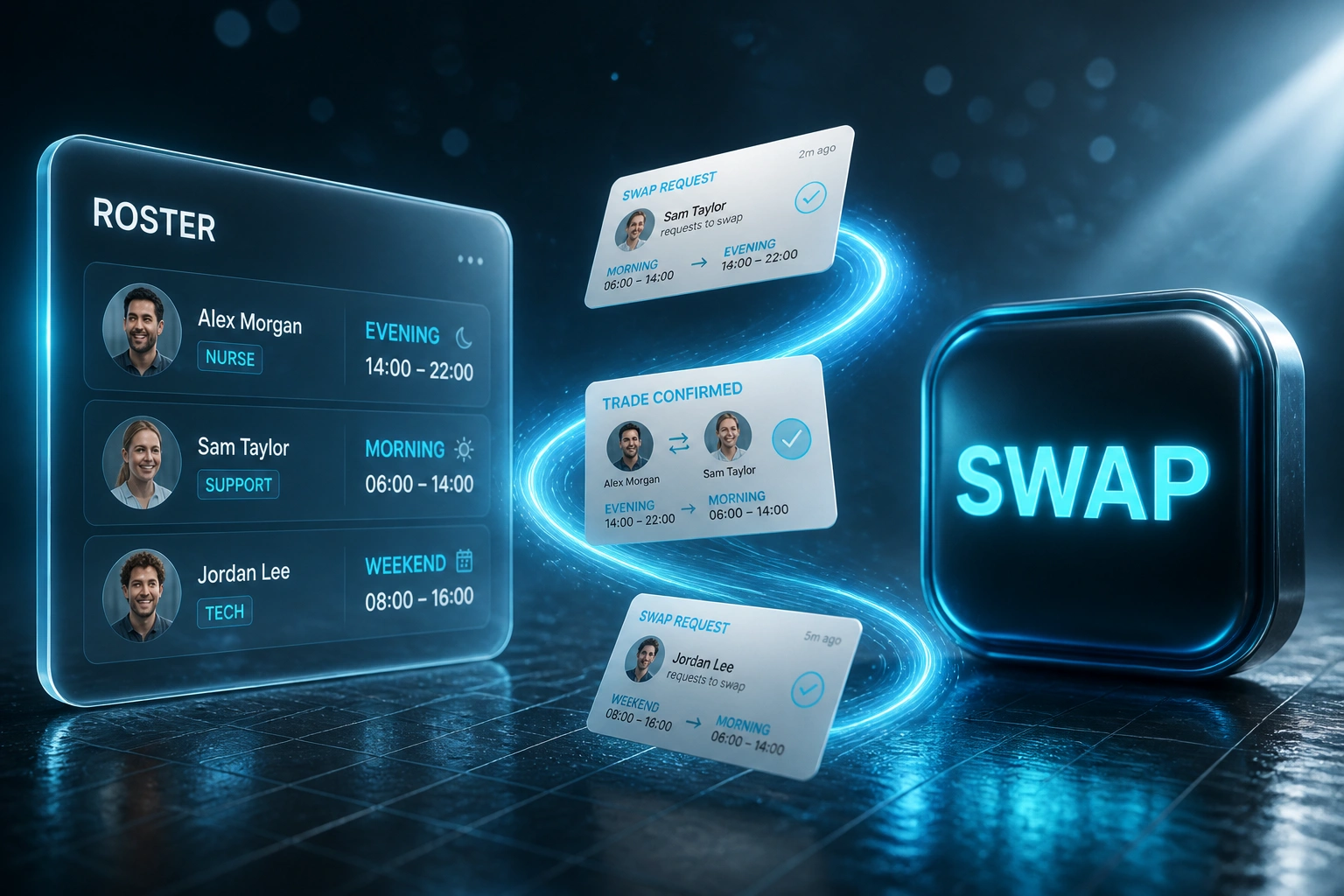
Staff request → rules check → trade confirms → roster updates. Managers only see the exceptions.
Employee Requests a Swap
Staff post a shift they need covered or propose a direct trade from the mobile roster
Rules Match the Candidate
Skills, max hours, overtime caps, and BCEA rest periods filter who can accept
Approve or Auto-Complete
Compliant trades finish peer-to-peer; exceptions queue for a one-tap manager decision
Roster and Team Update
Published schedule rewrites instantly and both parties get notified before the shift starts
Everything You Need for Reliable Schedule Trading
Employee-Initiated Swap Requests
Staff post a shift they need covered or propose a direct trade from their phone. No group chat, no floor walk, no chasing you after hours.
Skills and Role Matching
Only colleagues with the right certifications, keyholder status, or role tags can accept. Unqualified trades never reach approval.
Hours and Rest Guardrails
Max weekly hours, overtime caps, and BCEA daily or weekly rest periods block non-compliant trades before anyone agrees them.
Exception-Only Manager Approvals
Rule-compliant swaps auto-complete or queue with a one-tap confirm. You only intervene when a request breaks a guardrail or policy exception.
Live Roster Rewrite
Approved trades update the published roster instantly and notify both parties plus the site lead, so stale screenshots stop causing no-shows.
Audit Trail for Every Trade
Who requested, who accepted, which rules passed, and who approved is logged for BCEA and internal review, not buried in chat history.
Platforms We've Connected for Shift Swaps
From 3 Hours/Week Mediating Swaps to Under 20 Minutes
How a multi-site retail ops team stopped being the WhatsApp middleman and gave staff real roster flexibility without losing compliance control.
The Manual Process
- Floor managers fielded every shift trade by WhatsApp, often after hours
- Each request took 10–20 minutes: skills check, hours check, then rewrite the spreadsheet
- Swaps agreed in chat sometimes never reached the published roster
- Rest-period breaches only surfaced when payroll queried odd hour patterns
- Staff complained that trading a shift meant waiting on a manager who was busy
The Automated Process
- Employees request and accept trades from the mobile roster
- Skills, weekly hours, and BCEA rest rules block bad matches automatically
- Compliant swaps rewrite the roster and notify both parties in minutes
- Managers only open the exception queue for overrides and keyholder shifts
- Every trade leaves an audit trail for HR and labour queries
Before vs After Shift Swap Automation
How It Works
From first conversation to live shift swap automation in 2–4 weeks.
Tell Us Your Setup
How swaps happen today, which roles need skills checks, and where rest or overtime risk bites hardest.
Free Scoping Call
30-minute call to map request → match → rule check → approve → roster rewrite for your sites.
Build & Test
We encode skills, hours, and rest rules, then run parallel against your WhatsApp or spreadsheet swaps for two weeks.
Go Live & Monitor
Staff trade peer-to-peer inside the guardrails. You review exceptions; monitoring flags failed matches before the shift starts.
Frequently Asked Questions
How long does automated shift swap management take to set up?
A focused swap workflow on top of an existing roster tool typically takes 2–4 weeks from scoping to go-live. If you still live in Excel or WhatsApp, expect 3–5 weeks so we can stand up a publishable roster first, then layer schedule trading on top.
Will managers still approve every shift swap?
Only if you want them to. Most clients auto-approve trades that pass skills, hours, and rest checks, and reserve manager review for exceptions such as overtime overrides, probation staff, or keyholder-only shifts. You stay in control of the policy; you stop mediating every message.
How do you stop unsupervised swaps from breaking BCEA rules?
Every proposed trade is checked against daily rest of at least 12 consecutive hours, weekly rest of at least 36 consecutive hours, and overtime caps of three hours a day or ten hours a week before it can complete. Non-compliant requests are blocked or escalated with a clear reason, and the decision is logged.
Which employee scheduling tools can you connect?
We have wired swap flows into Deputy, When I Work, 7shifts, Homebase, and Humanity, and we can notify teams via WhatsApp or email when a trade lands. If your roster is still a spreadsheet, we migrate the published schedule into a proper tool as part of the build.
Will this disrupt our current roster process?
No. Managers keep publishing the base roster the way they do today. The automation sits on top for employee-initiated trades. We run parallel for at least two roster cycles so failed informal swaps and compliant automated trades can be compared before you switch off WhatsApp mediation.
How much does automated shift swap management cost?
Swap workflows on an existing scheduling stack start from around R20,000. Builds that include skills matrices, BCEA rule packs, WhatsApp notifications, and roster write-back typically range from R30,000 to R55,000. Teams recovering two to three hours of manager time a week usually see ROI within two months.
Stop Being the Middleman for Every Shift Trade
If your ops or HR managers are still approving WhatsApp swaps one message at a time, you are spending money on a problem employee scheduling tools already solve when the rules are encoded properly.
Tell us how many sites you roster, which roles need skills checks, and where rest or overtime risk hurts most. We will show you exactly how peer-to-peer schedule trading would work inside your guardrails.